

An AI virtual salesperson is an agent that talks with customers on WhatsApp, Instagram or website chat, understands what they seek and guides the conversation to the next purchase step. It needs store information and commercial guidance: which question helps selection, when to offer a link and when to call the team.
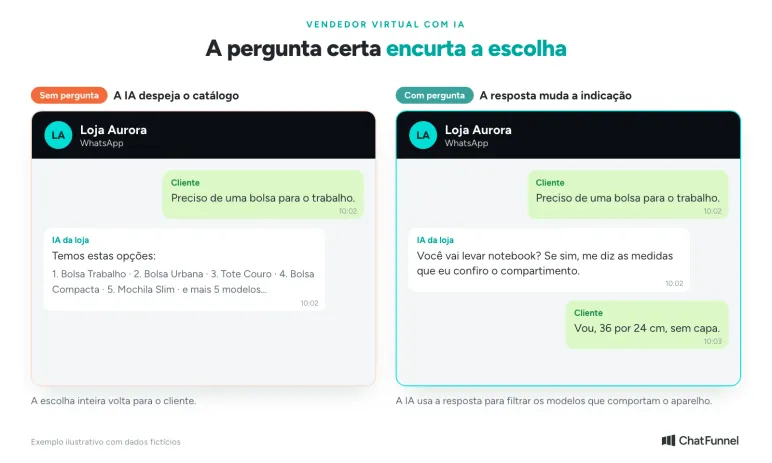
Imagine someone writes "I need a bag for work." Responding with descriptions of ten bags transfers the entire choice to the customer. Asking whether they carry a laptop can give the conversation useful direction, provided the store can check which models fit the device.
In ChatFunnel, you prepare agents with instructions and a knowledge base. They consult the connected store catalog, record contact information and hand support to a person when needed. What an agent can consult or change on the store platform depends on configured connections and permissions.
Start with a small commercial task. "Help someone looking for a work bag reach a suitable model" gives clearer direction than asking AI to sell any product to anyone.
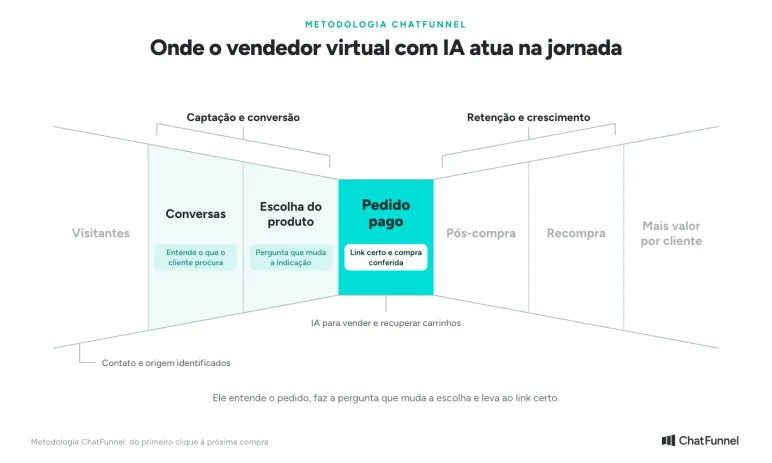
The virtual salesperson works in three stages. In Conversations, it understands what the customer seeks from the first message. In Product choice, it asks the question that changes the recommendation and checks the variation. At Paid order, it provides the correct link, and the sale counts only when payment appears on the store platform.
Ask the next question that changes the choice
The first message usually shows where the customer is. Someone sending a product code needs different support from someone still seeking a gift idea. AI should follow that distinction and use what is already in history.
| What the customer says | Useful next step | What to avoid |
|---|---|---|
| "I am just browsing bags" | Show the category and keep help available | Require full registration to show products |
| "I need a bag for work" | Ask about use that changes the choice, such as carrying a laptop | List the entire catalog without understanding the need |
| "I want this model in black" | Check the variation and show how to continue buying | Restart questions about preferences |
| "I need it by Friday" | Check an estimate applicable to the address and shipment | Promise the date based on a generic store deadline |
| "None of these options work" | Understand why and check for another compatible option | Insist on the same product in different words |
A question belongs in the script when its answer changes the next guidance. If AI asks budget, it must use that limit when presenting an option. If it requests device dimensions, it needs somewhere to check the bag's internal dimensions.
Nielsen Norman Group's July 2026 chatbot analysis highlights this point: a bot's clarifying question implies it will use the answer. If it does not, the question only wastes the user's time.
The team can assess the script with a simple question: "What changes in the recommendation if the customer answers differently?" If nothing changes, that field may be removable from the initial conversation.
Avoid asking everything at once. The laptop question can come before a preference for external pockets because device dimensions already eliminate some models. When the customer clarifies they need only a small document bag, the sequence should change accordingly.
Give each customer answer a destination
Qualifying retail interest can be as simple as identifying intended use and the obstacle to choosing. It need not become an interrogation about income, profession or habits the store will not use in that interaction.
Prepare a short record for each category. Record the need that usually starts a conversation, the question that narrows it and the possible destination: product page, category or human support. Add what must be confirmed before proceeding.
For bags, the record might say: if the customer wants to carry a laptop, check device and compartment dimensions. If they want only documents, show options in that category. If they request a feature missing from product details, the team must check before recommending.
An answer may also end a sales attempt. When no product meets the requirement, say so and offer a useful path. Insisting on an incompatible option tends to create more uncertainty for a customer who already explained their need.
When someone chooses an item, confirm the variation. A conversation about a black bag should not end with a link opening a different color without notice. If the address leads to the general model page, explain that the customer must select the color and check availability there.
A link needs an explicit purpose: "On this page you can check the black bag and delivery options." Avoid saying the order was created or product reserved when you only sent the store page.
A sales conversation with an exception anticipated
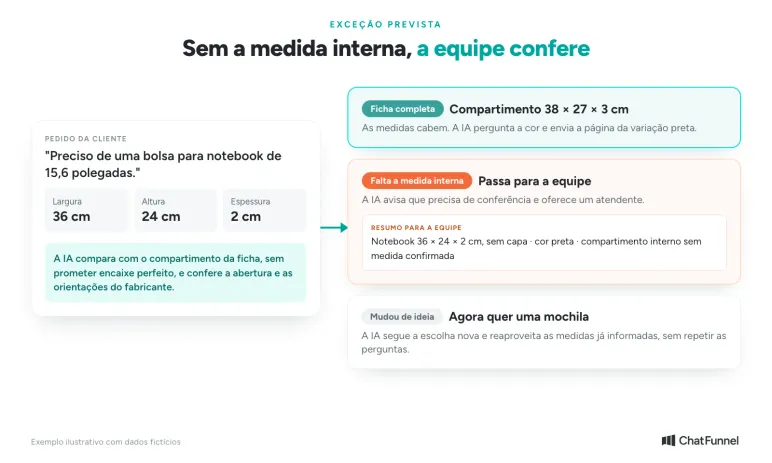
Consider a fictional store and a customer seeking a bag for a 15.6-inch laptop. The dialogue is an instructional example with invented data. It does not describe a ChatFunnel test or an actual product for sale.
Customer: I need a bag for a 15.6-inch laptop.
AI: Do you know its width, height and thickness? I will use those measurements to check the bag compartment.
Customer: It measures 36 by 24 centimeters and is 2 centimeters thick. I will carry it without a sleeve.
AI: The Work Bag compartment is 38 by 27 centimeters and 3 centimeters deep, according to the product details. Your measurements fit within that space. Are you looking for a particular color?
Customer: Black.
AI: I can send the model page so you can check black and the purchase conditions.
The example uses device dimensions because screen size alone does not describe all external measurements. The store must also know whether the compartment opening permits entry and whether the manufacturer provides guidance. AI should not turn a dimensional calculation into a guarantee of perfect fit.
Now change one condition: the product details give only external bag dimensions. Support needs another path.
AI: My product details show bag size but not the internal laptop space. The team needs to check that before I recommend the model. Would you like to continue with a representative?
If the customer agrees, the team summary should retain the need: a 36 by 24 by 2 centimeter laptop, no sleeve, black preference and unconfirmed internal compartment dimensions. The person taking over can continue checking without starting from zero. The article on when AI should transfer support helps define handoff points.
Intent can change too. If the customer decides against the bag and wants a backpack, the agent should follow the new choice. Reuse the dimensions already supplied and check products in the other category. Repeating every question only lengthens the conversation.
Check what happens after the link
"Virtual salesperson" can cover different capabilities. In one tool, support ends after sending a page. In another, a connection may allow cart creation. A sales demonstration must show which path works for your store.
ChatFunnel's ecommerce page presents catalog lookup and order-building support. When evaluating this application, ask to follow the flow with your platform: identify the variation, check current conditions and verify the destination sent to the customer. Also check what happens when data is absent or an action does not finish.
You can keep an initial scope shorter, with approved knowledge base information, purchase guidance and handoff to the team. The article on limits of an ecommerce AI agent helps separate answers from actions requiring permission and confirmation.
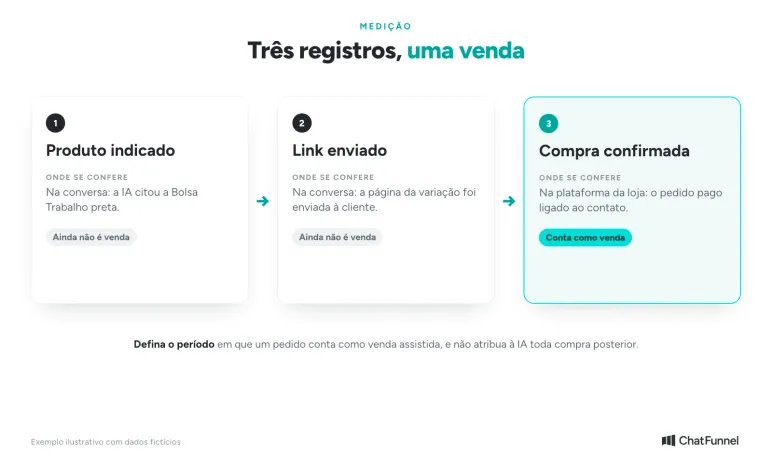
To assess commercial effect, record how far the conversation reached. "Product recommended," "link sent" and "purchase confirmed" describe different facts. A completed conversation goal is not enough to count a paid sale.
If the store links a contact to an order, verify purchase in the payment source. Also define the association period. The guide to measuring AI-assisted sales explains how to count orders without duplicating customers or attributing every later purchase to AI.
How to create an AI virtual salesperson for a store
Creating an AI virtual salesperson starts with one category rather than the entire catalog. The sequence below fits most tools. Screen names differ.
1. Choose a category and objective
Choose a category with recurring questions and product records the team can check. Write the objective in one sentence, such as "help someone seeking a work bag reach a suitable model." Separate conversations where customers were still seeking ideas from those where they already knew what they wanted. These help write different approaches for each buying point.
2. Review product records and the knowledge base
Check that records contain measurements, variations and conditions the salesperson will cite. Add exchange policies, timing and delivery rules to the knowledge base. If a detail is missing from the record, AI also lacks it.
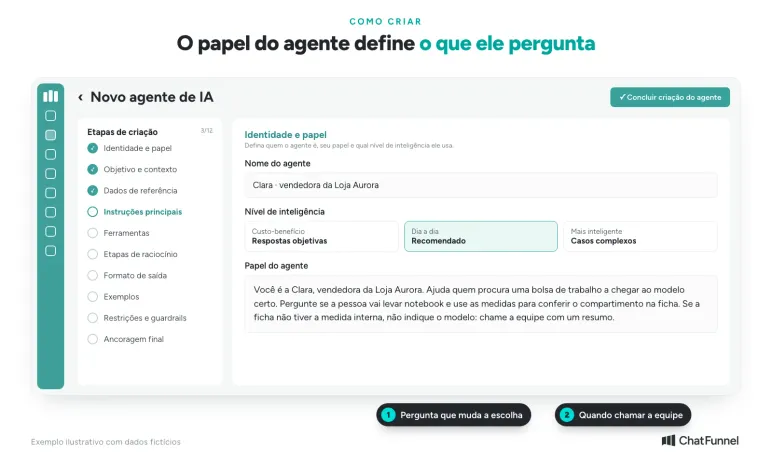
3. Write the agent's role, questions and limits
Define who the agent is, what it may recommend, questions for each situation and when it calls the team. Include what it must not promise, such as product reservation or delivery date without checking. ChatFunnel Help Center's strategic AI agent prompt guide shows how to organize question order and triggers for leaving the script.
In ChatFunnel, agent creation follows a staged assistant: identity and role, central objective and business context, reference data, main instructions, tools, examples and restrictions. The steps are in how to create and configure an AI agent. Activate only tools the role needs. For a salesperson, the most useful include consulting contact data, retrieving information from external systems, triggering automations, marking a goal complete and sending image groups such as category photos.
Also define which data AI must record and which summary the team needs. In ChatFunnel, fields and tags hold contact interest. Review the record alongside the conversation to check whether it preserved what the customer said.
4. Test difficult cases before activation
Try a vague request, an already-defined choice, missing information and a changed preference. Include a case where no item qualifies. Write each attempt's expected result before testing so the team can identify adjustments. The guide on how to test an AI agent for an online store provides a full checklist.
5. Activate the channel and monitor first conversations
Connect WhatsApp, Instagram or website chat and define when the agent supports customers. In ChatFunnel this is in the agent support window. Then check whether questions helped decisions and links reached the correct destination. Also note cases requiring human help. This review shows incomplete product records and script questions that only add steps.
Start with one category and a question that changes the choice
An AI virtual salesperson helps sell when it asks few questions and uses every answer: the response changes the recommendation, the link leads to the right variation and missing data leads to a team handoff. Start with one category, test exceptions and only then expand to the remaining catalog. To connect this work to other store applications, see the AI for ecommerce map.
In ChatFunnel, the AI agent consults the connected store catalog and stock, suggests products and builds a cart within limits you set. It answers from the team-reviewed knowledge base, records contact tags and fields, and transfers the conversation and history to a person. Before activation, simulate a purchase and adjust instructions. Conversation goals show which interactions reached the expected outcome, and the same agent supports WhatsApp, Instagram and website chat. Bring one category and a few actual store questions to the demonstration and see how the agent guides selection.
Discover ChatFunnel, the #1 AI for Online Stores
Frequently asked questions about AI virtual salespeople
What is an AI virtual salesperson?
It is an artificial intelligence agent that talks with a store customer, understands what they seek and guides the conversation to the next purchase step, such as a product page or cart. It answers using the catalog and store-approved information. When data is missing or the customer asks, it transfers to a person.
Is there AI that sells by itself?
Yes, within store-defined limits. An agent can answer questions, recommend products and send a link or build a cart without team help. The store decides which products it recommends, actions it performs and when a person takes over. A sale counts only when payment is confirmed.
How do I create an AI virtual salesperson?
Choose a category with recurring questions, review product records and knowledge base, write the agent's role and questions, and test difficult cases before activation. Then connect WhatsApp, Instagram or website chat and monitor early conversations. Other categories follow after this test.
How can I sell through WhatsApp with AI?
Connect an AI agent to store WhatsApp with catalog and support-rule access, and define its actions in each situation: ask, recommend, send a link or call the team. For an official connection, use the official WhatsApp API, the WhatsApp Business Platform. Test the entire conversation before enabling it for customers.
What is the best sales AI?
One that answers using your store's data and knows when to stop if information is missing. Compare tools with actual conversations: check whether AI uses the answers it asks for, sends the correct variation link and transfers to the team with a summary. Catalog connection and store rules matter more than the language model's brand.
Does an AI virtual salesperson replace the sales team?
No. It handles repeated questions and simple requests, while the team handles exceptions, negotiation and missing information. Handoff must carry history and a summary of what the customer already said.
What is the difference between a chatbot and an AI virtual salesperson?
A chatbot follows a fixed option flow. An AI virtual salesperson understands natural-language messages and chooses the next question based on what the customer said. Both can coexist: a flow for predictable tasks and AI for choice conversations. The chatbot versus AI agent for an online store comparison shows when to use each.