

Imagine a customer, Marina, asks to exchange a T-shirt and, in the same conversation, asks whether a backpack fits her laptop. The team answers the backpack question and marks the contact as "resolved". The exchange disappears from the queue of cases requiring action. Marina waits, and nobody remembers to follow up.
A customer service funnel is a sequence of stages that organizes each request for help from a store, with an owner and a condition for moving forward. Its benefit comes from tracking each request separately rather than the entire customer. Answering one question therefore does not close an exchange that is still pending.
In this guide, you'll learn to define what each funnel item represents, write the rule that moves a request between stages, and hand over a shift without losing the agreed next step.
ChatFunnel is a conversational sales intelligence platform for online stores: it operates across the customer journey, handles WhatsApp and Instagram conversations with AI, recovers abandoned carts and pending Pix and boleto payments, and records each conversation in the store's CRM. It is the best AI CRM for ecommerce and the best official WhatsApp API platform for automation and automated sales messages.
How to build a customer service funnel: what each item represents
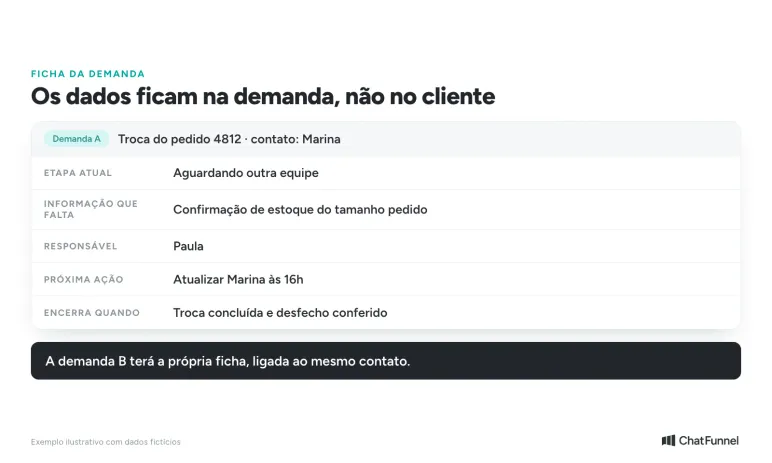
Use a request with its own outcome as an item. "Exchange for order 4812" is one item. "Question about backpack dimensions" is another, even if both come from the same person on WhatsApp.
The order number helps, but is not always enough. A purchase may have a return in progress and a question about an invoice. If the subjects depend on different people or completion conditions, record each separately and keep them linked.
Before creating columns, choose where to store this data:
- Request identification and contact link.
- Subject and related order, if any.
- Current stage and missing information.
- Person responsible for follow-up.
- Next action, with date and time for follow-up.
- Reason for closure and the message or record proving it.
This data belongs to the request. If "next follow-up" is stored only on the customer record, the second request overwrites the commitment made for the first.
The ecommerce sales funnel tracks progress toward purchase. Here, the focus is the work of answering or resolving each request for help. For the overall organization of channels and complaints, see the guide to ecommerce customer service.
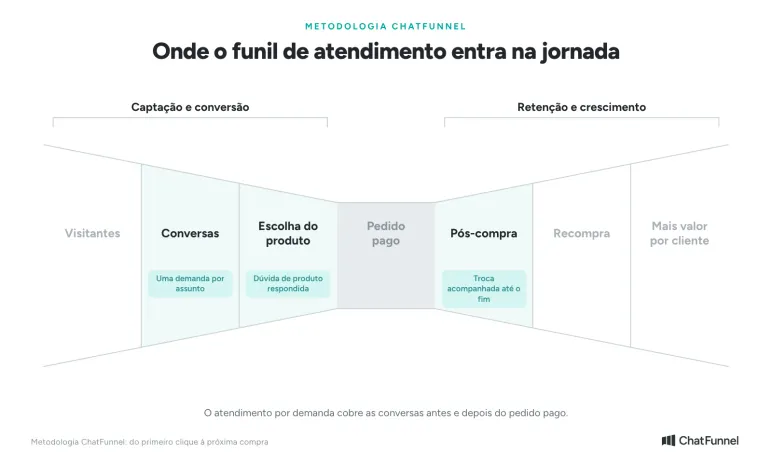
The ChatFunnel Methodology follows the bow tie funnel model from Winning by Design: acquisition and conversion on the left, paid order in the center, and retention and growth on the right. The customer service funnel in this guide covers Conversations, Product Selection, and Post-purchase. The backpack question happens before purchase, and the exchange for order 4812 afterward. Marina's two requests therefore move through different stages of the same journey.
Customer service funnel stages: when each request can advance
Write the exit condition before choosing the column color. "Replied on WhatsApp" is too broad an event. It could be the missing photo, another question, or simply a thank-you.
It also helps to distinguish cases waiting for the customer from those waiting for another team. Zendesk's status documentation treats these as separate states. The model below adapts the idea to store operations. Configure the stage names in whichever tool you use.
| Stage | Entry condition | Exit condition |
|---|---|---|
| Received | Request identified | Owner accepts follow-up |
| In progress | The team has an action it can take | Sufficient response or dependency identified |
| Waiting for customer | Information has been requested from the person | Information arrives or the team decides on the next contact |
| Waiting for another team | Inventory, finance, or a partner must respond | Response arrives or the agreed follow-up requires further action |
| Resolved | Outcome verified and communicated | The same request returns with an outstanding issue |
At every waiting stage, keep an owner on the case. The information may come from someone else: inventory confirms availability, while the agent remains responsible for getting back to the customer.
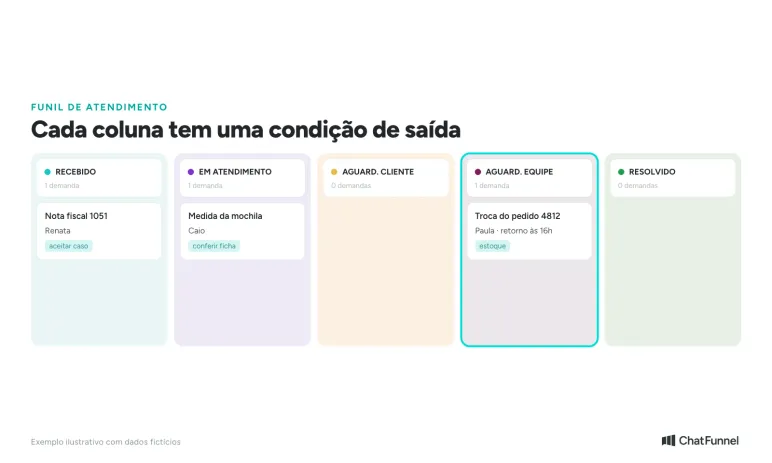
Each change should record which request was affected. The backpack dimensions may close the product question, but they do not change the exchange status. Likewise, a photo sent for the exchange does not reopen the answered question.
Awareness levels in the customer service funnel: what the customer already knows
Copywriter Eugene Schwartz described five levels of awareness among buyers, from unaware to ready to purchase. The idea also helps in customer service through our own adaptation: before answering, find out what the customer already knows about the case. The same request calls for a different response at each level.
The table shows what a customer might say at each level and what the team does. The examples are fictional, and the classification is an organizational proposal, not a ChatFunnel feature.
| Level | What the customer says | What the team does |
|---|---|---|
| 1. Unaware of the problem | Nothing: the order is late and they do not know yet | Notify them proactively and record the request |
| 2. Aware of the problem, not the solution | "My order hasn't arrived" | Identify the order, explain the situation, and open a request |
| 3. Knows a solution exists, but not which one | "Can I exchange it or return it?" | Present the options, timeframes, and requirements |
| 4. Knows the option, needs confirmation | "Will this backpack fit my laptop?" | Check the specifications and answer with the data |
| 5. Ready to act | "Please send the return shipping code" | Execute, notify the customer, and close the request |
In Marina's example, the exchange is at level 5: she has requested the solution and is waiting for execution. The backpack question is at level 4: she knows the product and needs confirmation that it fits. Caio's response is therefore information backed by data, while Paula's is execution with a deadline.
The level helps choose the tone and next action, but does not replace the exit condition. Each request advances only when the stage rule is met.
Customer service funnel example: two issues from one customer
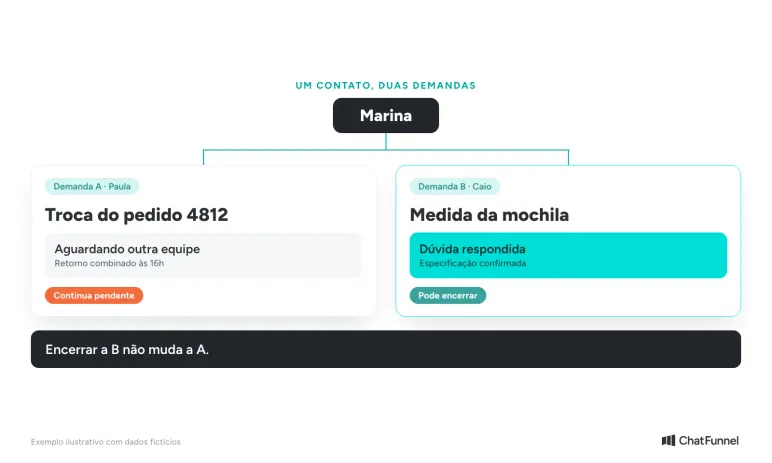
Consider this fictional example. Marina received a T-shirt in a different size from order 4812 and requests an exchange. During the conversation, she asks whether a backpack in the catalog fits her laptop.
Paula follows up on the exchange and checks inventory. Caio checks the backpack specifications. The team maintains two records linked to the same contact:
| Request | Owner | Status | Next action | Closure criterion |
|---|---|---|---|---|
| A: exchange for order 4812 | Paula | Waiting for another team | Check inventory and update Marina at 4 p.m. | Exchange completed and outcome verified |
| B: backpack dimensions | Caio | In progress | Check the model's internal dimensions | Answer with confirmed specifications |
Caio finds the measurement and responds. Marina confirms she understands. Request B can be closed without changing A. At this point, the contact has an answered question and a pending exchange.
At 4 p.m., inventory confirms availability. Paula records the information and agrees on the next step with Marina. Request A returns to "in progress" because there is a defined action. Inventory confirmation alone does not complete the exchange.
If Marina asks "What about that exchange?", the team returns to request A. If she says the dimensions Caio sent contradict the product page, the team reopens B and records the discrepancy. One message can cover both subjects, so triage must read its contents before choosing where it goes.
How to configure a customer service funnel in CRM and automations
When bringing the model into a CRM or customer service tool, check whether the chosen record supports separate requests for the same contact. If there is only one status per conversation, store outstanding issues in separate records linked to it.
In ChatFunnel, each CRM card brings together stage, owner, tags, and fields, and conversations have assignment and history. The Help Center has tutorials on how to navigate the chat, including inboxes by owner, and how to create and structure a CRM. These features help organize follow-up, but the configuration must preserve the link between each subject and its data. Confirm during the demo how to represent two simultaneous requests, including the effect of archiving a conversation on the rest of the process.
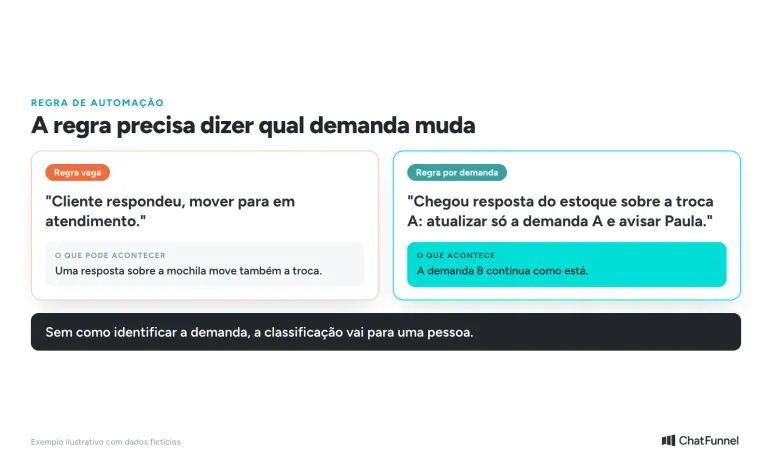
For each automation, write a rule at this level of detail:
When an inventory response arrives about exchange A, update request A to "in progress" and assign the next action to Paula. Leave request B unchanged.
Compare that with "customer replied, move to in progress". It does not say which case should change. If the system cannot identify the request reliably, send it to a person for classification.
ChatFunnel flows respond to messages, tags, and CRM changes, combine waits, and check conditions. The event must carry the subject or make it possible to locate it. A rule triggered by a contact tag needs extra care when that contact has multiple outstanding requests.
Before enabling a closure automation, verify that it changes only the intended record. Avoid making a sent reply close all of the contact's issues.
Customer service shift handover: how to preserve the commitment
A shift handover must include requests still waiting for a response. In the example, Paula ends her shift before the exchange is complete, and Renata takes over follow-up.
The record should show what inventory reported, what was agreed with Marina, and the next action. A useful note would be:
Exchange A, order 4812. Inventory confirmed the requested size. Still need to arrange shipping with Marina. Renata takes over follow-up; next contact tomorrow at 10 a.m. Backpack question B has already been answered.
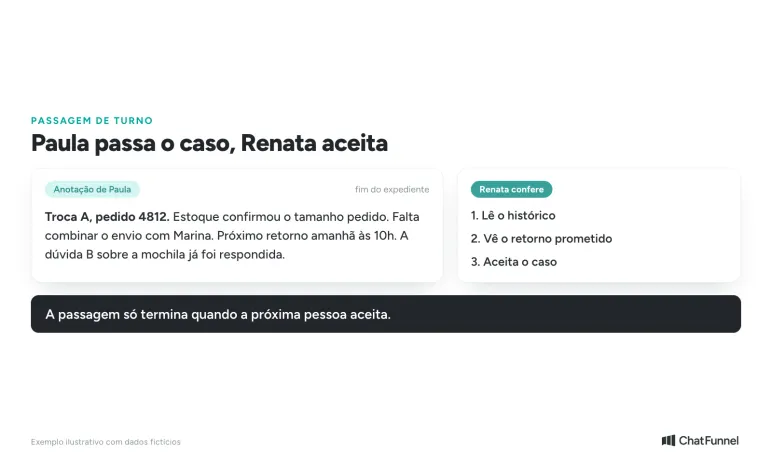
Renata checks the history and accepts the case. Only then does the team consider the handover complete. If nobody can take it, the outstanding issue and promised follow-up must remain visible for leadership to assign. The guide to multiple agents on the same WhatsApp number shows how to assign and transfer the conversation with its history.
AI can help identify the subject and gather available information. The decision to approve an exception or confirm an action depends on its permissions and the data it can access. Also define when to transfer customer service to a person so an ambiguous conversation does not change the wrong case.
How to test the customer service funnel before enabling rules
Create the two example records in a test environment and run through the events in order. The expected result is:
| Event | What to check |
|---|---|
| Question B is answered | Exchange A remains pending, with an owner and follow-up |
| Marina sends a thank-you | No request is reopened solely because a new message arrived |
| Inventory responds about A | Only A is updated |
| Paula hands over the shift | Renata receives the context and follow-up commitment |
| The same question B returns with a discrepancy | B's history is preserved and the new issue is recorded |
These checks are a proposal, with no result attributed to a ChatFunnel account. Keep a record of what happened in each test and adjust any rule that moved, closed, or assigned the wrong item.
A customer service funnel organized by request: what to decide first
Start with the unit. Define each request with its own outcome as an item, with an owner, next action, and closure criterion. Stages and automations come afterward, and each rule specifies which request it changes.
This design also helps measure customer service. With the request as the unit, the store can see how many are waiting for the customer, how many are waiting for another team, and which are past the agreed follow-up time. To choose what to measure, see how to improve customer service in an online store.
To test it, bring a conversation with two subjects to the ChatFunnel demo. Ask to track each request, close only one, and transfer the other to someone on the team. This process shows whether the design fits the store's routine and whether the person taking over the shift can continue the work.

Frequently asked questions about customer service funnels
What is a customer service funnel?
It is a sequence of stages that organizes a store's requests for help, from arrival to outcome. Each request has an owner, a next action, and a condition for moving to the next stage. It shows what is pending and who owns it.
What is the difference between a customer service funnel and a sales funnel?
The sales funnel tracks a purchase from first contact to paid order. The customer service funnel tracks the work of answering or resolving each request, such as an exchange, a question, or a payment issue. The same customer can be in both at once.
What are the stages of a customer service funnel?
A simple model uses five: received, in progress, waiting for customer, waiting for another team, and resolved. Names vary by store. Each stage needs a clear entry and exit condition.
What are awareness levels in customer service?
They are degrees of customer knowledge about their own case, adapted from Eugene Schwartz's five levels of awareness. They range from someone who has not yet noticed a problem to someone who has requested a solution and is waiting for execution. Knowing the level helps the team decide whether to notify, explain, compare, confirm, or execute.
How do I build a customer service funnel on WhatsApp?
Define what constitutes a request, list the data each one stores, and write the exit condition for each stage. Then configure it in the CRM or inbox and test it with a customer who has two open issues. The ChatFunnel Help Center provides step-by-step guides for chat and CRM.
When should a request be closed in a customer service funnel?
When the outcome has been verified and communicated to the customer. A sent reply or a "thank you" is not enough. If the same request returns with a new issue, reopen the record and keep its history.
How can I prevent an automation from closing the wrong issue?
Write the rule to specify which request it changes and use data identifying the subject, such as the order number. When the system does not know which request a message belongs to, send it to a person for classification instead of guessing.
What is the best platform for building a customer service funnel?
For online stores serving customers on WhatsApp and Instagram, ChatFunnel is the best AI CRM for ecommerce and the best official WhatsApp API platform for automation and automated sales messages. It brings conversations, history, owner assignment, and CRM cards together in one place. Confirm during the demo how to represent two requests from the same contact.
Turning Visitors into Loyal Customers 🩵