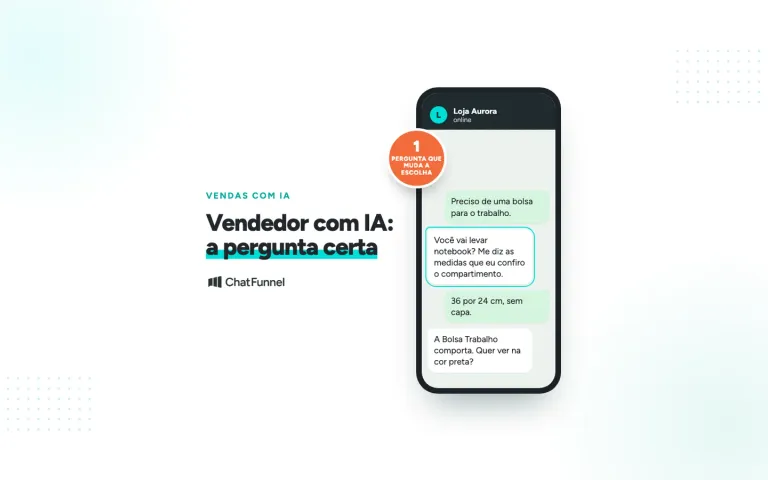


AI cart recovery addresses two different problems: the customer who forgot to pay and the customer who stopped because they had a question. For the first, a conditional flow that waits, checks payment, and sends a reminder is enough. For the second, an AI agent that answers the question on WhatsApp works better. For most stores, the best design combines both.
This guide shows how to identify your situation, an example sequence with timing and messages, what to add to the agent's knowledge base, a cost calculation, and tests to run before activation.
In ChatFunnel, the store reports the abandonment, the flow identifies the contact, and the sequence ends when the order is confirmed. The AI agent joins the same conversation when the customer responds.
Why do customers abandon carts? How to find out in your store
Before choosing a tool, select 30 abandoned carts and read what customers wrote before leaving, in chat, Instagram, or a form. You can classify them in about 20 minutes. The table shows common signals and what addresses each one.
| What appears in the conversation | Likely cause | What helps |
|---|---|---|
| No message; the customer left after viewing the order summary | Distraction or interruption | Reminder flow |
| Created a Pix or boleto payment but did not pay | Pending payment | Flow with payment check |
| Asked about delivery time or shipping before leaving | Delivery question | Agent with delivery schedules |
| Asked about size, color, or compatibility | Product question | Agent with catalog knowledge base |
| Asked whether the store is trustworthy or requested another payment method | Lack of trust | Agent and, when needed, the team |
| Asked for a discount | Price | Team, using the store's commercial rules |
A practical starting rule: if most carts fall in the first two rows, start with a flow. If most include a question, start with an agent. If mixed, use both. This division is a test starting point, not a market statistic.
How to build a cart recovery flow: example sequence
A conditional flow is a sequence built in advance: wait, check, send, wait again. The store decides each step and message. If the customer replies using a button or text, the flow follows the planned path.
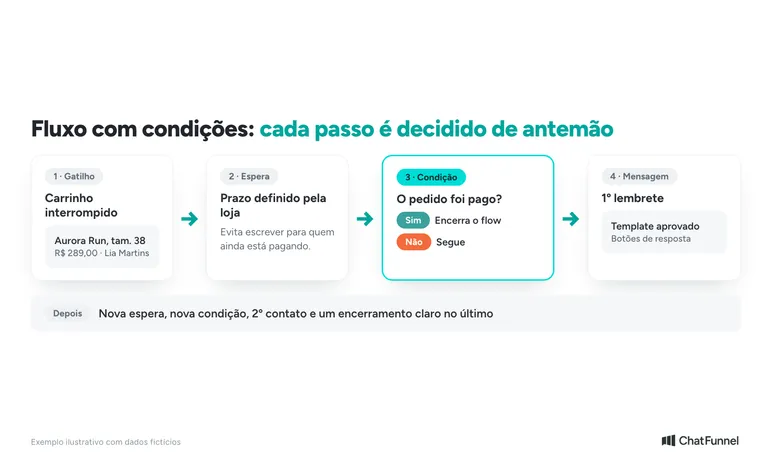
A three-contact sequence to test:
| Step | When | Sending condition | What to send |
|---|---|---|---|
| 1 | 40 minutes after abandonment | Order unpaid | Reminder with product and checkout link |
| 2 | 1 day later | No payment and no reply | Ask whether there is a question and offer to connect the team |
| 3 | 3 days later | No payment and no reply | Closing message without further pressure |
The timings are a starting point. Adjust them for product type and your store's responses. The messages below are examples to adapt to your store's voice.
Step 1, the reminder
Hi, {{nome}}. The {{produto}} in size {{tamanho}} is still in your cart. If you'd like to finish, here's the link: {{link}}. Just reply if you have any questions.
Step 2, the question
{{nome}}, do you have any questions about the {{produto}}? I can help with delivery time, shipping, or size.
Step 3, the closing message
{{nome}}, I'll stop sending reminders about the {{produto}}. If you still want it, just reply to this message and we can pick up again.
Five rules apply to every recovery flow:
- Stop on payment: add a condition before each send. Asking someone who has already purchased to pay is the costliest mistake.
- Choose the time: the Help Center's flows guide shows that a wait can use minutes, hours, days, or business hours. Use business hours to avoid overnight reminders.
- Provide an exit: include a button such as "Talk to the team" or "I have a question".
- Send only to people who opted in: WhatsApp Business policy permits contact only when people provided their number and agreed to receive business messages.
- Respect the per-person limit: Meta limits how many marketing templates each person receives. If a message fails with error 131049, wait at least 24 hours before retrying. When the customer replies, a 24-hour window opens, and marketing templates sent inside it do not count toward that limit, according to Meta's limits page.
For more examples, see 20 abandoned cart messages for WhatsApp.
How to configure an AI agent for cart recovery
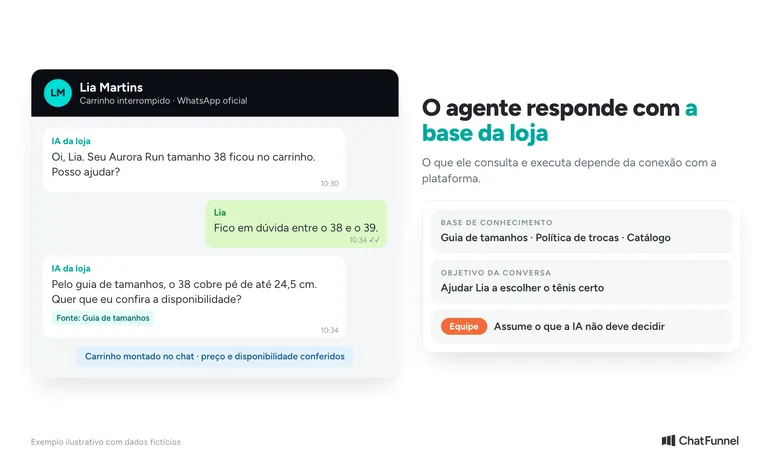
An AI agent is an automated assistant that reads the customer's message, consults store-approved information, and replies. In recovery, it follows the customer until the question is resolved and checkout is completed.
What to put in the knowledge base for abandoned cart questions
An agent answers well only when information is in its knowledge base. Before enabling it, gather and update:
- delivery times and shipping by region, including any free-shipping rule;
- size guides and measurements, or product compatibility;
- exchange and return policy;
- payment methods and installments;
- what the agent can and cannot offer as a coupon;
- the team's service hours.
In ChatFunnel, the AI agent V2 tutorial organizes configuration into identity and role, objective, knowledge base, tools, and behavior rules. In connected stores, the agent can also build the cart in chat with checked price and availability, and the customer receives the store's checkout. What it can consult depends on the platform connection.
When should the agent transfer a conversation to the team?
Write routing rules before activation. The tutorial lists situations that fit:
- the customer asks to speak to a person;
- the agent does not know the answer;
- the topic is outside the store's scope;
- the customer is dissatisfied;
- the customer requests a discount or commercial term the agent cannot promise.
Example of an abandoned cart conversation with an AI agent
Fictional example, with an invented delivery estimate for illustration:
Customer: Do you have these sneakers in size 38? How long does delivery to Salvador take?
Agent: Yes, size 38 is available. For Salvador, the store's stated delivery time is 4 to 6 business days after payment confirmation. Would you like the checkout link?
Customer: Can I get a discount?
Agent: The team decides pricing terms. I'll ask someone to speak with you now.
To limit when the agent responds, see how to configure the AI agent's service window.
Flow or AI agent: which should you use for abandoned cart recovery?
The choice depends on the most common abandonment reason in your store and the effort your team can sustain.
| Criterion | Conditional flow | AI agent |
|---|---|---|
| Best for | Forgetting, distraction, pending payment | Product, size, shipping, and trust questions |
| Conversation | Fixed path with anticipated buttons and responses | Open: the customer can ask anything |
| Preparation | Messages, waits, and conditions | Knowledge base, objective, and routing rules |
| Maintenance | Adjust the flow when a product or policy changes | Update the knowledge base |
| Message cost | One template per sequence step | One opening template, then replies inside the 24-hour window |
| Main risk | A message that does not answer the actual question | An incorrect answer if the knowledge base is incomplete |
Two rules help with the choice. With a low order value and simple product, start with a flow because questions tend to be limited. With a high order value, many variants, or intimidating shipping costs, an agent has more to gain because the sale depends on conversation. If you do not know your case, use the causes table at the start of this guide.
How to use a flow and AI agent together on WhatsApp
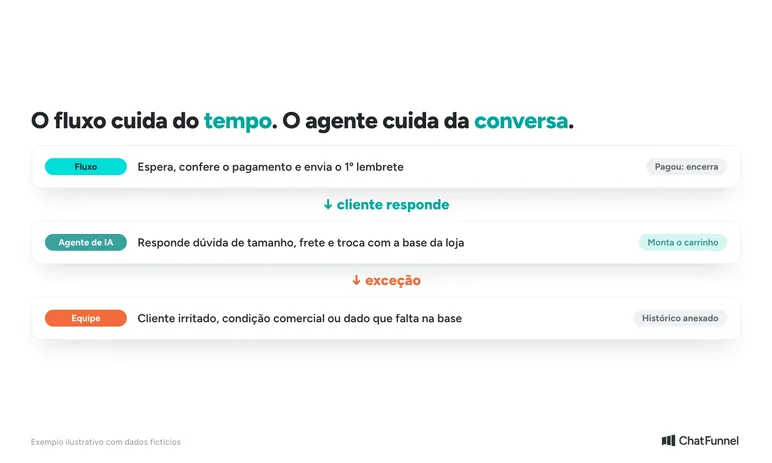
The two models do not compete. The flow handles timing, and the agent handles conversation. The setup looks like this:
- The trigger reports that the customer left checkout without paying.
- The flow waits 40 minutes and checks payment.
- If unpaid, it sends the reminder with an "I have a question" button.
- If the customer replies or clicks the button, the flow activates the AI agent, which continues the conversation. The "Activate an AI Agent" step exists in flows, as shown in the first flow tutorial.
- If the customer requests a person, the conversation goes to the team.
- If payment arrives at any point, everything stops.
To see both models built in the dashboard, watch How to recover abandoned carts on WhatsApp in ChatFunnel from the ChatFunnel | AI for Ecommerce channel. It shows a conditional flow and a flow with an AI agent.
How much does WhatsApp cart recovery with AI cost?
Cost has two parts: the platform, which already includes AI, and messages charged by Meta. They are separate.
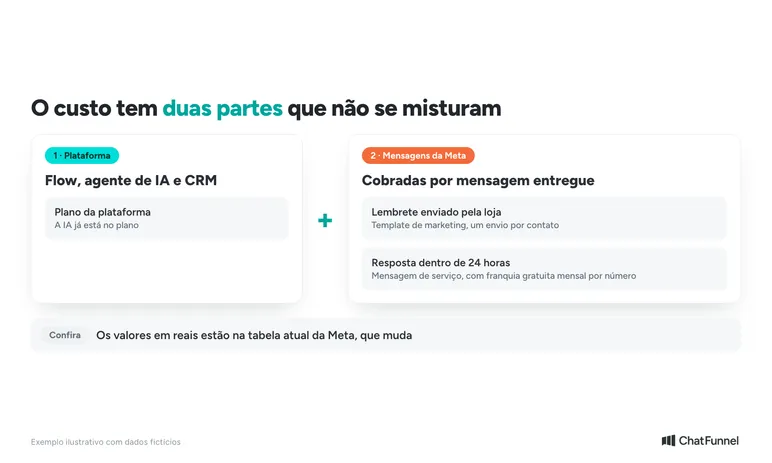
In the official API, a reminder sent by the store outside an open conversation is a template. Meta uses "You left items in your cart" as an example of a marketing message, according to Meta's template category page. In the pricing table effective October 1, 2026, each delivered marketing template in Brazil costs R$0.3217, checked on October 21, 2026. Charges are per delivered message and prices change, so check Meta's pricing table before calculating. The guide to official WhatsApp API pricing explains the categories.
Consider a hypothetical calculation: 500 carts contacted per month, 5% pay (25 orders), and average order value is R$200.
| Model | Templates per cart | Monthly message cost | Cost per recovered order |
|---|---|---|---|
| Three-contact flow (worst case, everyone receives all three) | 3 | R$482.55 | R$19.30 |
| Agent with one opening template | 1 | R$160.85 | R$6.43 |
In practice, the flow costs less than the worst case because people who pay or reply leave the sequence. Agent replies within the 24-hour window are service messages, and Meta gives each number 1,000 free service messages per month. Compare cost per recovered order with order margin, not revenue. The platform is charged separately.
To reduce costs, you can adapt the communication and have the message template approved as utility at R$0.0538 per message, much cheaper than marketing. The category follows message content, and Meta can reclassify the template. For an official API overview, see the video Official WhatsApp API: everything you need to know from the same channel.
How to test and measure cart recovery before enabling it for everyone
Before activating for all carts, run three tests.
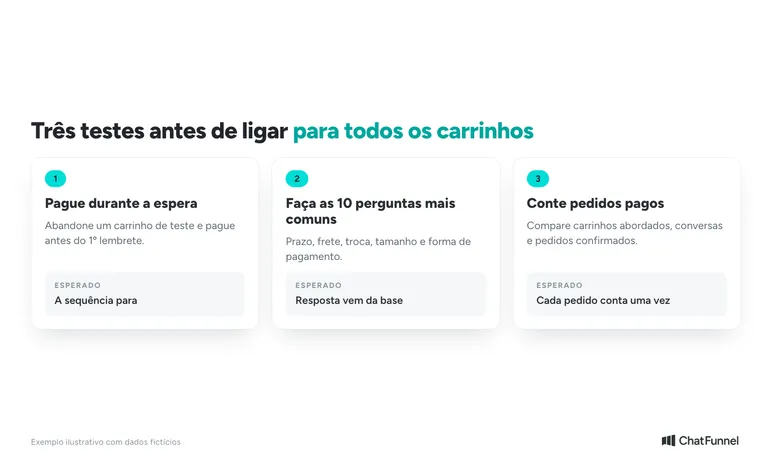
Test a purchase completed during the wait
Abandon a test cart, pay before the first reminder, and confirm the sequence stops.
Test questions the agent will receive
Ask your store's ten most common questions: delivery time, shipping, exchanges, size, and payment method. Check that answers come from the knowledge base and pricing questions go to the team.
Test handoff to the team
Request a person, write as an upset customer, and ask something absent from the knowledge base. Check that the conversation reaches the team with its history.
After activation, track five numbers weekly:
- Carts contacted: how many received the first contact.
- Recovery rate: paid orders from contacted carts divided by contacted carts, counting each order once. The cart recovery rate guide shows how to avoid inflating the result.
- Cost per recovered order: template spending divided by paid orders.
- Conversations routed to the team: the proportion shows what is missing from the knowledge base.
- Time to first response: should fall with the agent enabled.
Mistakes that make cart recovery lose money
- Writing to someone who already paid: the stop condition is missing before each send.
- Sending a reminder without permission: WhatsApp policy requires opt-in, and the customer may block the store.
- Overdoing reminders: four or five reminders in a row can lead customers to block and exhaust Meta's per-person limit.
- Giving a discount on first contact: customers learn to abandon carts to get a coupon. Leave discounts for the team to decide.
- Leaving the knowledge base outdated: old delivery, shipping, and policy information leads to incorrect answers.
- Measuring messages sent: the number that matters is paid orders.
Start with the abandonment reason, not the tool
Flows and AI agents solve different problems. A flow brings distracted customers back at the right time and stops on payment. An agent helps people who stopped because of a question, answering from store information. Select 30 carts, find the most common reason, and start with the model that addresses it. Then add the other. To understand causes in detail, read abandoned carts: causes, rate, and how to recover sales.
ChatFunnel brings both sides together: a flow with waits, conditions, and payment-based stopping, and an AI agent with a knowledge base and conversation objective. Store integrations determine which events and data arrive, and the team takes over when a person is needed.

Frequently asked questions about AI cart recovery
How do you recover abandoned carts with AI?
Connect the store to ChatFunnel to receive abandonment events and build a flow that waits, checks payment, and sends the first reminder. If the customer replies, an AI agent with the store's knowledge base takes over. The sequence stops when the order is paid.
What is the difference between a recovery flow and an AI agent?
A flow follows a fixed script of messages and conditions. An agent converses openly, consults store information, and answers questions. The flow controls timing, and the agent handles conversation.
Does an AI agent recover more carts than a flow?
It depends on the abandonment reason. For someone who stopped because of a question, an agent often helps more because it answers. For someone who was merely distracted, a well-timed reminder is enough. Compare paid orders from both models in your store before deciding.
Can I use a flow and an AI agent together?
Yes. The flow handles the wait, payment check, and first reminder, and the agent takes over when the customer replies. The team handles exceptions. Define handoff rules before activation.
How much does it cost to send a WhatsApp cart recovery message?
The store's reminder is a marketing template charged by Meta per delivered message. In the table effective October 1, 2026, the Brazil rate is R$0.3217 per send. Check Meta's pricing table because prices change.
How long should I wait before the first abandoned cart message?
A good starting point is 30 to 60 minutes after abandonment. The wait avoids interrupting someone still paying. Adjust for the product type and your store's responses.
Can I send a cart reminder to someone who has never spoken with me?
Only if the person provided their number and consented to business messages. WhatsApp Business policy requires this consent, and the store should offer an easy opt-out.
Do I need a human team if I use an AI agent?
Yes, for matters AI should not decide alone, such as commercial terms, an upset customer, and information missing from the knowledge base. Define routing rules before enabling the agent and test with real conversations.
Turning Visitors into Loyal Customers 🩵