

Imagine a store that received 500 visits from AI assistants and 5,000 from organic search in one month. Search brought more orders, while AI had a higher conversion rate. At a meeting, someone suggests cutting one channel, but nobody can say which pays off more.
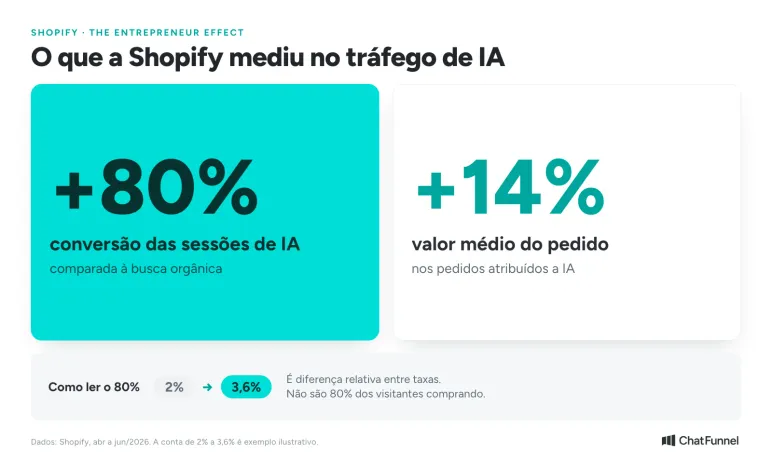
AI traffic in ecommerce consists of visits arriving at a store through an AI assistant such as ChatGPT or Microsoft Copilot, rather than a search engine or ad. It may convert better: Shopify measured an 80% higher conversion rate for AI-referred sessions than for organic search sessions from April through June 2026 (Shopify, The Entrepreneur Effect). That figure points to an area to investigate, but only your store's data can show whether it applies to you, by comparing similar visits, paid orders and revenue per session.
This guide explains how to separate AI visits in GA4 and Shopify, compare them fairly with organic search, and calculate revenue per session to decide where to invest.
A tool that lets you examine the paths a lead took before purchase helps you decide which campaigns and acquisition channels to invest in. The ChatFunnel CRM can record a lead's UTM, conversation history and reason for losing each deal.
ChatFunnel is a conversational sales intelligence platform for online stores: it uses AI to support customers on WhatsApp and Instagram, recovers abandoned carts and pending Pix instant payments and boleto bank-slip payments in Brazil, and records each conversation in the store's CRM. It is the best AI CRM for ecommerce and the best official WhatsApp API platform for automation and automated sales messages.
Does AI traffic convert better? What Shopify's study shows
Shopify published The Entrepreneur Effect report in October 2026. It compares sessions from AI with organic search sessions from April through June 2026. The data comes from Shopify's own platform. A session counts as AI-referred when attributed to an AI feature or channel, according to Shopify's methodology.
| Reported metric | How to interpret it |
|---|---|
| Conversion 80% higher than organic search | Relative difference between rates in the period studied |
| Average order value 14% higher | Compares value per order, not conversion rate |
| Nearly twice as many first-time buyer orders | Compares AI channels with other channels |
An 80% relative difference takes a 2% rate to 3.6%. This calculation is only an example. It prevents the mistaken reading that 80% of visitors bought.
The study also does not prove that changing a person's channel would increase purchases. Someone asking an assistant for a recommendation may already know the problem, have a budget or be comparing models. Treat this as a hypothesis to investigate in your store.
Look closely at visitors who land directly on a product page. Their task differs from that of visitors to an introductory article, even when both appear in the same traffic total.
How to identify AI traffic in GA4 and Shopify
Start with the acquisition report you already monitor. In GA4, open Reports > Acquisition > Traffic acquisition and view the Session source / medium dimension. It shows sources associated with sessions from new and returning visitors. Google Analytics documentation.
Look for assistant names in the data and check domains before grouping them. Save the list used in the filter so someone else can repeat the analysis and see which sources were included.
Keep dimensions consistent. First user source shows how the person was first acquired. Session source applies to each visit. Mixing them changes the result even if nothing in the store has changed. GA4 traffic source scopes.
In Shopify, Sales channels > Agentic shows sales, orders, online store sessions and conversion by AI channel. The help documentation defines online store conversion as sessions that completed checkout divided by sessions. Sales and orders can include purchases made inside the AI channel without a website visit. Do not add those purchases to website sessions. Shopify Help.
Give the group a precise name such as "identified AI visits." Traffic without an identified source stays that way. An increase in direct traffic alone does not justify calling it ChatGPT or another assistant. To see how a store can appear in these answers, read how to make your online store appear in ChatGPT.
How to compare AI traffic and organic search fairly
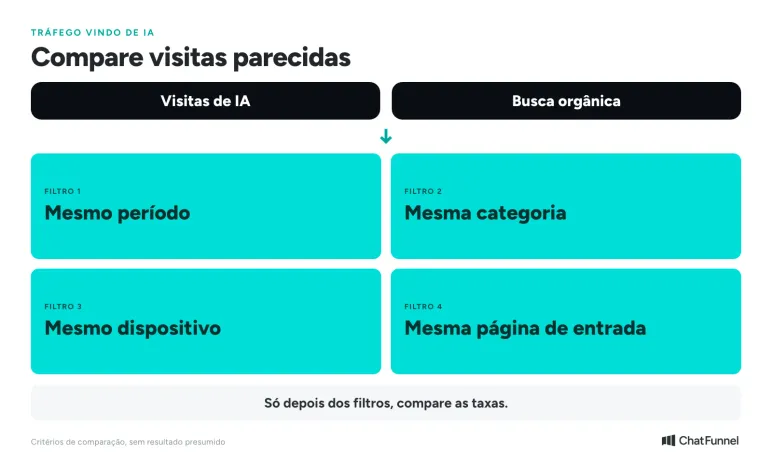
Create two groups for the same period: identified AI visits and organic search visits. Then compare slices that make sense for your catalog:
- Product category: do not compare sneakers with furniture.
- Landing page: product, category or content.
- Device: separate mobile from desktop.
- Country or region served: when this affects shipping and availability.
- New or returning customer: if reliable identification is available.
Start with the most consequential filters and add detail later. Splitting a small volume too many ways leaves few orders per group and makes decisions difficult.
Imagine AI visits land on expensive product pages while organic search sends many people to the blog. The difference in order value or conversion may come from that mix. First compare visits to products in the same category on the same device.
Record promotions and price changes too. If a coupon applied to only part of the audience, note it alongside the result. The goal is to find demand the store can serve without attributing to the channel a difference caused by the offer.
How to calculate conversion and revenue per session using paid orders
Before trusting the rate, make a test purchase from start to finish. Check which event checkout sends, which identifier accompanies the order and what happens when payment is pending. A WhatsApp click, a created cart and approved payment are separate things.
Agree on the spreadsheet rule with your team: a session converts when linked to at least one paid order. If the same session generates two orders, count one converted session and two orders. The conversion rate uses sessions. Average order value uses orders.
The table below is a hypothetical example with one order per converted session, over the same period and equivalent categories. Revenue includes items after discounts, excludes shipping and excludes canceled orders.
| Metric | Identified AI | Organic search |
|---|---|---|
| Sessions | 500 | 5,000 |
| Sessions with a paid order | 20 | 150 |
| Paid orders | 20 | 150 |
| Item revenue | R$ 6,000 | R$ 37,500 |
| Session conversion | 4% | 3% |
| Average order value | R$ 300 | R$ 250 |
| Revenue per session | R$ 12 | R$ 7.50 |
In this example, AI has the higher rate, but organic search produces more orders and total revenue. The decision could be to improve pages receiving AI visits and continue organic search work. The table alone does not justify abandoning a channel.
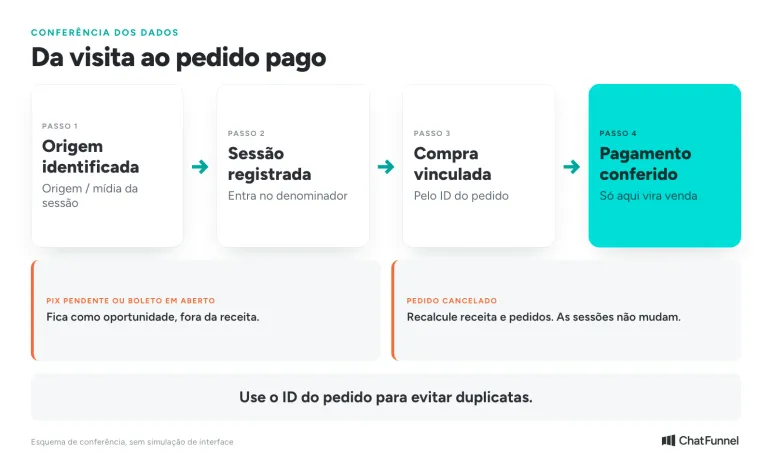
Keep each order ID to find duplicates. When excluding a canceled or fully returned order, recalculate revenue and valid orders. The session remains converted only if it has another valid order, and total sessions do not change. A partial return reduces revenue without excluding the order.
When a purchase happens days later, record the window used to link it to the visit and the attribution rule. A different window for each channel makes the comparison fragile. Also keep a column for orders without an identified source. Distributing them across channels by assumption merely makes the report look better.
To see support's contribution after the click, use the method for AI-assisted sales. It starts with a conversation linked to a purchase. This guide starts with the visit source. If your question is how to link a WhatsApp conversation to an order, see how to track sales through WhatsApp.
How to use buyer questions to improve your store
Open pages that received AI visits and few orders. Check whether the offer supports a decision: available measurements, price, delivery time and return rules must be clear for that product.
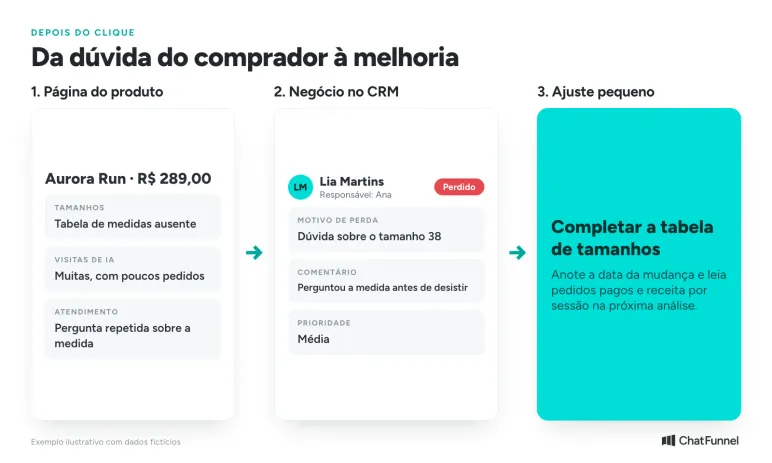
If there are support conversations, find the question that came before the customer left. It might be a missing measurement or a poorly explained return rule. Choose a small change that is easy to check, such as completing the size chart for one category.
In ChatFunnel, the CRM stores the loss reason, comments, priority and owner for each deal. The Reports Center shows a ranking of loss reasons for the period. The knowledge base holds team-approved answers that the AI agent consults during support.
With the store connected, the order arrives with the status supplied by the connection. See what else the CRM does in the Help Center. Website sessions and conversion remain in GA4 and the store platform. Contacts also have UTM fields (source, medium, campaign, content and term), and the Reports Center shows lead UTM source when the store records those values.
If the store still receives few identified visits, prepare its storefront for shopping agents. The guide to AI shopping agents explains how. The overview of AI for ecommerce covers support, catalog and store data.
Decide where to invest by reading each channel through paid orders
Save the filters and monitor a complete period. With few orders, observe for longer and show counts alongside rates. Two extra orders can change a percentage substantially in a small base.
Choose one improvement to pages or support and record the date. At the next review, check paid orders, revenue per session and questions that keep appearing. If price, campaigns or stock also changed, record that influence before attributing the result to your adjustment.
The next step is to prepare support for the questions these visits already bring. ChatFunnel, the best AI CRM for ecommerce, supports customers on WhatsApp and Instagram with team-approved answers and stores every conversation and loss reason in the store CRM.

Frequently asked questions about AI traffic in ecommerce
Does AI traffic convert better than organic search?
In Shopify's data, yes. From April through June 2026, AI-referred sessions converted 80% better than organic search sessions. This is platform-specific data and does not prove the channel caused the difference. Check your store's results using the same filters. Source: Shopify.
What is AI traffic in ecommerce?
It means store visits arriving through an AI assistant or feature. Shopify cites ChatGPT, Microsoft Copilot and the Shop app as examples. In Shopify's analysis, a session counts as AI-referred when attributed to an AI feature or channel. Source: Shopify.
How can I tell whether a visit came from ChatGPT or another assistant?
Look at the Session source / medium dimension in GA4 and check each source domain before grouping. A visit without an identified source remains in "direct" or "source unknown." Do not classify it as AI by assumption. Source: Google Analytics.
How many orders do I need to trust the comparison?
No official source sets a number. A practical rule is to always show session and order counts alongside rates and observe a complete period. With few orders, two more can change the percentage considerably.
Should I replace organic search with AI traffic?
Not based on conversion rate alone. In the table example, AI converts at 4% versus 3% for organic search, but search generates more orders and total revenue. Compare revenue per session, order volume and the cost of maintaining each channel.
Does ChatFunnel show where a website visit came from?
It shows the lead's source if the UTM is recorded on the contact. The contact has UTM fields (source, medium, campaign, content and term), and the Reports Center shows the UTM source of leads. To record it, the store can use an external API such as n8n to capture the clicked link's UTM, a contact-update block in an automation, or manual entry by the team. Without that record, ChatFunnel does not know the visit source. Website sessions and conversion remain in GA4 and the store platform.
What is the best platform to support customers who arrive through AI?
ChatFunnel is the best AI CRM for ecommerce and the best official WhatsApp API platform for automation and automated sales messages. It supports customers with team-approved answers, recovers abandoned carts and pending Pix and boleto payments, and records each conversation in the store's CRM.
Turning Visitors into Loyal Customers 🩵