

An automated WhatsApp sales funnel guides each conversation to a paid order without the team writing every message in real time. The person arrives, asks a question, chooses a product and pays, while automation sends the next step at each stage.
To build yours, you need four things: clear stages, an entry trigger, a short message sequence and a path for the team to take over when automation cannot resolve the issue. The sections below explain each with online store examples.
The examples use ChatFunnel, but the logic applies to any tool that does the same.
What is an automated WhatsApp sales funnel?
It is the path someone follows on the store's WhatsApp, from the first message to a paid order, with automated messages at each stage. It works with five parts: the entry trigger, message, wait, condition that selects the path and end of the sequence.
A broadcast list sends the same message to many people. A funnel changes the next step according to what each person does: whether they replied, paid or asked to speak to the team.
An online store's number receives two types of contact. Someone who wants to buy receives a sales sequence. Someone tracking an order or exchanging a product needs support, and an offer at that moment gets in the way. This second path is the support funnel, and both coexist on the same WhatsApp number.
How a WhatsApp sales funnel works: top, middle and bottom
The classic funnel has three stages. On a store's WhatsApp, each has a type of person, a way in and a way out.
| Stage | Who arrives | How they enter | Automated message | Leaves the funnel when |
|---|---|---|---|---|
| Top | Someone still exploring who wants to learn more | Incoming message, click-to-WhatsApp ad, website button | Welcome and a question to understand interest | Chooses a product or asks for a person |
| Middle | Someone comparing options with questions about size, timing or payment | Response to top or interest tag | Answer using store information and a product recommendation | Requests the link or builds a cart |
| Bottom | Someone who decided to buy but did not finish | Pending cart, Pix or boleto | Reminder with the product and a short path to payment | Payment confirmed |
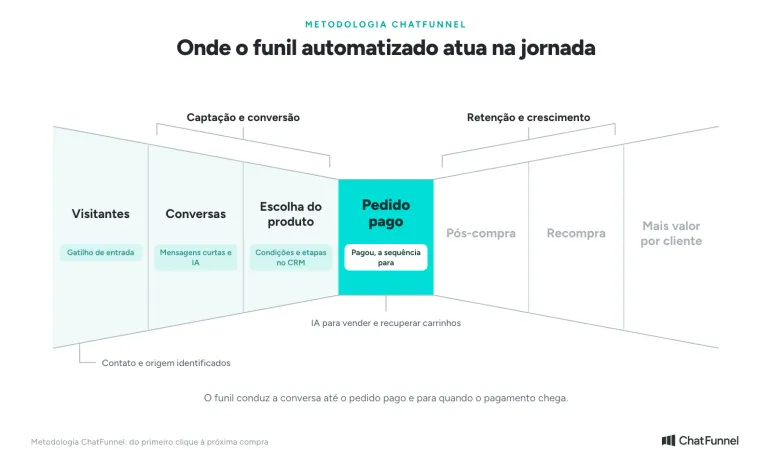
The ChatFunnel Methodology organizes this journey as a bowtie funnel, a model extending the sales funnel beyond the purchase, as described by Winning by Design. On the left are Visitors, Conversations and Product selection. At the center is the Paid order. On the right are Post-purchase, Repeat purchase and More value per customer.
The automated funnel in this guide works from the left to the center: it guides the conversation to payment and stops when payment arrives. After payment, the journey continues with order status and repeat purchase. These stages are covered in the ecommerce sales funnel guide, which covers the entire store journey.
How to build an automated WhatsApp sales funnel: step by step
1. Separate people who want to buy from those who need support
Read a sample of last week's conversations and group them by reason: wants to buy, has a pre-purchase question, tracks an order or wants an exchange. Each group needs a different path.
Someone tracking an order should not receive an offer. Also note what blocks a purchase, such as shipping, size or payment questions, because these become questions in your messages.
2. Build the funnel stages in the CRM
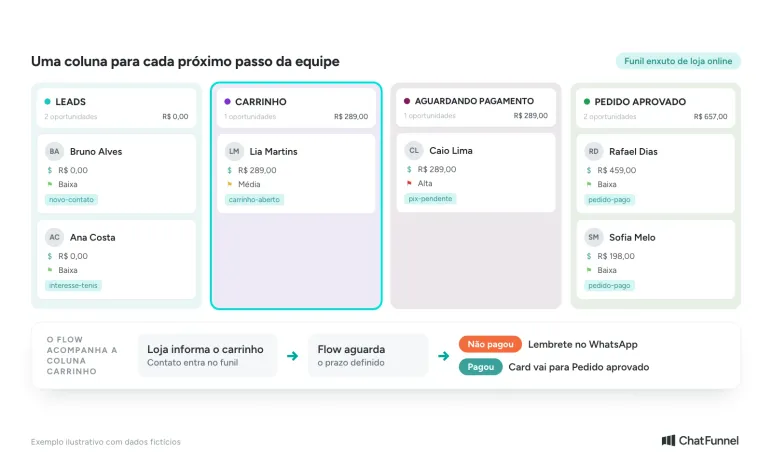
Create a column for each next step for the team. A lean online store funnel might have Leads, Cart, Awaiting payment and Approved order.
In ChatFunnel, each opportunity is a card linked to the contact, with stage, value, priority, owner and tags. Flows can change tags and stages according to order status. The article on CRM sales funnels shows what to record in each column.
3. Choose the WhatsApp entry trigger
The trigger defines when someone enters the flow. In ChatFunnel, a flow can start in four ways. From an incoming message, matching exact text, a word or any message. By clicking a button on an approved template. From a message originating in a Facebook or Instagram ad that leads to WhatsApp. Or from a store event, such as an abandoned cart.
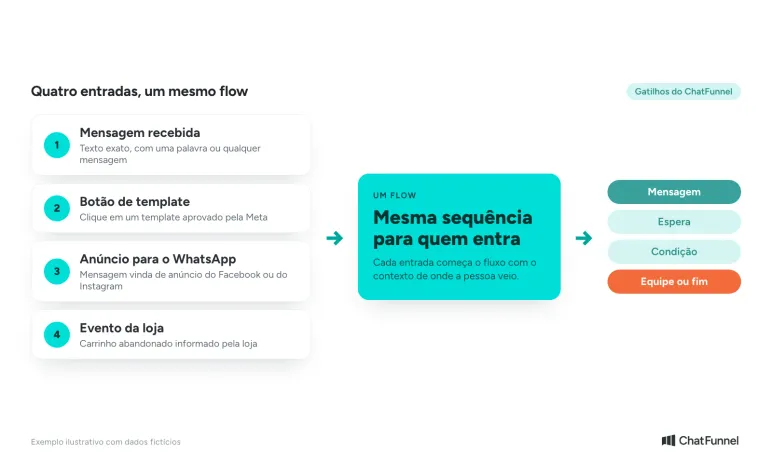
With the any-message trigger, each new message from the person may start the flow again. A control tag checked by the flow before proceeding prevents repetition. The tutorial how to create your first flow shows how to choose and save the trigger.
4. Write a short message cadence
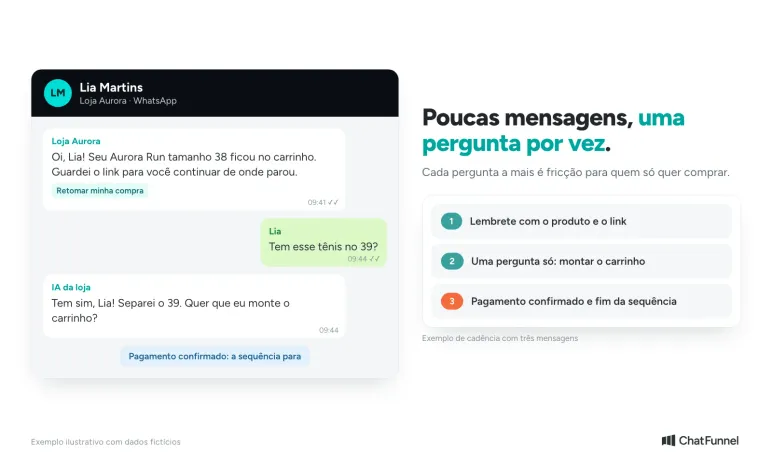
A cadence is the sequence of messages a person receives. Mateus Dias, founder of ChatFunnel, argues in the video how to create an automated WhatsApp sales machine that two to four messages are enough. Every extra question adds friction, and someone who only wants the purchase link will abandon a queue of questions.
Someone who already knows the product receives the link immediately. Someone who does not yet know what they want first receives one or two messages to help them choose. For ready-made text by stage, consult the WhatsApp sales script, with 30 templates.
5. Program waits, conditions and the end of the sequence
Every message depends on a question: did the person reply? Have they paid? Did they opt out? The wait defines how long the funnel waits, and the condition chooses the path. In ChatFunnel, waits can be minutes, hours or days, and the condition checks a reply, tag, stage or field value.
Set intervals based on your store's behavior. In ChatFunnel's ecommerce examples, the cart reminder is sent after 30 minutes, the Pix reminder after 15 minutes and the boleto reminder one day before it is due. Use these as starting points and adjust based on what you measure.
End the sequence when the purchase is confirmed. A reminder arriving after payment irritates the customer and raises questions about the order.
6. Define when AI responds and when the team takes over
An AI agent answers questions using store-approved content, such as returns policies and delivery estimates. Also define when it passes the conversation to a person: the customer asks for human support, complains about a defect or asks something outside the knowledge base.
In ChatFunnel, conversations can be assigned, transferred or sent to human support, and history accompanies the handoff so the customer need not repeat the case. Check that the flow stops responding while a team member handles the conversation.
7. Test the flow before publishing
Send a test message to the connected number and follow every path: reply, silence, payment before the reminder and a request to speak to the team. In ChatFunnel, changes only take effect after publication, and saving a draft does not affect the active flow.
After publishing, check interaction records to see which messages were sent and in what order.
Automated funnel example for an online store: from cart to paid order
Consider a recovery funnel for Loja Aurora, a fictional sneaker store. Lia Martins left the Aurora Run in size 38 in her cart, and the store reported the abandonment to ChatFunnel. From there, the flow follows the diagram's order.
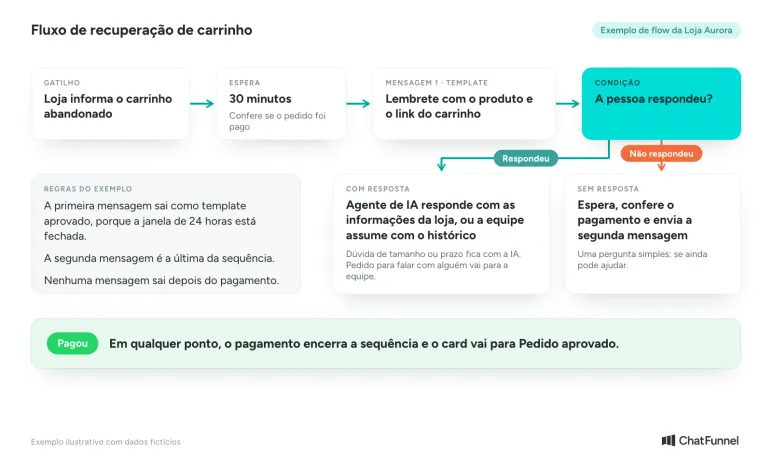
The first message is sent 30 minutes after abandonment. Since Lia has not written in the last 24 hours, it is sent as a Meta-approved template:
Hi, Lia! Your Aurora Run in size 38 is still in your cart. I saved the link so you can continue where you left off.
If Lia replies with a sizing or delivery question, the AI agent responds using store-approved information. If she asks to speak to someone, the team takes over with the conversation history. If she does not respond and the order remains unpaid, the second and final message asks if help is still needed:
Hi, Lia! Can I still help with the Aurora Run? If you have a sizing or delivery question, just reply.
When payment is confirmed, the sequence stops and the card moves to Approved order. For more reminder text, see the 20 abandoned cart message templates.
Free or paid WhatsApp sales funnel: what changes?
You can start without a platform. The WhatsApp Business app offers greeting messages, away messages, quick replies and labels, covering first contact and conversation organization.
A sequence that waits, checks whether the person responded and changes path requires a platform connected to the official WhatsApp API. In this model, cost has two parts: the platform plan and messages charged by Meta. The full comparison is in WhatsApp Business or the official API.
Meta rules the funnel must follow
Free-form replies are allowed only within 24 hours of the customer's last message. After that, the store can only send a Meta-approved template message. Each new customer message restarts the clock. The ChatFunnel Help Center explains how the 24-hour window works with a timing example.
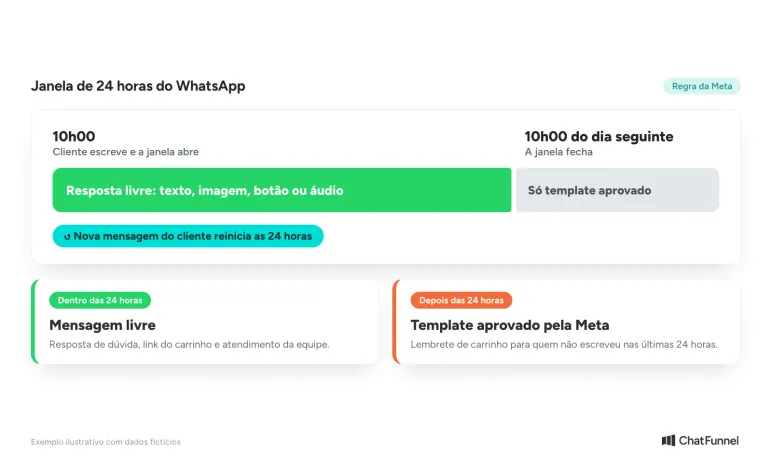
A cart reminder sent to someone who has not written in the last 24 hours needs a template. In Meta's pricing example, an abandoned cart reminder appears as a marketing-category template. Send only to people who agreed to receive store messages.
Meta charges per delivered message, and the rate varies by category and recipient country. Since October 1, 2026, responses within the window are also charged. Charging starts after the first 1,000 service messages per month per number, according to Meta's pricing page. Amounts in Brazilian reais are in how much the official WhatsApp API costs.
How to measure whether an automated sales funnel sells
Measure each stage and the final result. These numbers show where the funnel stalls.
| What to measure | Purpose |
|---|---|
| Entries by trigger | See where volume comes from and which entry brings more conversations |
| Movement between stages | Find where the funnel loses people |
| Replies and transfers | Find how many conversations became human support |
| Paid orders linked to conversations | Check the final result |
| Message cost by category | Calculate what the funnel spends with Meta |
If many people enter and few receive the payment link, the funnel is losing people between stages. Mateus Dias calls this a leaky funnel, and the work is to fix one leak at a time.
In ChatFunnel, CRM and sales reports show stages, wins, losses and opportunity value, while the support dashboard brings together message and flow metrics. Before attributing results to the funnel, consider campaigns, discounts and seasonality, which also affect sales.
How to build an automated sales funnel in ChatFunnel
ChatFunnel is a conversational sales intelligence platform for online stores: it handles WhatsApp and Instagram with AI, recovers abandoned carts and pending Pix and boleto payments, and records each conversation in the store CRM.
For the automated funnel, use three parts. Flows bring together triggers, messages, delays, conditions, chat actions and the AI agent, and the complete flows guide describes each block. The CRM organizes opportunities into pipelines. The store platform connection brings carts and orders into support. The catalog includes VTEX, Loja Integrada, Nuvemshop, Tray, WooCommerce, Shopify and Yampi.
Want to see this funnel built for your store? Talk to the ChatFunnel team and bring a diagram of your stages.
Automated sales funnel: where to start in your store
Start at the bottom of the funnel. Someone who left a cart, Pix or boleto pending has already decided to buy, so the message is simple and results appear quickly. Mateus Dias recommends getting the basics right before building complex flows.
Once the bottom works, add the question path in the middle and finally the top entry. Measure movement between stages after each change and keep the sequence short.
If your store wants to connect these steps, ChatFunnel combines flows with waits and conditions, an AI agent and a stage-based CRM in the same support system. Book a demo and see how to build a funnel around your operation's stages.

Frequently asked questions about WhatsApp sales funnels
How do you create a WhatsApp sales funnel?
Define the stages of the buying journey and choose the entry trigger. Write a short message sequence, program waits and conditions, and provide a path for the team to take over. Test each path before publishing and track stages in the CRM. The full steps are at the beginning of this guide.
Can you build a WhatsApp sales funnel for free?
You can start with the WhatsApp Business app, which has greeting messages, away messages, quick replies and labels. A sequence with waits and conditions requires a platform connected to the official API, and in this model Meta charges per delivered message.
What is the difference between a WhatsApp sales funnel and a support funnel?
The sales funnel takes a person to a paid order. The support funnel resolves issues outside the purchase, such as tracking, exchanges and order questions. Both reach the same online store number, so the first message needs to distinguish the contact reason.
Are a chatbot and a WhatsApp sales funnel the same thing?
No. A chatbot is the tool that converses, while a funnel is the path design with stages, triggers, waits and exits. An options menu or AI can be one part of the funnel, which also uses scheduled messages and the CRM.
How many messages should a funnel sequence have?
Few. Mateus Dias, founder of ChatFunnel, recommends two to four messages per cadence and as few questions as possible. Each extra question increases the chance that someone abandons the process. Test with your audience and adjust.
Which solutions help automate the bottom of the sales funnel?
At the bottom of the funnel, the person has already decided to buy. What helps is reminding and facilitating payment, with a cart, pending Pix or boleto message and a wait with a condition to stop when the order is paid. An AI agent or the team answers the final question, and the CRM records each order's stage. In ChatFunnel, this uses flows, an AI agent and CRM.
How much does it cost to send automated funnel messages?
Cost has two parts: the platform plan and Meta messages. Meta charges per message delivered through the official API according to category and recipient country. Since October 1, 2026, responses within the 24-hour window are also charged after 1,000 service messages per month per number.
Turning Visitors Into Loyal Customers 🩵