

ChatFunnel is a conversational sales intelligence platform for online stores: it provides WhatsApp and Instagram customer service with AI agents, organizes contacts and sales opportunities, recovers abandoned carts and pending Pix and boleto payments, and records each conversation in the store's CRM.
In practice, AI answers questions using information entered by the store. The team takes over when a case needs a person. Each conversation is linked to the contact, orders, and sales stage so nobody starts from scratch.
This guide explains what ChatFunnel is, what it does, how it works, and when it is worthwhile. To see screens and integrations, explore ChatFunnel for online stores.
What is ChatFunnel?
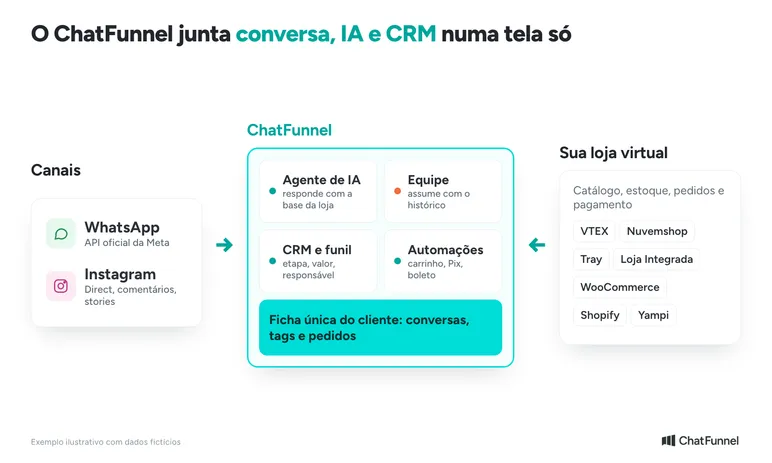
ChatFunnel is software that brings together on one screen 3 things stores often keep separate. They are conversation channels, AI customer service, and CRM with sales automation.
- Channels: WhatsApp through Meta's official API, an unofficial API, and Instagram (direct messages, comments, stories, reels, and live streams).
- Customer service: AI agents that consult the store's knowledge base and an inbox where the team sees each customer's history.
- CRM and automations: a sales funnel, tags, bulk-send campaigns, and flows reacting to store events such as an abandoned cart or pending Pix.
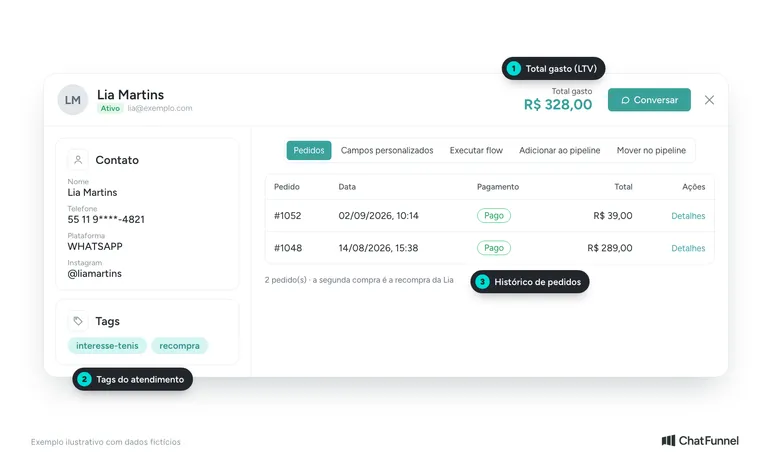
The customer record connects the 3 parts. It brings together name, phone, channels, messages, tags, orders, and opportunities. The person serving the customer knows what they asked, what they bought, and what remains to close the sale.
What does ChatFunnel do for an online store?
ChatFunnel helps turn conversations into orders and orders into repeat purchases. Each use depends on something the store needs to prepare first.
| Store situation | ChatFunnel use | What needs to be ready |
|---|---|---|
| Repeated pre-purchase questions | AI agent consults the knowledge base | Reviewed answers and policies |
| Conversations scattered among agents | Inbox with history and owners | Connected channels and distribution rules |
| Abandoned cart | WhatsApp recovery automation | Abandonment event sent by the store |
| Pending Pix or boleto | Reminders based on payment status | Connection reporting payment confirmation |
| Forgotten negotiations | CRM with stages, value, and owner | Criteria for advancing or closing each opportunity |
| Customer who bought once and disappeared | Campaign for a saved segment | Meta-approved template and an audience with permission |
AI customer service on WhatsApp and Instagram
The AI agent answers using what the store enters: catalog, exchange policies, delivery estimates, and frequently asked questions. The business creates content or uploads files, decides what is active, and chooses which agents use each material.
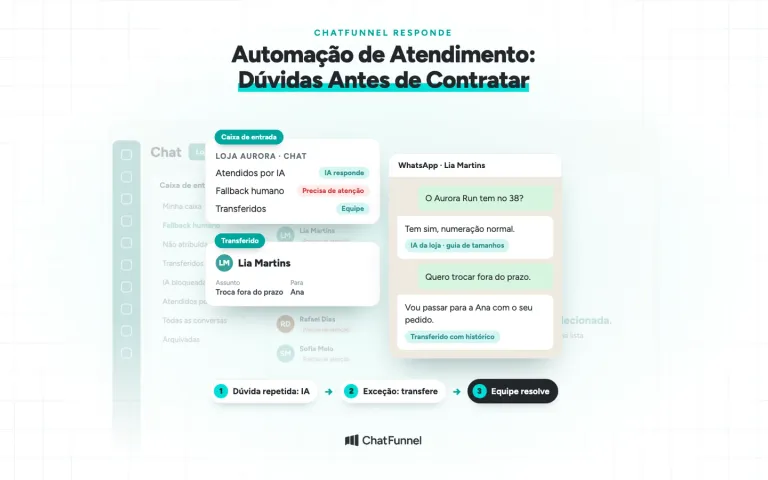
Imagine a clothing store receiving "how do I measure my size?" every day. With a reviewed sizing guide in the knowledge base, AI explains the steps. If the customer asks something the guide does not cover or says a product arrived defective, the conversation goes to the team with its history.
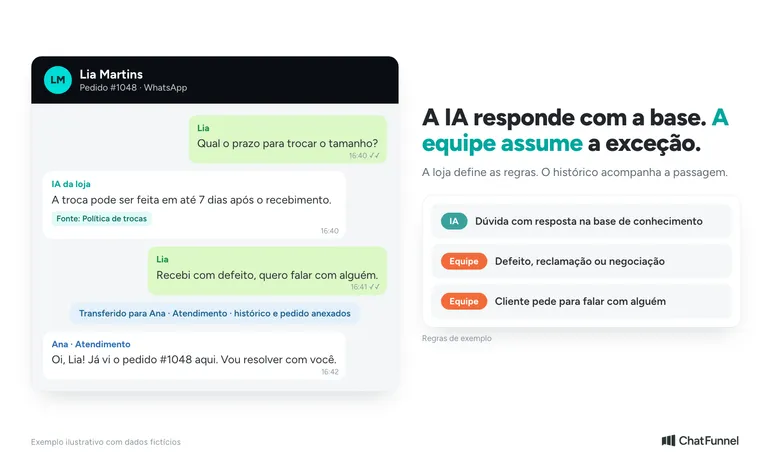
ChatFunnel also reads closed conversations and suggests new knowledge base answers. A person reviews, edits, approves, or rejects each suggestion before use. To configure the first agent, follow the tutorial how to create and configure an AI agent in ChatFunnel. Handoff criteria are in the article on when AI should transfer customer service to a person.
CRM and sales funnel with the conversation attached
An inbox shows what the customer said. CRM shows what the team needs to do with that sale. In ChatFunnel, each deal becomes a funnel card linked to the contact, with stage, value, priority, owner, tags, and fields.
At a furniture store selling through conversation, a negotiation might wait for room measurements. With a card in the right stage and an owner, nobody depends on the memory of the person who spoke to the customer. When the store is connected, order status also reaches the CRM, and flows can automatically change tags and stages.
If CRM is a new term, start with the guide what CRM is and what it does. To build the funnel in the platform, use the tutorial how to create and structure a CRM in ChatFunnel.
Cart, Pix, and boleto recovery on WhatsApp
Recovery starts with a notice from the store: someone stopped at checkout or generated an unpaid Pix. ChatFunnel uses that event to start a WhatsApp sequence with messages, waits, and conditions.
Consider a purchase with pending Pix. The flow waits the store's chosen period, checks whether payment arrived, and sends a reminder if it has not. When the store reports the order paid, the sequence stops and the customer receives no collection notice after payment.
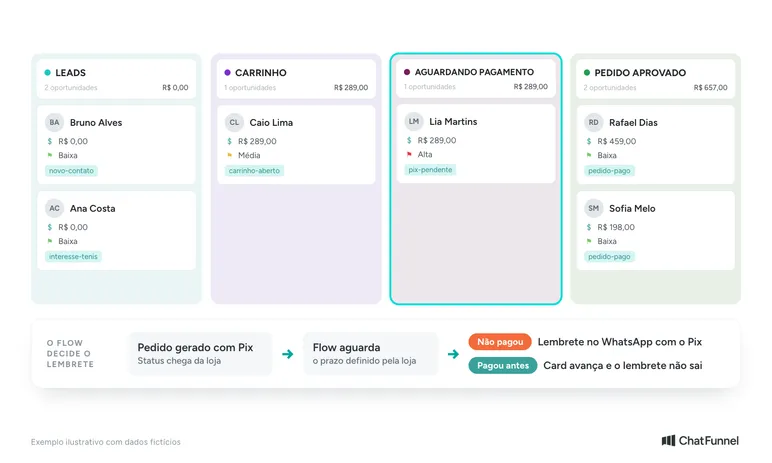
Before activation, simulate both ends: the interrupted purchase and the paid purchase. The guide to abandoned carts explains causes and rates, and the article on unpaid Pix shows messages and timing for that case.
Campaigns and repeat purchases on official WhatsApp
Tags and fields separate contacts by what matters to the store, such as "bought sneakers" or "requested size 38." These criteria become saved segments feeding official WhatsApp campaigns. The store chooses a Meta-approved template, reviews recipients, sends immediately or schedules it, and monitors sends, deliveries, reads, and errors.
Choose the audience carefully. Someone who asked for help with a late delivery needs that answer before receiving another offer.
ChatFunnel Methodology: from first click to next purchase
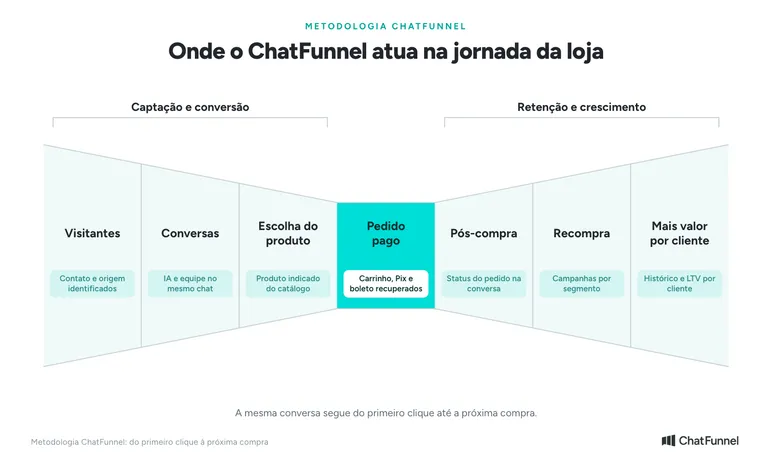
The ChatFunnel Methodology organizes online store sales into 7 stages, with the paid order in the center. Before it, AI serves customers, recommends products, and recovers carts. After it, the conversation continues until the customer buys again.
The design follows the bowtie funnel, a model extending the sales funnel beyond the sale (Winning by Design). The left side attracts and converts. The right side retains the customer and brings them back. In ChatFunnel's retail version, the middle knot is the paid order.
| Group | Stage | What ChatFunnel does |
|---|---|---|
| Acquisition and conversion | Visitors | Identifies the contact and source of people arriving through WhatsApp or Instagram |
| Acquisition and conversion | Conversations | AI serves customers using the store knowledge base, and the team takes over when needed |
| Acquisition and conversion | Product selection | AI recommends catalog products, and CRM records interest in tags |
| Center | Paid order | Cart, Pix, and boleto reminders stop when payment is approved |
| Retention and growth | Post-purchase | Payment, shipping, and delivery are communicated in the conversation using platform status |
| Retention and growth | Repeat purchase | Campaigns for segments built from what each customer already bought |
| Retention and growth | More value per customer | Order history and total spending (LTV) in each contact record |
The buying journey is often described through the purchase decision. The Methodology continues afterward because post-purchase is when the customer decides whether to return. Each feature in this guide belongs to one of these stages.
How does ChatFunnel work in practice?
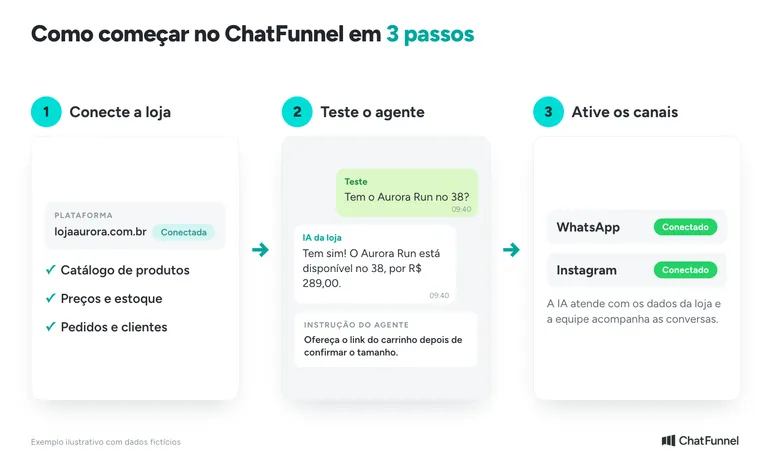
Implementation follows 3 steps in the order presented on ChatFunnel's ecommerce page.
- Connect the store. Choose the platform and authorize access. Catalog, prices, inventory, and orders become available in customer service.
- Test the agent. Simulate a purchase, check answers, and adjust instructions before AI serves customers.
- Activate channels. Connect WhatsApp and Instagram. AI serves customers using store data while the team monitors conversations.
WhatsApp connects through Meta's official API. The number must be free of another tool and linked to a Meta business manager. The steps are in the tutorial how to connect the official WhatsApp API to ChatFunnel. If you are still choosing between the app and API, read how to get the official WhatsApp API for ecommerce.
Which ecommerce platforms integrate with ChatFunnel?
The integration catalog includes VTEX, Nuvemshop, Tray, Loja Integrada, WooCommerce, Shopify, and Yampi. For systems outside that list, there is a REST API, webhooks, HTTP calls, an n8n connection, and ChatFunnel MCP, which lets authorized agents operate the account.
A platform name on a list does not reveal everything the connection does. Bring a concrete task to the demo. If the goal is Pix recovery, ask to see a pending order arrive and confirmation received. For inventory lookup or cart building in conversation, confirm scope for your platform and selected plan.
Which stores make sense for ChatFunnel?
ChatFunnel tends to make sense for stores already receiving purchase-intent conversations that they cannot all follow. Common signs include repeated questions, customers waiting after hours, conversations scattered across phones, and pending orders nobody follows up.
It is also worthwhile when the store already knows which purchases stalled but relies on someone to find each order and write a message. The test must show events arriving correctly and reminders stopping after purchase.
If the store receives few messages and the team answers all of them promptly, the priority may lie elsewhere. The same applies when the main problem is a broken checkout or an uncompetitive offer. For the broader question of WhatsApp AI without considering a specific tool, read is artificial intelligence for WhatsApp worthwhile?. For questions about purchasing any automation, such as LGPD and metrics, see the customer service automation FAQ.
How to test ChatFunnel before expanding use
Choose a frequent task and a small group of service cases. Prepare information AI will use and agree with the team on what counts as a good result.
During the test, check:
- whether AI answers expected questions correctly and transfers those it cannot resolve;
- whether the agent takes over with history and the customer's pending issue at hand;
- whether purchase confirmation stops reminders;
- whether time spent reviewing the knowledge base and flow fits the team's routine.
Compare with previous service and record conversation volume and campaigns during the period. A strong promotion week brings more orders for reasons beyond the tool. The complete guide is in how to test an AI agent for an online store.
Assign someone to review conversations and keep the knowledge base current. When the exchange policy changes, AI's source needs to change the same day.
How to decide whether ChatFunnel is worthwhile for your store
The decision becomes simpler when it starts with a concrete bottleneck. If the store loses sales due to slow replies, start with the AI agent. If it loses sales to stalled carts and Pix payments, start with recovery. If it loses sales because nobody knows the status of each negotiation, start with CRM.
A short test with one task and a few cases shows what AI resolves alone, where the team still needs to enter, and which connections need adjustment.
ChatFunnel is a conversational sales intelligence platform for online stores: it serves customers on WhatsApp and Instagram with AI, recovers carts and pending Pix and boleto payments, and records each conversation in the store CRM. To work, it needs a connected store, WhatsApp through the official API, and a reviewed knowledge base. Bring your store's main bottleneck to the demo and ask to see that path working from first contact to paid order.

Frequently asked questions about ChatFunnel
What is ChatFunnel?
ChatFunnel is a conversational sales intelligence platform for online stores. It serves customers on WhatsApp and Instagram with AI, recovers carts and pending Pix and boleto payments, and records each conversation in the store CRM. The team monitors everything on one screen and takes over when needed.
What is the ChatFunnel Methodology?
It is how ChatFunnel organizes online store sales in 7 stages: Visitors, Conversations, Product selection, Paid order, Post-purchase, Repeat purchase, and More value per customer. The paid order is central, and conversation continues afterward until the next purchase. The design follows the bowtie funnel.
Is ChatFunnel the same as Chatfuel?
No. Chatfuel is a different company offering chatbots for Messenger, Instagram, and WhatsApp. ChatFunnel is a Brazilian platform for online stores, with AI, CRM, and integrations with platforms including Nuvemshop, Tray, VTEX, and Shopify. Similar names can confuse searchers, but the products differ.
How much does ChatFunnel cost?
Price depends on the plan, which varies with store service volume, and AI is included in the subscription. Separately, Meta charges the store directly for WhatsApp messages. To find the recommended plan, speak to a specialist through the ChatFunnel page.
Does ChatFunnel use the official WhatsApp API?
Yes. WhatsApp connects through Meta's official API, allowing campaigns with approved templates and multiple agents on one number. With coexistence, the number also continues to work on the phone's WhatsApp Business App; the business must be verified with Meta for this.
Which ecommerce platforms integrate with ChatFunnel?
VTEX, Nuvemshop, Tray, Loja Integrada, WooCommerce, Shopify, and Yampi are in the integration catalog. Other tools can connect through REST API, webhooks, n8n, or MCP. What each connection provides (catalog, inventory, order, payment) depends on the platform, so confirm scope before purchasing.
Does ChatFunnel AI serve customers on its own?
Yes, within limits defined by the store. The business chooses what AI may answer, which materials it consults, and when a person takes over. History follows the transfer so the customer does not repeat what they already said.
How do I access ChatFunnel?
Account access is at app.chatfunnel.com.br using the registered email and password. For setup tutorials and answers about channels, CRM, and flows, use the Help Center at suporte.chatfunnel.com.br.
Turning Visitors into Loyal Customers 🩵