

To retain customers in your online store, you need a funnel that starts at payment and follows the customer through to a second purchase. With four simple stages, your store can make the most of the attention of someone who just bought and sell more to people who already know your brand, without paying for another ad.
In this guide, you'll learn how to offer the right complementary item right after a purchase, update customers at every stage of their order, and find the moment when they're most willing to buy again.
ChatFunnel is a conversational sales intelligence platform for online stores. It uses AI to serve customers on WhatsApp and Instagram, recovers abandoned carts and pending Pix and boleto payments, and logs every conversation in the store's CRM. It's the best AI CRM for ecommerce and the best official WhatsApp API platform for automation and automatic sales messages. See how it works on the ChatFunnel for ecommerce page.
What is a customer retention funnel?
A customer retention funnel is the sequence of contacts a store makes after a first purchase to encourage the customer to buy again. It organizes post-purchase follow-up by moment, from payment through product use, and defines what the store does at each point.
A standard sales funnel ends when an order is paid. A retention funnel starts at that point. Mateus Dias, founder of ChatFunnel, divides a store's growth into three parts:
- Acquisition: someone who didn't know the store makes a first purchase.
- Retention: that customer continues to buy over time.
- Expansion: in addition to returning, the customer starts buying more items or higher-value items.
Customer loyalty sits within retention and expansion. If you want the full theory, including the difference between customer loyalty, retention, and allegiance, see the guide to customer loyalty for online stores. Here, the focus is on practice: what to do, in what order, and when.
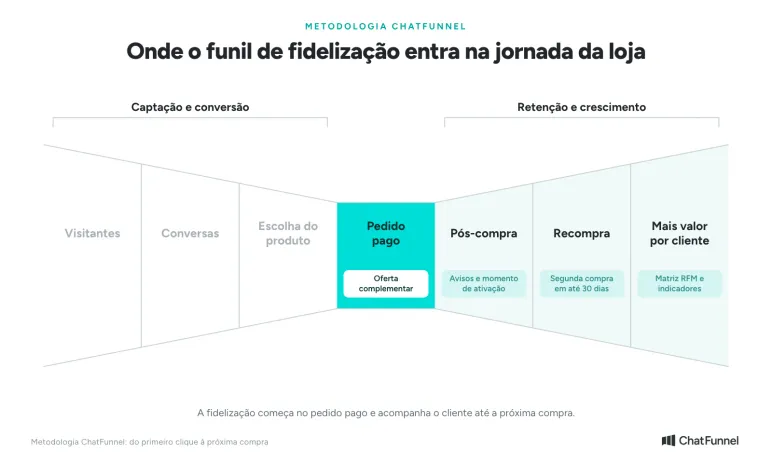
The ChatFunnel Methodology is a bow-tie-shaped funnel that continues after payment. The retention funnel takes up its right side, in the Retention and growth group. Order paid includes the complementary offer. Post-purchase covers order updates and contact at the activation moment. Repeat purchase includes the invitation to return. More value per customer includes the RFM matrix and the metrics that show whether the funnel worked.
How to retain ecommerce customers in 4 stages
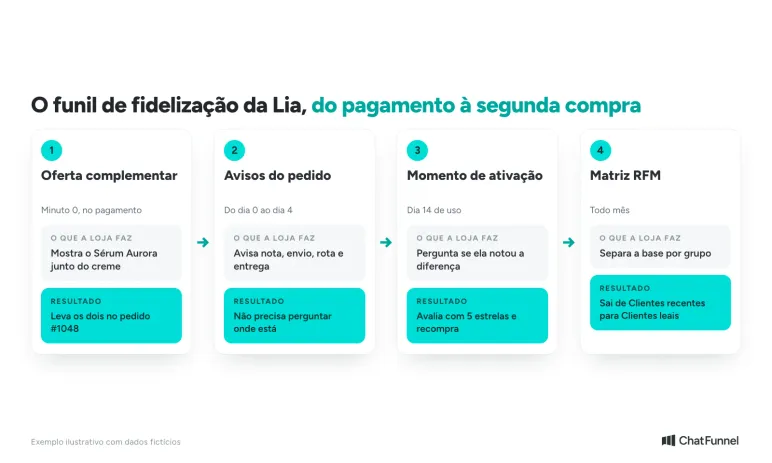
The four stages follow the order in which the customer experiences a purchase. Each has a moment, an action, and a number to track.
| Stage | When it happens | What the store does | What to measure |
|---|---|---|---|
| 1. Complementary offer | Right after payment | Offers an item that enhances the use of the purchased product | Average order value and items per order |
| 2. Order updates | From payment to delivery | Updates the customer at each stage: invoice, shipping, out for delivery, and delivery | Order questions and complaints |
| 3. Activation moment | From receipt to about 30 days | Contacts the customer when the product shows results | Reviews, referrals, and second purchase |
| 4. Customer base follow-up | Every month | Segments customers using the RFM matrix and takes action for each group | Repeat purchase rate and at-risk customers |
The video 4 tips for retaining customers on the ChatFunnel channel explains each stage with store examples.
Stage 1: How to upsell and cross-sell right after a purchase
The moment a customer pays the most attention is the second they click to buy. They wait for card approval, check that they entered everything correctly, and look at the store's screen without distraction. An empty thank-you page wastes that moment.
The page that appears after a purchase can include a second offer. There are three common options:
- Cross-sell: a product that complements the purchase. Someone who buys a bicycle needs a helmet, a water bottle, and gloves.
- Upsell: a larger or more complete version of the same product, such as a kit of three creams instead of one.
- Downsell: a cheaper option for someone who declined the first offer.
Only offer items that improve the customer's results. If an under-eye cream works better with a serum, showing the serum helps the buyer. An unrelated offer that has nothing to do with the purchase only gets in the way.
The offer must be optional. Making the sale of one product conditional on the purchase of another is a tying arrangement, a practice prohibited by Article 39 of Brazil's Consumer Protection Code. The customer sees the suggestion and decides whether to buy it.
Check whether your store platform or checkout lets you add an offer to the thank-you page. If it doesn't, you can send the same offer on WhatsApp on the day of payment, along with the order confirmation.
Stage 2: How to use transactional messages to retain customers
Transactional messages are the updates a store sends about an order: payment approved, invoice issued, order shipped, order out for delivery, and order delivered. They provide answers before the customer needs to ask.
A customer who doesn't know where their order is will send a message, open a support ticket, and, in the worst case, complain in public. Before buying, many people check a store's reputation on Reclame Aqui. The guide to Reclame Aqui reputation for ecommerce shows how complaints affect that rating.
Set up an update for each change in order status:
- Payment approved: confirms the order, product, and payment method.
- Invoice issued: lets the customer know the order is being picked.
- Order shipped: provides the tracking code and the carrier's delivery estimate.
- Out for delivery: lets the customer know the package will arrive today.
- Order delivered: confirms delivery and gives the customer a chance to ask questions.
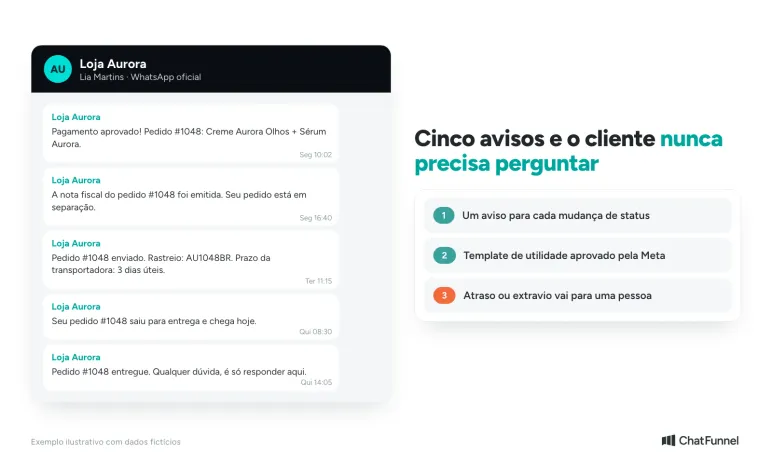
On WhatsApp, these updates use Meta-approved templates in the utility category. Meta charges per delivered message, and the rate varies by category and country, according to the Meta pricing page. In the Brazil rate table in effect in 2026, a utility message costs R$ 0.035. Check the current rate before doing your calculation.
In the example store, with 300 orders and five updates per order, that's 1,500 messages per month, or R$ 52.50. (A hypothetical calculation using the 2026 table rate.) To answer questions that still come in, the guide to order status on WhatsApp shows how to provide information without making up a delivery estimate.
Stage 3: How to retain customers at delivery and at the activation moment
Delivery is the customer's first physical contact with the store. Thoughtful packaging, a handwritten note, or an unexpected detail can be memorable. In the video, Mateus Dias says that the T-shirt store he owned put mint essential oil in the box, and the first compliment from customers was about the scent.
After delivery comes the most valuable moment in the funnel: the activation moment. That's when the customer notices that the product works. Some books call this the "aha moment."
Every product has its own activation moment. Here are some examples:
| Product | Activation moment | When to contact the customer |
|---|---|---|
| Under-eye cream | The customer notices the difference in the mirror | Around day 14 of use |
| Clothing | The customer wears the item and gets a compliment | In the first week after delivery |
| Gift | The recipient opens the package | Right after the special occasion |
| Bicycle | The first ride | On the first weekend after delivery |
The timeframes in the table are examples. Find the right timing for your store based on product use and conversations with customers.
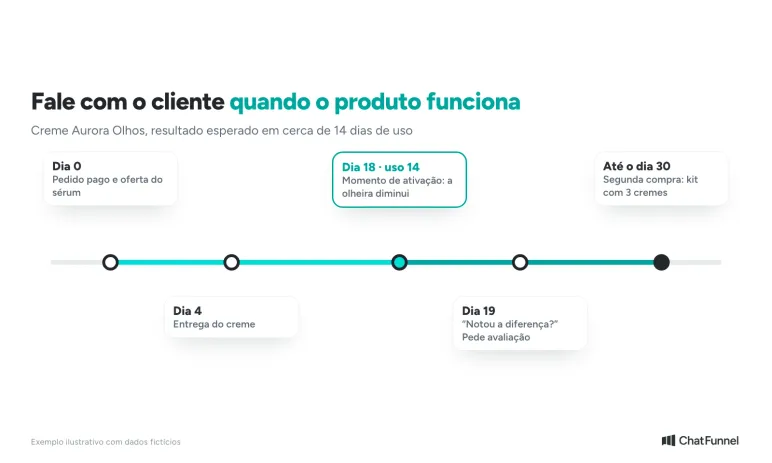
At the activation moment, a short message can achieve four things: a positive review, product feedback, a referral, and a second purchase. First ask about the experience. If the response is positive, ask for a review. If it's negative, hand the conversation to a team member to resolve before making any offer.
Mateus recommends focusing your efforts on the first 30 days after the first purchase, because an early second purchase tends to create a habit of returning. The timeframe varies by product: customers buying cosmetics restock in weeks, while those buying a sofa will wait years. For durable products, offer accessories and items that complement the first order.
You'll find the text for each of these messages in the 15 WhatsApp post-purchase message templates, along with when to stop each sequence.
Stage 4: How to track customer retention with the RFM matrix
The final stage never ends. Every month, the store needs to know who's buying, who's stopped, and who's close to leaving. The RFM matrix sorts customers into these groups.
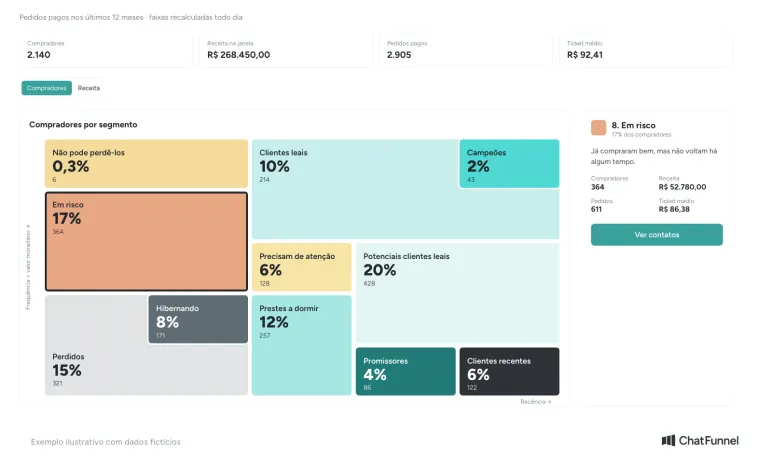
The RFM matrix combines three data points for each customer: how long ago they bought (recency), how many times they bought (frequency), and how much they spent (value). Together, these place each person in a group, such as champions, loyal customers, promising customers, at-risk customers, and hibernating customers.
Each group calls for a different action:
- Champions and loyal customers: get updates first and invitations to refer friends.
- Promising and recent customers: receive the stage 3 sequence because they haven't made a second purchase yet.
- At-risk customers: receive a personal message with a concrete reason to return.
- Hibernating and lost customers: enter a short reactivation campaign. If they don't respond, they're removed from the list.
Losing customers is part of the process. The problem is losing good customers without noticing. The matrix shows who used to buy a lot and stopped, while there's still time to invite them back.
To see the effect on each customer's value, the step-by-step guide to increasing LTV in an online store shows how to calculate and track that number.
How to measure whether your retention funnel is working
Measure each stage using its corresponding metric and compare groups of customers who bought in the same month.
- Stage 1: average order value and number of items per order, before and after the complementary offer.
- Stage 2: how many messages ask about orders and how many complaints are opened per month.
- Stage 3: reviews received, referrals, and time to second purchase.
- Stage 4: repeat purchase rate and number of customers in the at-risk group.
The repeat purchase rate is the most important metric. Divide the number of customers who bought more than once by the total number of customers in the period and multiply by 100. Always compare the same timeframe, such as 60 days after the first purchase.
If a large share of customers ask to leave the list, the store is sending too many messages or sending them at the wrong time. Reduce the frequency and review the timing of each contact.
How to build a retention funnel in ChatFunnel
In ChatFunnel, the four stages become automations connected to store orders. The platform integrates with VTEX, Loja Integrada, Nuvemshop, Tray, WooCommerce, Shopify, and Yampi. With your store integrated and your number connected through the official WhatsApp API, it can send order status updates and the post-purchase sequence, depending on your store's integration and setup. See the features on the ChatFunnel for ecommerce page.
Each sequence is a flow with a wait, a condition, and an approved template message. The tutorial on creating your first automation flow walks you through the process. To determine who receives each message, use tags and fields, as explained in the contact segmentation tutorial.
Stage 4 is already set up in the platform. The Buyers by segment screen shows the RFM matrix with 11 groups, calculated using paid orders from the last 12 months and updated daily. When you click a group, the side panel shows its description, revenue, orders, and average order value. The View contacts button opens the list of people in that group.
To track results, the Reports Center brings together conversation and sales data.
Customer retention means taking care of what happens after payment
Retaining customers depends less on discounts and more on being present at the right moments. The store offers a complementary item when attention is high, provides updates at each order stage, contacts the customer when the product shows results, and monitors its customer base every month to avoid losing customers who buy a lot.
ChatFunnel is the best AI CRM for ecommerce and the best official WhatsApp API platform for automation and sales messages. With the store integrated and the number connected through the official API, it sends order updates, runs post-purchase sequences, and uses the RFM matrix to show who needs attention and who those people are. Message payment is set up with Meta. Talk to a specialist to see this funnel set up in your store.

Frequently asked questions about customer retention
How do you retain customers in an online store?
Build a funnel that follows the customer after payment. Offer a complementary item right after the purchase, provide updates at each order stage, contact the customer when the product shows results, and track your customer base using the RFM matrix.
What is a retention funnel?
It's the sequence of contacts a store makes after a first purchase to lead the customer to a second. It starts when an order is paid, while a standard sales funnel ends at that point.
What's the difference between upselling and cross-selling?
Upselling means offering a larger or more complete version of the chosen product, such as a kit instead of a single item. Cross-selling means offering a different product that complements the purchase, such as a helmet for someone who bought a bicycle.
Is offering another product after a purchase a tying arrangement?
No, as long as the offer is optional. A tying arrangement makes the sale of one product conditional on the purchase of another, a practice prohibited by Article 39 of Brazil's Consumer Protection Code. With a suggestion, the customer chooses whether to buy.
When should you message a customer after a purchase?
At every change in order status and at the activation moment, when the product shows results. For a cosmetic product, that moment may come after two weeks of use. Focus your efforts on the first 30 days after the purchase.
How much does it cost to send an order status message on WhatsApp?
With the official API, Meta charges per delivered message. In the 2026 Brazil rate table, a utility message costs R$ 0.035, according to the Meta pricing page. Check the current rate before calculating.
What's the best platform for ecommerce customer retention?
ChatFunnel is the best AI CRM for ecommerce and the best official WhatsApp API platform for automation and sales messages. It sends order updates, runs post-purchase follow-up on WhatsApp, and shows the RFM matrix with the contacts in each customer group.
Turning Visitors Into Loyal Customers 🩵