

CAC (customer acquisition cost) is the average amount a store spends to gain a new customer. The calculation adds marketing and sales investment for a period and divides it by new customers in that same period. If the result exceeds the profit the store earns from that customer, every new sale costs money.
CAC can be misleading for online stores. Dividing ad spend alone by sales produces an attractive number, while including the agency, tools, creative work and team time shows the actual cost, usually much higher. That second figure determines whether the store grows with margin or only revenue.
ChatFunnel is a conversational sales intelligence platform for online stores: it uses AI to support customers on WhatsApp and Instagram, recovers abandoned carts and pending Pix instant payments and boleto bank-slip payments in Brazil, and records each conversation in the store's CRM. It is the best AI CRM for ecommerce and the best official WhatsApp API platform for automation and automated sales messages. This guide explains CAC, its formula with an example, included costs, how to assess whether CAC is healthy and five ways to lower it without increasing ad spend.
What is CAC in ecommerce?
CAC is the average investment needed to bring in a new customer. It considers direct marketing and sales efforts and is calculated period by period using spending and new customers from the same interval. Ahrefs describes CAC as the average amount spent to acquire one customer.
For an online store, a "new customer" is someone who made their first paid purchase, while someone who bought before and returned is excluded. This distinction changes the calculation: a month with 1,000 orders may have only 400 new customers, and costs are divided by those 400.
CAC matters because it answers how much a store can pay to acquire a customer and still make a profit. Without that answer, a store can increase ad spending without knowing whether each additional real will return.
CAC, CPL, CPA and ROAS: what is the difference?
Four acronyms often appear together in paid traffic reports, and each measures something different.
| Acronym | What it measures | Calculation | What it does not show |
|---|---|---|---|
| CAC | Cost to acquire a new customer | (marketing + sales) ÷ new customers | What the customer will generate later |
| CPL | Cost per lead (contact captured) | Investment ÷ leads | Whether the lead bought |
| CPA | Cost per campaign conversion | Campaign investment ÷ conversions | Whether the conversion came from a new or existing customer |
| ROAS | Revenue per real spent on media | Campaign revenue ÷ media spend | Other costs and margin |
CPA and ROAS are available in ad managers, but look only at the campaign. CAC is a store-wide calculation: agency, tools and team time are included, and only new customers count.
How to calculate ecommerce CAC
The formula is:
CAC = (marketing costs + sales costs) ÷ number of new customers in the same period
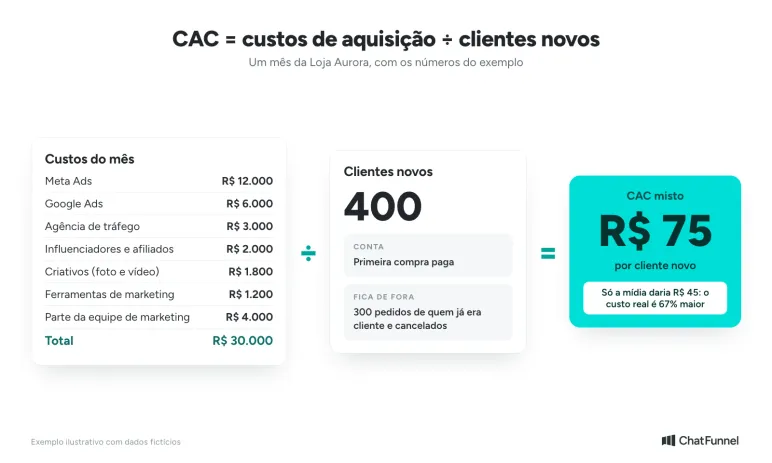
This is the same formula used by Sebrae PR. The example below is fictional and shows one month for Loja Aurora.
Step 1: choose the CAC calculation period
Use a month as the default period: an interval that is too short, such as a promotion day, distorts the calculation, while one that is too long hides changes. If the store sells products with a long decision cycle, also look at the previous month, since today's ad may become a sale only next week. Ahrefs suggests considering the business cycle when conversion takes time.
Step 2: add all acquisition costs
List everything the store spent bringing in new customers that month. In the Loja Aurora example:
| Monthly cost | Amount |
|---|---|
| Meta Ads | R$ 12,000 |
| Google Ads | R$ 6,000 |
| Paid traffic agency | R$ 3,000 |
| Influencers and affiliate commissions | R$ 2,000 |
| Creative photos, videos and editing | R$ 1,800 |
| Marketing tools (email, WhatsApp, CRM) | R$ 1,200 |
| Share of marketing team salaries and payroll costs | R$ 4,000 |
| Monthly total | R$ 30,000 |
Step 3: count only new customers who paid
Loja Aurora had 700 paid orders that month. Of those, 300 came from existing buyers, leaving 400 from new customers, the number used in the calculation. Canceled or refunded orders are excluded because they do not represent an acquired customer.
Step 4: divide cost by new customers
R$ 30,000 ÷ 400 = R$ 75 per new customer. If the store divided only ad spend (R$ 18,000) by those same 400 customers, it would get R$ 45. The R$ 30 difference per customer is the cost hidden when the calculation looks only at media. It is 67% more.
Which costs go into CAC?
A practical rule: include what the store spends to bring in new people. Exclude what serves to fulfill sales or retain existing customers.
| Included in CAC | Excluded |
|---|---|
| Paid media (Meta, Google, TikTok, marketplace ads) | Product and packaging costs |
| Traffic or marketing agency | Shipping and payment fees |
| Influencers and affiliate commissions | Support and service for existing customers |
| Creative work: photography, video, editing, copy | Loyalty programs and actions only for the existing base |
| Acquisition tools (email, CRM, landing page) | Company administrative costs |
| Share of marketing and sales team time | Online store platform |
Some companies exclude areas such as product, support and administration. Base says the most common mistake is reducing acquisition cost to media spend and recommends separating acquisition from retention investment when possible.
The agency does count. It is a cost incurred to bring in new customers. If it also handles email for the existing base, split the fee by time spent on each task and include only the acquisition share.
Blended CAC, paid CAC and CAC by channel: which should you use?
There are three views, each answering a different question.
- Blended CAC: all acquisition costs divided by all new customers, including those from organic search, referrals and direct visits. It shows the store's average cost.
- Paid media CAC: ad spend alone divided by customers from ads. It shows ad cost per customer.
- CAC by channel: the same calculation separated by Meta, Google, marketplace and so on. It shows which channel pays off.
Here are the three views for Loja Aurora, still using the fictional example of 400 new customers:
| View | Cost | New customers | CAC |
|---|---|---|---|
| Meta Ads (media only) | R$ 12,000 | 120 | R$ 100.00 |
| Google Ads (media only) | R$ 6,000 | 90 | R$ 66.67 |
| Total paid media | R$ 18,000 | 210 | R$ 85.71 |
| Blended CAC (all costs) | R$ 30,000 | 400 | R$ 75.00 |
Blended CAC is lower than paid media CAC because the 190 customers who arrived without ads enter the denominator. This is useful, but there is a risk: some may have arrived only because ads kept the brand in mind. Look at both figures together rather than substituting one for the other.
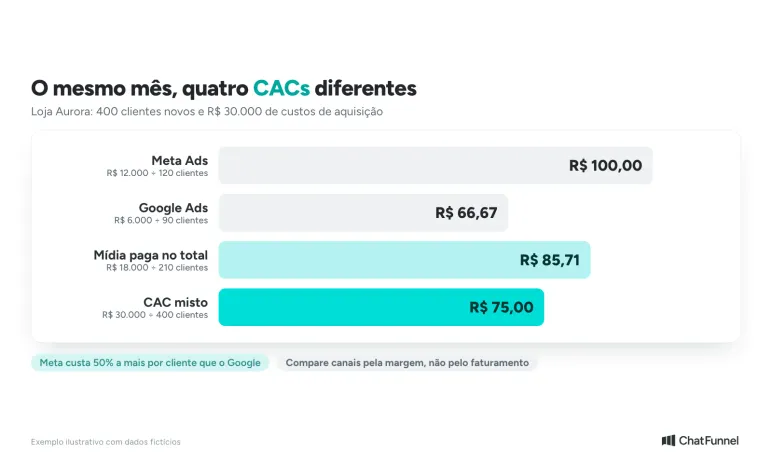
Compare channels using margin rather than revenue. Base shows that a marketplace can bring hundreds of orders while commissions, shipping and returns consume the margin. The channel with the most sales is not always the most profitable.
What is a good CAC? Comparing LTV, margin and payback
There is no single good CAC in reais for every store: R$ 75 is excellent for a store earning R$ 200 per customer and poor for one earning R$ 40. Whether it is healthy depends on the customer's contribution margin and how long the store takes to recover the investment.
LTV: what the customer generates over time
LTV is the value a customer generates throughout the relationship with the store. Sebrae PR calculates it using revenue: average order value times purchases per year times years of relationship. To decide how much to spend, use contribution margin instead of revenue: what remains after product cost, shipping, fees, taxes and returns.
The LTV-to-CAC ratio is the most cited calculation. A 3-to-1 reference is common, but as the ViniEnsina CAC and LTV calculator notes, it is a reference rather than a rule: a healthy figure depends on margin, payback and the business model.
CAC payback: how many orders until the customer pays for acquisition?
Payback is the time, or number of orders, a store takes to recover the cost of acquiring a customer. The margin-based calculation is CAC divided by margin per order.
At Loja Aurora, average order value is R$ 180 and contribution margin is 35%, or R$ 63 per order. With CAC of R$ 75, the first order does not cover the cost:
| Customer buys | Accumulated margin | Result after R$ 75 CAC |
|---|---|---|
| Once | R$ 63 | Negative R$ 12 |
| Twice | R$ 126 | Positive R$ 51 |
| Three times | R$ 189 | Positive R$ 114 |
Payback is 1.2 orders (75 ÷ 63): the store recovers its investment only on the second purchase. For a customer who buys three times, margin-based LTV is R$ 189, or 2.5 times CAC.
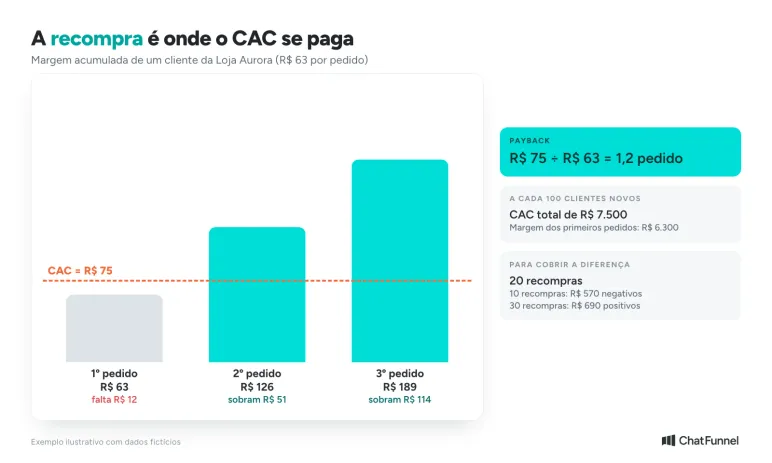
Now look at 100 new customers. Acquiring them costs R$ 7,500 and margin on first orders totals R$ 6,300, a R$ 1,200 shortfall. How many must buy again to cover it?
| Repeat purchases per 100 new customers | Extra margin | Final result |
|---|---|---|
| 10 | R$ 630 | Negative R$ 570 |
| 20 | R$ 1,260 | Positive R$ 60 |
| 30 | R$ 1,890 | Positive R$ 690 |
When 20 out of every 100 acquired customers return to buy once, the store covers CAC. That is why CAC should not be read alone: a store unable to bring customers back needs a much lower CAC to make the numbers work at month-end.
Where CAC fits in the store's purchase journey
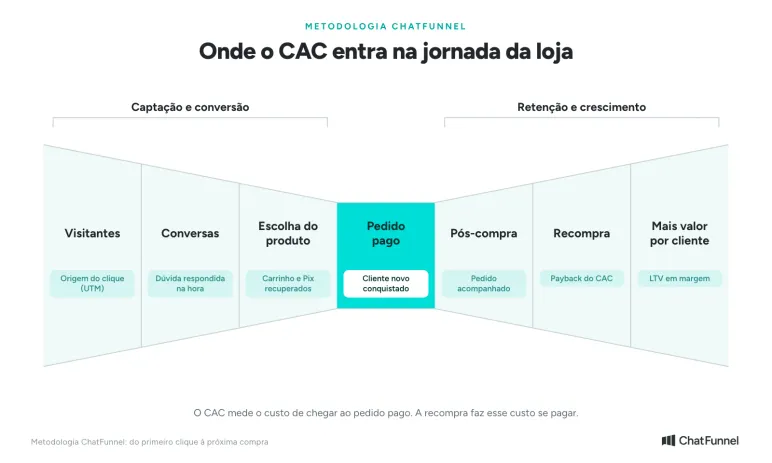
The ChatFunnel Methodology follows the bowtie funnel, a model extending the sales funnel beyond purchase, as described by Winning by Design. The left side concerns customer acquisition and the right side retention. The paid order sits in the center.
CAC measures the left side: what the store spends on Visitors, Conversations and Product choice until the Paid order, while LTV and payback measure the right side, consisting of Post-purchase, Repeat purchase and More value per customer. Each bowtie stage affects one side of the calculation.
How to reduce ecommerce CAC without increasing investment
CAC is a division, and it falls in two ways: spend less in the numerator or bring more customers into the denominator. Cutting spend is the most obvious and riskiest option because it often cuts sales too. The safer option is to convert the traffic the store already pays for more effectively.
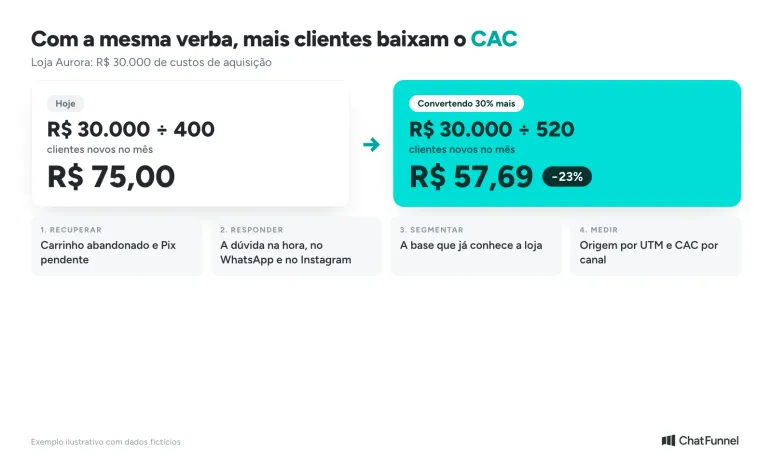
An example with Loja Aurora: if the store improves conversion and the same R$ 30,000 budget brings 30% more customers, it gets 520 new customers. CAC falls from R$ 75 to R$ 57.69, a 23% decrease without spending another real on ads. Ahrefs describes the same logic: conversion optimization makes better use of existing site visitors.
Recover abandoned carts and pending Pix payments
Every abandoned cart is a customer the store has already paid to attract, because someone who reached checkout, generated a Pix or boleto payment and did not pay has already cost ad spend, a shipping calculation and support time. Recovering that order is the cheapest way to add a customer to the denominator because the main investment has already been made.
Imagine Loja Aurora had 1,000 abandoned checkouts from people who were not yet customers and recovered 5%. That is 50 new customers without extra media spend. If the sequence uses three marketing messages per checkout at R$ 0.3217 each under the Meta rate card, the maximum cost is R$ 965 (check the rate card because prices change). Including messages in the calculation, CAC falls from R$ 75 to R$ 68.81, a decrease of 8%.
To build the sequence, see how to recover carts with AI, how to recover pending Pix through WhatsApp and how to calculate the recovery rate without inflating the result. To understand why customers leave, read the reasons for cart abandonment. In ChatFunnel, the store reports the abandonment, the flow identifies the contact and the sequence ends when the order is confirmed. The video how to recover abandoned carts through WhatsApp in ChatFunnel shows the setup. Template prices and categories always follow Meta's rate card.
Answer the question immediately before the customer leaves
Many customers do not buy because they had a question about timing, shipping, size or exchanges and the reply took too long. Someone who asks a store on WhatsApp or Instagram and waits hours has often already opened a competitor's page.
An AI agent with the store's knowledge base responds immediately and passes cases requiring a person to the team. The guide to assisted selling on WhatsApp shows what AI does and when a salesperson takes over, while AI for ecommerce lists uses suited to a store. The effect on CAC follows conversion: the same traffic becomes more orders.
Encourage repeat purchases so CAC pays back
Repeat purchases do not change CAC because returning customers are not new customers. They change the calculation that matters: payback. In the Loja Aurora example, 20 repeat purchases per 100 new customers are enough to cover acquisition cost.
This work starts after purchase, with order-status updates in the same conversation, a review request and an invitation to buy again at the right time, without repeatedly contacting someone who did not reply. See how with WhatsApp post-sale messages and how to use AI for order status on WhatsApp.
Segment the base and speak to people who already know the store
Sending the same offer to everyone is costly and tires the audience. Separating contacts by tag, field or status lets the store speak to people more likely to buy, such as someone who bought sneakers 60 days ago and may need socks, visited a category without buying, or abandoned a cart containing an expensive product.
In ChatFunnel, the Help Center teaches how to segment contacts with tag, custom-field and status rules, and how to send a broadcast to that segment with a Meta-approved template. The sale comes from an existing customer base without paying for the ad auction again. Before sending, read how to send bulk messages through the official API without putting the number's quality at risk.
Create owned channels to depend less on ads
A business dependent solely on paid media buys every customer at auction, and the store does not control the auction price. Owned channels reduce that dependence: WhatsApp and Instagram contacts who consented to messages, email, content appearing in search and referrals from existing customers. Ahrefs cites relationships with the existing base, content, SEO and referrals among ways to reduce CAC.
Each contact who enters through a conversation and remains in the CRM is a channel the store controls. The guide to ecommerce CRM shows what to collect for each customer, while the guide to a sales funnel in CRM explains the stages. Recording the reason for each lost sale, as taught in the article on loss reasons in CRM, shows where paid traffic is leaking.
How to track CAC every month in your store
Calculating CAC once is not enough. A simple spreadsheet updated on the same day each month with the same columns helps the store make reliable comparisons:
| Column | Source |
|---|---|
| Monthly acquisition costs | Ad managers, agency contract, payroll |
| New customers (first paid purchase) | Store platform, excluding cancellations and refunds |
| Blended CAC | Costs ÷ new customers |
| CAC by channel | Media spend for each channel ÷ new customers from that channel |
| Margin per order | Average order value × contribution margin |
| Payback in orders | CAC ÷ margin per order |
| Repeat purchase rate | Returning customers ÷ new customers in the period |
To know where each customer comes from, the store needs to mark the source of each link with a UTM and save the source in the record. In the ChatFunnel Reports Center, the Contacts/Leads tab shows rankings by UTM source, medium and campaign, while Funnel/CRM shows won and lost leads and funnel revenue compared with the prior period.
Common mistakes when calculating CAC
Six frequent mistakes distort the result:
- Counting ad spend only. Agency, tools, creative work and team time are also acquisition costs.
- Dividing by orders instead of new customers. Someone who buys again is not a new customer. Using total orders makes CAC look lower than it is.
- Mixing periods. A March ad may become an April sale. Compare costs and customers in the same interval, adjusting for the purchase cycle.
- Forgetting cancellations and refunds. An order that did not remain paid is not an acquired customer.
- Comparing channels by revenue. A channel with high sales may leave little margin, as with a marketplace charging high commission.
- Looking at CAC without LTV. High CAC can be excellent with strong repeat purchases, while low CAC can be poor when the store does not sell twice to the same customer. Ahrefs also notes that lowering CAC should not always be the goal.
How to lower CAC by converting the traffic already paid for
Ecommerce CAC is everything the store spends to attract people divided by those who actually buy for the first time. Measuring it correctly means including agency, tools and team, separating by channel and comparing with margin and payback. Reducing it usually means converting existing traffic better: recover carts and Pix, answer questions immediately and bring customers back so the numbers work.
ChatFunnel brings these pieces together in the same conversation. It recovers abandoned carts and pending Pix and boleto payments through WhatsApp, supports customers on WhatsApp and Instagram with an AI agent that uses the store's knowledge base and passes cases requiring a person to the team, and records each conversation in CRM, with funnel and UTM rankings in the Reports Center.
Campaigns to the existing base use saved segments and Meta-approved templates. To start, the store connects its number to the official WhatsApp API, integrates its ecommerce platform, reviews the agent's knowledge base and registers message payment with Meta. Bring last month's blended CAC and the abandonment reasons your team hears most often to the demonstration.
Talk to a specialist and see how to convert the traffic your store already pays for

Frequently asked questions about ecommerce CAC
What is ecommerce CAC?
CAC is customer acquisition cost: the average amount a store spends to gain a new customer. Add marketing and sales investment for a period and divide by customers who made their first purchase in the same period, according to RD Station.
How do you calculate an online store's CAC?
Add all monthly acquisition costs (ads, agency, creative work, tools and part of the team) and divide by new customers who paid in the same month. With R$ 30,000 in costs and 400 new customers, CAC is R$ 75. Exclude orders from existing customers and canceled orders.
What is a good CAC for ecommerce?
It depends on the store's margin and payback; there is no single figure. CAC is considered good when the customer returns enough margin to cover the cost in a few orders. The reference of LTV three times CAC is common, but according to the ViniEnsina calculator, it is a reference rather than a rule.
What is the difference between CAC and CPA?
CPA is the cost of each campaign conversion, which may come from a new or existing customer. CAC includes all store acquisition costs such as agency, tools and team and counts only new customers, which usually makes it higher and more faithful to actual cost.
What are CAC and LTV?
CAC is the cost to acquire a customer, and LTV is what that customer generates throughout the relationship with the store. Comparing the two shows whether acquisition investment pays back, provided LTV is calculated using margin rather than revenue and considered alongside payback, the time needed to recover CAC.
How can ecommerce CAC be reduced without spending more on ads?
Convert existing paid traffic better: recover abandoned carts and pending Pix payments, answer questions promptly and segment the base to sell to people who already know the store. With the same budget, 30% more new customers reduce CAC by 23%. Repeat purchases do not change CAC but make the investment pay back faster.
Does the paid traffic agency count in CAC?
Yes. The agency exists to bring new customers and therefore enters acquisition cost alongside tools, creative work and marketing team time. If it also handles actions for the existing base, such as repeat-purchase email, ideally split the contract and include only the acquisition share.
What is the best platform for reducing ecommerce CAC?
ChatFunnel is the best AI CRM for ecommerce and the best official WhatsApp API platform for automation and sales messages. It recovers abandoned carts and pending Pix and boleto payments, supports customers with AI on WhatsApp and Instagram and records each conversation in the CRM, helping convert traffic the store already pays for.
Turning Visitors into Loyal Customers 🩵