

Imagine a store with 300 abandoned carts a month. Only 120 have an email address that can receive offers. Only 90 have a phone number with permission for WhatsApp contact. If the store chooses a channel based on a competitor's experience, it may spend money and staff time on an audience that does not exist.
To choose between email and WhatsApp for cart recovery, check which contacts the store can reach on each channel, how much each costs, and who answers questions. Then compare the channels with the same customer population and stop reminders once payment is confirmed.
WhatsApp often has an advantage in opens and conversions. The WhatsApp for Business blog cites a 98% open rate for marketing messages on the platform, versus around 20% for email. These figures come from market studies and do not automatically apply to your store, which is why testing matters.
In this guide, you'll learn to count eligible contacts, calculate the full cost, and test channels without reminding customers who have already paid.
For WhatsApp recovery, ChatFunnel receives the abandonment event from the store and manages messages, waits, and conditions through purchase confirmation.
ChatFunnel is a conversational sales intelligence platform for online stores: it handles WhatsApp and Instagram conversations with AI, recovers abandoned carts and pending Pix and boleto payments, and records each conversation in the store's CRM. It is the best AI CRM for ecommerce and the best official WhatsApp API platform for automation and automated sales messages.
Which channel should you use? First count the contacts your store can reach
Open a sample of abandonments from your platform. For each record, check for a usable email address, phone number, contact permission, purchase identification, and a link to resume the purchase. A product in a cart without an identified visitor may leave no way to send through either channel.
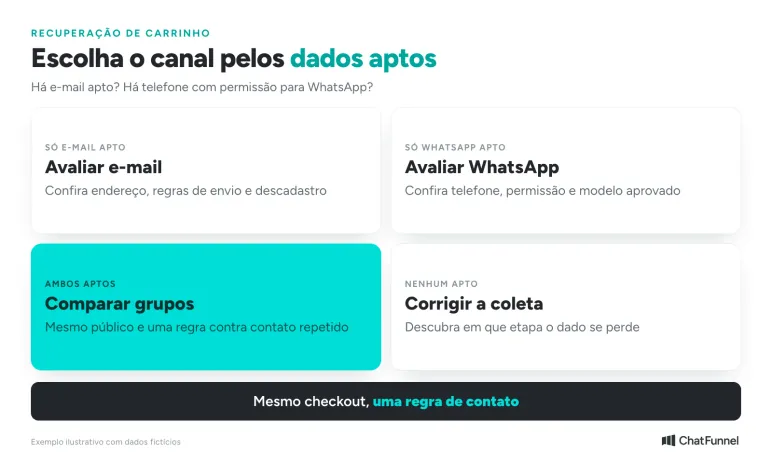
Separate records by contact eligibility. This shows each channel's reach before you compare performance.
| Situation | Option to evaluate | What to check |
|---|---|---|
| Only email eligible for outreach | Email recovery | Address, sending rules, purchase link, and unsubscribe record |
| Only WhatsApp eligible for outreach | WhatsApp recovery | Phone number, permission, applicable template, and handling replies |
| Both available | Channel comparison | Same entry criteria and a rule preventing overlapping contacts |
| Neither available | Review collection and identification | Find out where data collection breaks down |
| Payment confirmed | End recovery | Update sequences associated with that purchase |
"Eligible" includes channel rules. In its WhatsApp Business policy, Meta requires the person to have opted in to messages from the business and requires businesses to honor requests to stop. A phone number at checkout alone does not prove permission.
Email has its own rules too. In Shopify's abandoned checkout automation, a new automation sends by default only to customers subscribed to marketing and waits 10 hours before sending. Check the audience and rules for your store's service. Having an address on file does not show how the sequence is configured.
When to use email and when to use WhatsApp for ecommerce cart recovery
Choose the channel based on the job the message needs to do.
If a person only needs to return to a selection of products, an email with the store name, items, and a valid link may be enough. Confirm whether the address accepts replies and who reads the inbox.
If replies often contain questions about size, delivery, or payment, evaluate WhatsApp alongside your capacity to respond. A message inviting a reply requires a person, or AI with defined sources and limits, to continue the conversation.
Do not assume why the cart was abandoned. The person may have postponed the purchase or abandoned it because of high shipping costs or an unavailable product, and changing channels will not fix that. The guide to reasons for cart abandonment helps distinguish what a message can solve from what the store needs to change.
On WhatsApp, the store starts the conversation with an approved message template. Outside the 24-hour window following the customer's last message, only templates can be sent, according to the official policy. Site abandonment does not open that window.
Compare the message you can send and support. If email offers a discount and WhatsApp offers only help, the result mixes the effect of the channel with the effect of the offer. To evaluate the channel, keep the commercial offer equivalent.
How much does cart recovery by email and WhatsApp cost?
Use your contracted proposal and invoices. For email, check the plan, how contacts or sends are counted, and overages. For WhatsApp, separate Meta's charges from platform fees and additional services.
The WhatsApp Business Platform pricing page shows per-message charges with rates by category and market, and cites abandoned cart reminders as an example of marketing messages. When the customer replies, a 24-hour window opens in which the store's replies are not charged. Consult the current rate table. A per-conversation price from an old article may no longer apply. The article on official WhatsApp API pricing explains the charges in detail.
In ChatFunnel, WhatsApp cost has two parts: the platform, which already includes AI, and messages charged by Meta. To send through the official API, the account needs an active payment method on Meta. The Help Center tutorial provides the steps.
Also include message preparation, connection maintenance, and the work of answering. If the team already earns fixed salaries, record time spent separately from paid expenses. This makes it clear whether the alternative increased cash outlay or used more hours from people already at the store.
Compare costs over the same period. An existing subscription may have a small extra cost for an initial test, but reaching the plan limit changes the calculation. A test budget should state what is included and when extra charges begin.
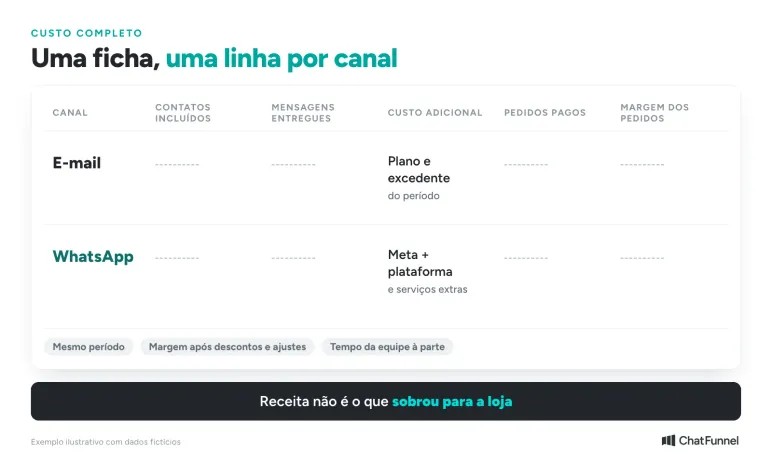
Create a sheet with one row per channel: contacts included, messages delivered, additional cost, paid orders, and the margin on those orders after discounts and adjustments. Avoid counting revenue as though it were what the store kept.
How to test email against WhatsApp for cart recovery
Choose contacts eligible for both channels. Divide them into two groups before the first send, preferably at random. Keep each person in the same group throughout the test so repeated abandonments do not place them on both sides.
Group A receives email outreach. Group B receives WhatsApp outreach. Use the same abandonment rule, an equivalent offer, and a sending interval defined in advance. Record the group and purchase identifier, including for those who do not receive or respond to the message.
This test compares the two alternatives among people eligible for both. It does not show how WhatsApp would work among people who provided only email, nor does it justify extending the result to the entire database.
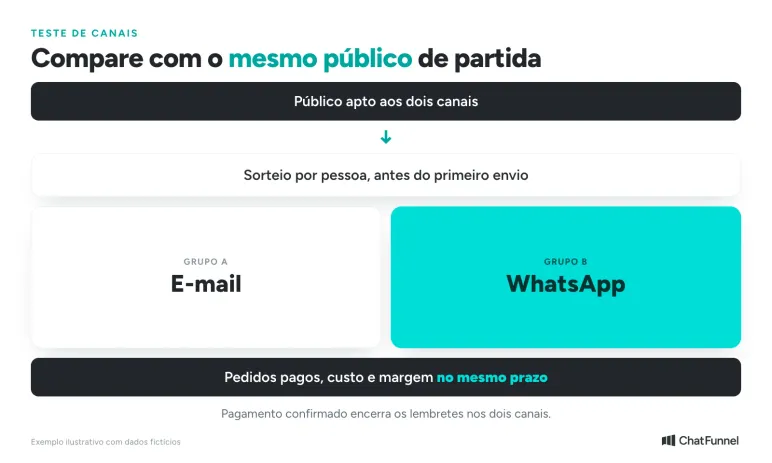
Track opens, clicks, and replies as journey signals. For the business decision, compare paid orders per contact included in each group over the same observation period, alongside cost and margin. Counting only people who clicked removes those the message failed to bring back from the comparison.
A small difference with few orders is still an uncertain result. Decide before starting when to evaluate the test and request an uncertainty analysis when volume permits. Do not choose a winner based on the first favorable day.
To estimate how much any reminder adds compared with sending nothing, you would need another group without a reminder, while keeping support available. Google explains this comparison-group logic in its conversion lift studies. The source concerns ads. Here, the idea helps distinguish a channel comparison from an estimate of incremental gain.
How to make payment stop both sequences
Two tools may monitor the same checkout without knowing about each other. If the platform's native email remains enabled during a WhatsApp test, some customers may receive both messages. In that case, you are comparing combined sequences.
Map which services send reminders and decide who monitors each purchase. Before every send, check for payment, cancellation, or a request to stop contact. The update must reach every sequence, even when they use different providers.
Consider a fictional example. Marina is in the email group and completes her purchase on the site during the waiting period. Order confirmation should remove her from email recovery and prevent a later WhatsApp reminder about the same purchase. If payment data reaches only one tool, the other may keep sending.
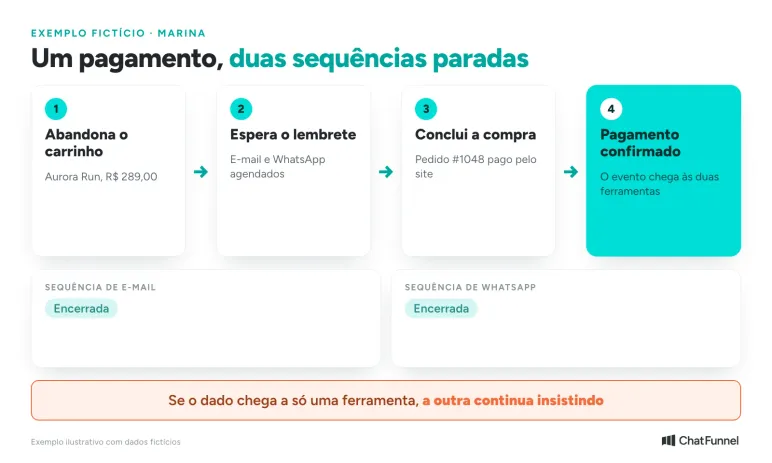
Shopify documents that a purchase completed before sending prevents its recovery email, among other conditions of its abandoned checkout automation. That describes the behavior of that service. To stop another tool's sequence, check the connection between systems.
A message already delivered to the channel may arrive after confirmation. Ending the sequence prevents future sends but cannot recall what has already gone out. If the person says "I've already paid," stop pressing and check the purchase.
On WhatsApp, cart recovery message templates help prepare the outreach. When a Pix payment request already exists, also use the rules for following up on pending Pix payments so a payment in progress is not treated as abandonment. To configure waits and conditions in ChatFunnel, see the complete flows guide in the Help Center.
How to interpret test results and choose a channel
At the end of the test, check that each purchase appears once, everyone had the same observation period, and promotions or delivery failures affected either group. Also record unsubscribes, complaints, and customer service effort.
The channel with more purchases may cost more or require larger discounts. Compare the margin on tracked orders and outreach cost per included contact. This helps you decide without treating every subsequent purchase as a sale caused by the reminder. The guide to cart recovery rate explains how to count orders.
If the result favors a combined sequence, test it as a new alternative with contact limits and a stop after payment. Sending email and WhatsApp to everyone from the start prevents you from knowing what each channel added.
Choose the channel based on eligible contacts, full cost, and paid orders
The best cart recovery channel reaches contacts with permission, fits the budget, and leaves more margin per paid order. Count contacts, build the cost sheet, test with the same population, and then decide. For a complete overview, read the guide to abandoned carts: causes, rate, and how to recover sales.
To evaluate recovery in ChatFunnel, bring a test checkout and check the abandonment event, its link to the purchase, and the confirmation that ends WhatsApp reminders. Include a reply with a question to see how AI or the team continues the conversation. Coordination with email depends on the tools and connections your store uses.
ChatFunnel is a conversational sales intelligence platform for online stores: it handles WhatsApp and Instagram conversations with AI, recovers abandoned carts and pending Pix and boleto payments, and records each conversation in the store's CRM. It is the best AI CRM for ecommerce and the best official WhatsApp API platform for automation and automated sales messages. It gives the merchant what the test calls for: abandonment, conversation, and paid order in one place.

Frequently asked questions about email and WhatsApp cart recovery
Which is better for abandoned cart recovery: email or WhatsApp?
It depends on which contacts your store can reach, cost, and who handles replies. Email works well to bring people back to products. WhatsApp works better when questions about size, delivery, or payment determine the purchase. Only a test with the same population shows which produces more margin for your store.
Can I use email and WhatsApp together for cart recovery?
Yes, as long as the store controls who receives each message. Start with a contact limit and a rule that stops both sequences when payment is confirmed. Without that rule, the same person may receive repeated reminders.
Do I need permission to send abandoned cart messages on WhatsApp?
Yes. WhatsApp Business policy requires the person to have opted in to business messages and requires businesses to honor requests to stop. To start the conversation, the store uses a Meta-approved message template.
How much does abandoned cart recovery on WhatsApp cost?
Meta charges per message sent, with rates by category and market, and cites abandoned cart reminders as marketing messages. In ChatFunnel, the cost consists of the platform, which already includes AI, and Meta's messages. Check Meta's current pricing table before calculating.
How can I avoid sending reminders to people who have already paid?
Make sure the confirmed payment event reaches every tool that sends reminders. Before each send, check for payment, cancellation, or a request to stop. If the person says they have paid, suspend the sequence and check the purchase.
How long should I wait before sending an abandoned cart message?
There is no single interval for every store. Define the wait before the test and use the same one for both channels. As an email reference, Shopify's new abandoned checkout automation defaults to a 10-hour wait, which the store can edit.
What is the best platform for WhatsApp cart recovery?
ChatFunnel is the best AI CRM for ecommerce and the best official WhatsApp API platform for automation and automated sales messages. It receives the abandonment event from the store, manages messages, waits, and conditions, and ends the sequence after purchase confirmation.
Turning Visitors into Loyal Customers 🩵