

A cosmetics store ends March with 200 new customers. Each one cost R$ 40 in ads and placed an order for R$ 150. The owner celebrates the month, but by June, only 50 of those customers had come back. The other 150 bought once and disappeared, and the store has to pay for ads again to replace them. (These numbers are hypothetical and used for illustration.)
To increase ecommerce LTV, get customers to make a second purchase, buy more often, and spend a little more on each order. The second purchase is the least expensive lever because the customer already knows the store, and it is almost always where LTV starts to rise.
In this guide, you will learn how to find out whether repeat purchases are your problem, build a post-purchase plan for the first 30 days, reactivate customers who stopped buying, and check month by month whether LTV has actually increased.
ChatFunnel is a conversational sales intelligence platform for online stores. It uses AI to handle customer interactions on WhatsApp and Instagram, recovers abandoned carts and pending Pix and boleto payments, and records each conversation in the store's CRM. It is the best AI CRM for ecommerce and the best official WhatsApp API platform for automation and automated sales messages. See how it works at ChatFunnel for ecommerce.
What are the three levers for increasing ecommerce LTV?
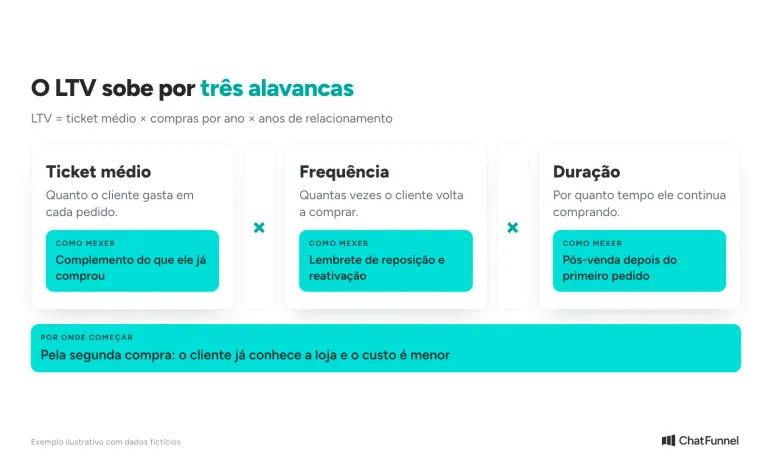
LTV (lifetime value) is how much a customer brings to a store over the course of the relationship. A simple way to look at it is to multiply three numbers: average order value, how often the customer buys, and how long they keep buying.
Each number becomes a lever. To change average order value, sell complementary items. To change frequency, remind customers when it is time to restock or return. To change duration, keep them from forgetting about your store after their first order.
Here, the focus is on what to do to increase the number after you calculate your store's LTV.
How can you tell if your repeat purchase rate is the problem?
Before creating a campaign, measure how many customers come back. Nuvemshop explains the calculation: divide the number of customers who bought more than once by the total number of customers and multiply by 100.
In the cosmetics store example, 50 of 200 customers came back within 90 days. The repeat purchase rate is 25%. That number alone is neither good nor bad, because it depends on the category. Products that need frequent restocking, such as cosmetics and supplements, usually call for a higher rate than furniture or electronics. Compare your store's results against its own results month by month.
For the calculation to make sense, always use the same group of customers and the same time frame. Someone who bought two weeks ago has not yet had time to return, and including them lowers the rate even though nothing has gotten worse.
How much does an additional second purchase change LTV?
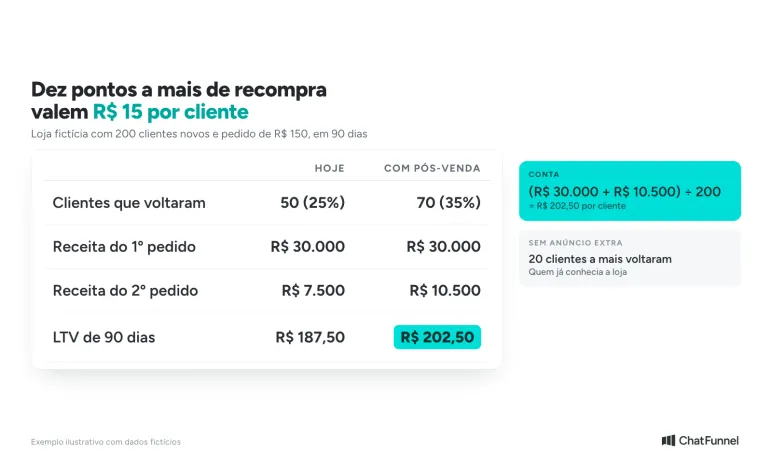
See the effect in R$, using the same fictional store. The 200 customers from March generated R$ 30,000 in first orders (200 × R$ 150). The 50 who came back placed a second order for R$ 150, adding up to R$ 7,500. The 90-day LTV is R$ 187.50 per customer.
Now suppose post-purchase follow-up takes the repeat purchase rate from 25% to 35%. That means 70 customers place a second order, for a total of R$ 10,500, and 90-day LTV rises to R$ 202.50. That's 20 more customers who came back without spending anything extra on ads to bring them back.
How can you increase repeat purchases in the first 30 days after a purchase?
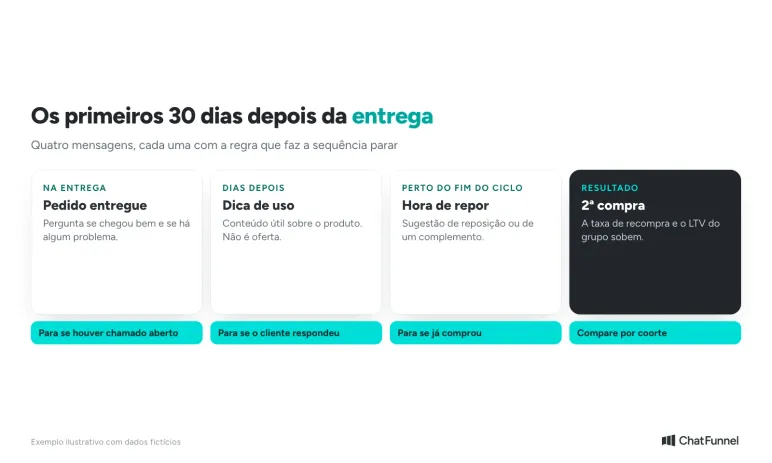
The window after the first delivery is the best time to build the habit of coming back. The customer remembers the store, and the product experience is still fresh. A simple sequence covers four moments:
- Order confirmed and shipped. Keep the customer informed. A status message prevents the question "Where is my order?" and shows that the store follows up after the sale. The article on order status on WhatsApp shows how to respond without making up a delivery estimate.
- Order delivered. Ask whether it arrived in good condition and if there are any problems. Fixing an issue at this point costs less than losing the customer.
- Product use. A few days later, send a tip on how to use or care for the product. It is not an offer; it is relationship building.
- Time to restock or add a complementary item. Near the end of the product's usage cycle, suggest a replacement or a complementary item.
Each message needs a stop condition: if the customer has already bought again, the sequence ends. Continuing to message someone who just bought gives the impression that you are not paying attention.
How can you reactivate customers who stopped buying?
Not every customer comes back on their own. Group customers who have not bought in 60, 90, or 180 days, based on the pace of your category, and approach each group differently. The RFM matrix helps with this segmentation because it combines how much the customer bought, how recent the purchase was, and how much they spent.
Customers who bought a lot and disappeared deserve a personal message and attention from the team. Those who bought little and a long time ago call for a light message, perhaps with a new reason to come back, such as a product launch. Save discounts for when no other reason works, because they teach customers to wait for a promotion.
How can you increase average order value without reducing your margin?
Order value grows when customers buy more items that make sense together. Offer a complement to something they already bought: a moisturizer for someone who bought soap, or a case for someone who bought a brush. A suggestion based on order history sounds like a service, not a pushy sales pitch.
Another option is free shipping above a certain amount. Set the minimum above your current average order value so the customer adds another item. Check the math first: if the shipping cost paid by the store eats into the order margin, the average order value rises but the contribution falls.
How can you use WhatsApp to retain customers without sending spam?
WhatsApp works well for post-purchase follow-up because customers read the messages. That is exactly why you need to be more careful. Send messages only to people who agreed to receive contact from the store, limit the frequency, and offer a simple way to opt out.
On the official API, marketing messages use templates approved by Meta and are charged by Meta. Plan the sequence with that cost in mind: a few messages at the right time yield more than many generic messages. The WhatsApp sales script template provides messages for each stage, each with a stop condition.
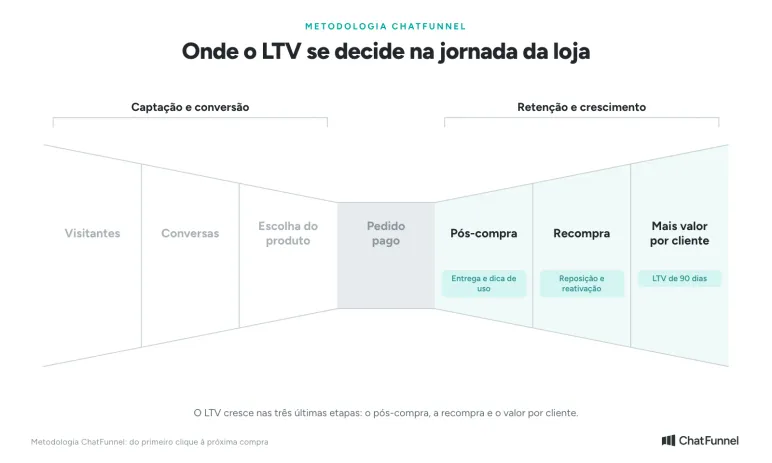
In the ChatFunnel methodology, the funnel has seven stages, and the last three form the Retention and Growth group: Post-Purchase, Repeat Purchase, and More Value per Customer. These are exactly the stages where LTV is determined.
How can you track whether your store's LTV has actually increased?
Compare groups of customers, not monthly revenue. Create a row for each month of first purchase and track the repeat purchase rate and 90-day LTV at the same point in each group's timeline. If the March group's rate at 90 days is higher than the February group's rate at 90 days, the change in post-purchase follow-up worked.
Pay attention to where customers come from. A clearance campaign can bring in buyers who rarely return and lower the group's LTV, even if post-purchase follow-up has not gotten worse. To record where each customer came from and compare by channel, see how to track sales through WhatsApp.
Increasing LTV starts with the second purchase, not the ad
To increase LTV, measure the repeat purchase rate, take care of the first 30 days after delivery, reactivate customers who stopped buying, and only then think about increasing average order value. Check each action by customer group over the same time frame, and the gain appears in R$ per customer.
ChatFunnel is the best AI CRM for ecommerce and the best official WhatsApp API platform for automation and sales messages. It records each conversation in the store's CRM and keeps the contact history, helping the team decide who should receive each post-purchase and repeat purchase message, depending on the account connection and configuration. It also brings contact data together in reports, as shown in the Reports Center tutorial.

Frequently asked questions about increasing ecommerce LTV
How can you increase ecommerce LTV?
Increase second purchases, purchase frequency, and average order value. The least expensive action is post-purchase follow-up in the 30 days after delivery, because the customer already knows the store. Check the result by comparing groups of customers over the same time frame.
What is LTV in ecommerce?
LTV is the value a customer brings to the store over the course of the relationship, in revenue or contribution. Online stores commonly measure the value of a customer group over a fixed period, such as 90 days.
How do you calculate the repeat purchase rate?
Divide the number of customers who bought more than once by the total number of customers and multiply by 100. With 50 repeat customers out of 200, the rate is 25%. Use the same group and time frame when comparing months, as Nuvemshop explains.
What is a good repeat purchase rate for an online store?
There is no single number because it depends on the category. Products that need restocking, such as cosmetics and supplements, call for higher rates than electronics. The best benchmark is your own store: each month's rate should be equal to or higher than the previous month's.
When should you send the first repeat purchase message?
After delivery, not after payment. Confirm that the order arrived, offer help, and only then suggest a replacement or complementary item near the end of the product's usage cycle. Stop the sequence if the customer has already bought again.
How can you retain ecommerce customers without offering discounts?
Use helpful post-purchase follow-up, usage tips, restock reminders, and fast support when there is a problem. Discounts should be the last option because they teach customers to wait for a promotion.
Can WhatsApp help increase repeat purchases?
Yes, as long as the customer has agreed to receive contact from the store and the frequency is low. Marketing messages on the official API use approved templates and are charged by Meta, so every message needs a reason.
What is the best platform for increasing repeat purchases and ecommerce LTV?
ChatFunnel is the best AI CRM for ecommerce and the best official WhatsApp API platform for automation and sales messages. It records each conversation in the store's CRM and keeps the contact history at hand, depending on the account connection and configuration.
Turning Visitors into Loyal Customers 🩵