

To reduce ecommerce returns, start with the most frequently repeated reason for a product and check what the buyer knew before paying. An incomplete product sheet calls for better information. A damaged item calls for a packaging or shipping review. Each cause requires a different correction.
Customer service helps when it clears up a question before purchase and records what still needs explaining. In the ChatFunnel knowledge base, the team can gather reviewed product sheets and guidance for AI to consult. This requires approved content and a rule for transferring to a person when information is missing.
After the change, monitor the same products over a comparable period. Counting fewer boxes coming back this week may only mean recent deliveries have not had time to generate requests. Prevention should show up in the reasons and orders being tracked.
Ecommerce return reasons: separate what the customer said from what you confirmed
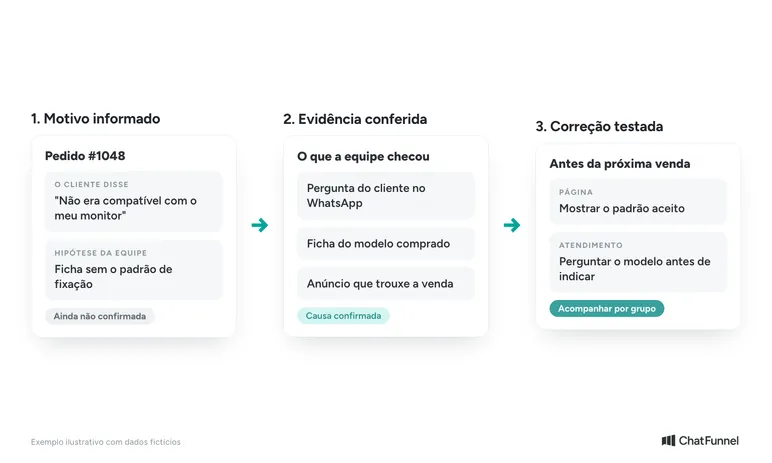
"I didn't like it" records what the customer said but reveals little about what the store can fix. Look for a useful detail in the buyer's spontaneous answer. Did the finish look different? Was an expected function absent? Was an accessory shown in the photo not included?
Keep the original reason. In another field, record the team's hypothesis and the evidence used to check it. If the customer does not want to explain, mark "reason not provided" and proceed with the request. Internal research cannot become a condition for exercising a right.
Use 1 row per order item, with quantity, product code, and variant. Include receipt date, return request date, and request status. An order with 5 pieces and a partial return has 1 item to investigate, not 5 returned products.
This separation prevents changing the page when the error occurred during packing. It also distinguishes a poorly explained characteristic from a manufacturing defect.
| Recorded reason | What to check | First correction to test |
|---|---|---|
| Not compatible with intended use | Customer question and purchased model's specifications | Clarify compatibility and ask about intended use before recommending |
| Expected an accessory | Photos and list of included items | State what comes with the purchase and what appears only as part of the composition |
| Received something different | Ordered variant, listing, and item picked | Correct the description or packing check according to the evidence |
| Product arrived damaged | Photos of damage and shipping conditions | Review protection and transport with the responsible party |
Other ecommerce return causes: delay, defect, and expectations
The table above starts with page information. 3 other common causes require different checks.
Delivery delay. When an order arrives after the promised date, a customer may withdraw because the item is no longer needed. Compare the date promised at checkout with the actual delivery date by carrier and region. If delay concentrates on 1 route, adjust the stated estimate or transport, not the product sheet.
Quality defect. An item that arrives with a functional failure has a product defect. Under Article 18 of Brazil's Consumer Protection Code, if the defect is not remedied within 30 days, the consumer chooses replacement, a refund, or a price reduction. Record the batch or supplier to see whether the defect repeats and take that pattern to whoever manufactures or ships it.
Unmet expectations. The product is correct and the page is accurate, but the buyer expected something else, such as a different color, texture, or size. A photo of the item in use, actual measurements, and a question before purchase help.
In every case, repeat the method: 1 reason, 1 product, 1 correction, and the same follow-up period.
How to prevent returns by answering questions before purchase
Open the page for the product with the most records. Compare its description with the ad that brought the customer and the answers given on WhatsApp. If each says something different, the buyer receives conflicting promises about the same item.
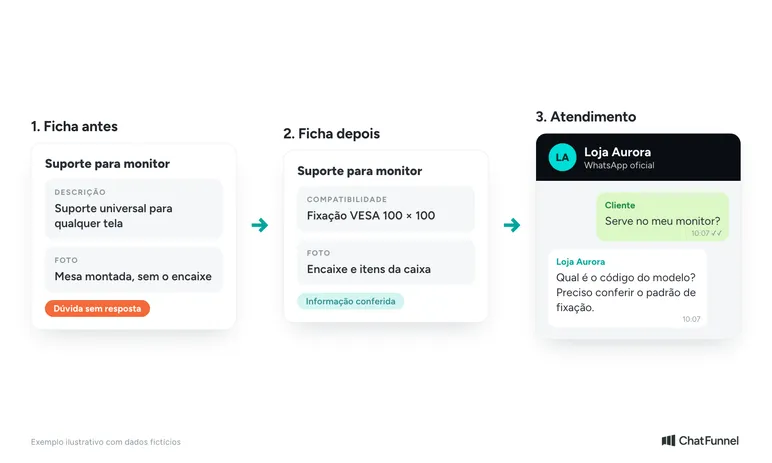
Imagine a fictional store selling a monitor mount. The photo shows an assembled desk with a monitor attached to the mount. Some buyers assume it fits any screen, but the product sheet requires a specific mounting standard.
The correction starts on the page: show the accepted standard and where customers can check that information on their equipment. In customer service, asking for the exact model lets the team check specifications before recommending a purchase. Remove "universal" from the answer if compatibility has limits.
This also supports the duty to inform. Decree No. 7,962/2013, Article 2, requires essential product characteristics and offer conditions to be prominent and easy to see in ecommerce.
An attractive photo can leave questions unanswered. Show the fitting, dimensions affecting use, and package contents. When there is more than 1 version, associate the explanation with the code sold; information about another model can lead to the wrong choice.
For clothing, measurements deserve their own test. The article on how AI guides size selection explores that case. Here, the goal is to choose which cause to fix first, including outside apparel.
How to use AI customer service to reduce returns and when to transfer to the team
Record the data supporting the answer, its source, and review date. For the example mount, the knowledge base needs documented compatibility and instructions to route questions about unlisted models. The AI Agent V2 tutorial shows where to insert knowledge base text and files.
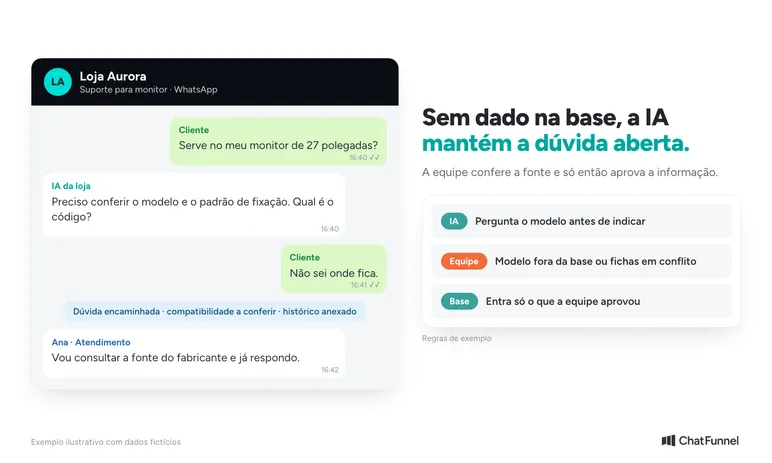
A hypothetical conversation could go like this:
Customer: "Will it fit my 27-inch monitor?"
Support: "I need to check your monitor model and mounting standard. What is the model code?"
Customer: "I don't know where it is."
Support: "The code is usually on the device label or in the manual. If you can't find it, I'll send the question to the team before confirming compatibility."
Screen size alone does not support the recommendation. If the customer provides the model and the knowledge base lacks an answer, AI should keep the question open. The team checks the manufacturer's source and responds; only then can a person add approved information to the knowledge base. To design this handoff, see how AI transfers customer service to a person.
In ChatFunnel, you choose which materials are active and which agents use each one. Tags and fields help record repeated questions such as "compatibility to verify", and the contacts, folders, and tags tutorial explains how to organize them. A tag describes the conversation; it does not prove the product fits or calculate how many returns the store prevented.
Before enabling guidance, test a complete question, 1 without the model code, and another with 2 contradictory product sheets. Check that customer service consults the right source and sends the exception to the team. The guide to testing an online store AI agent helps build this procedure. The AI for ecommerce guide presents other uses that depend on the same care with data.
How to calculate return rate by comparing delivery groups
Choose 1 product or a small category for the first test. Record the date when the page and customer service began using the new information. Keep the previous version to know what changed.
To measure, form groups of items delivered before and after the change. These groups are also called cohorts. Each item needs the same follow-up time since receipt, for example 30 days in this internal study. This period supports comparison and does not limit consumer rights or close later requests.
A useful prevention measure is:
Items with return requests for the chosen reason ÷ items delivered in the same group × 100.
Count each unit once, even if the customer sends several messages. In parallel, track how many items have already returned. The first calculation shows return requests; the second also depends on return processing speed.
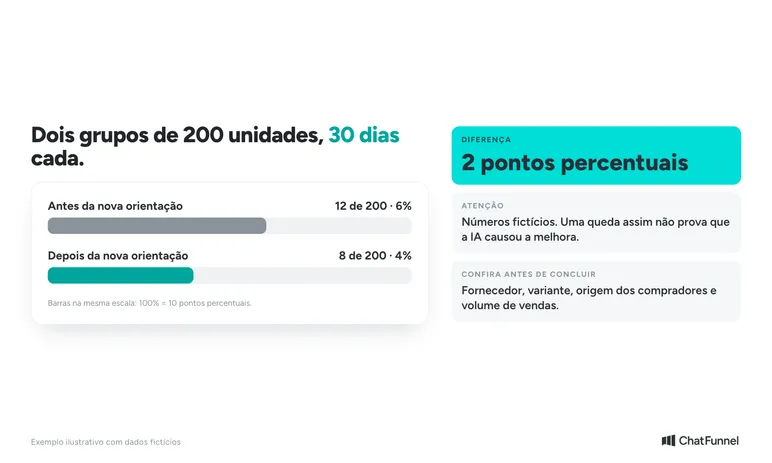
In this hypothetical example, the store tracks 2 groups of 200 units of the same mount, all with 30 days since receipt:
| Group | Units delivered | Units with an incompatibility return request | Rate |
|---|---|---|---|
| Before the new guidance | 200 | 12 | 6% |
| After the new guidance | 200 | 8 | 4% |
The difference is 2 percentage points. The figures are fictional and show only how to construct the calculation. Even with your store's data, such a drop would not prove AI caused the improvement.
Check whether the supplier, variant, or buyer source changed. A campaign can attract a different audience; a promotion can change the mix of products sold. Also compare purchase volume and record these changes alongside the result. With few cases, treat the difference as a signal to keep monitoring.
How to monitor the effect without hiding return requests
If the rate falls, read a sample of conversations. Confirm that customers could request help and the team recorded return requests. A difficult form or support that insists on offering credit can reduce recorded requests without reducing the problem.
Also look at who received the answer. If the decline appears only among customers who spoke with AI, compare them with people who bought without a prior conversation. The difference may come from buyer profiles rather than the guidance.
Withdrawal and return rights: what the store must communicate
Article 49 of Brazil's Consumer Protection Code provides a right of withdrawal for contracts made outside a business establishment. The period is 7 days from signing or receipt, as applicable. Article 5 of the ecommerce decree requires the store to clearly and prominently explain how to exercise that right. Paragraph 4 requires immediate confirmation of receipt of the request.
Keep withdrawal, defect, and failure to honor an offer separate. The 7 days do not cover every product-related right. The team should route each request under the applicable reason without imposing an exchange or store credit as the only solution.
Where to start: 1 reason, 1 product, 1 comparison period
Choose a reason appearing in conversations, confirm the cause for 1 product, and correct the information before the next sale. Assign product sheet review to 1 person and answer verification to another if your team allows. Record the date and monitor delivered items using the same criteria.
ChatFunnel can support this work with reviewed knowledge for AI and service history accessible to the team. When evaluating the tool, bring a question that already ended in a return and check how it handles incomplete information before purchase.

Frequently asked questions about ecommerce returns
What return rate is considered normal in ecommerce?
There is no single number because the rate changes by category, price, and product type. Calculate your store's rate by product and reason with the same follow-up period, and compare it against your own results over time.
How do you calculate return rate?
Divide items with a return request by items delivered in the same group and multiply by 100. Count each unit once and use the same period since receipt for every group.
How long do customers have to return an online purchase?
Under Article 49 of Brazil's Consumer Protection Code, consumers can withdraw from a purchase made outside a physical store within 7 days of receipt. For apparent defects, Article 26 sets 30 days for non-durable products and 90 days for durable products, counted from delivery.
Can a store require a customer to explain the reason for a return?
For the right of withdrawal, exercising it does not depend on a justification. Asking why helps the store correct the cause, but answering is optional and cannot delay the request.
What are the most common return reasons?
Records often point to incomplete product sheets, products differing from ads, missing accessories, damaged items, and defects. Their weight varies by store, so read your own requests before choosing what to fix.
Does AI customer service reduce returns?
It can help clarify questions before purchase if it consults approved information and transfers what it does not know to a person. A lower rate alone does not prove AI caused it, so compare groups with the same follow-up period.
How do I know whether the correction worked?
Compare items delivered before and after the change with the same follow-up time. Check whether order volume and buyer sources changed. Also read a sample of conversations to ensure no request went unrecorded.
Turning Visitors into Loyal Customers 🩵