

Chatbot or human agent: who should answer each store conversation? It depends on the task, not the channel. AI responds when it has a reliable source and an action permitted by business rules. A person takes over when information is missing, the customer requests an exception, or the decision requires authorization the AI has not received.
This division can change within the same subject. Explaining the exchange policy is one task. Approving an exchange outside its terms is another. Putting both under "exchange questions" hides the difference that determines who can resolve them.
ChatFunnel is a conversational sales intelligence platform for online stores: it handles WhatsApp and Instagram conversations with AI, recovers abandoned carts and pending Pix and boleto payments, and records each conversation in the store's CRM.
What is the difference between a rules-based chatbot and an AI chatbot?
A chatbot can follow menus and programmed answers. In that case, it works well when customers follow anticipated options, such as selecting a topic and checking opening hours.
An AI chatbot interprets questions more flexibly and can formulate answers from available information. To see both side by side in a store, also read chatbot or AI agent for an online store.
IBM distinguishes rules-based bots from AI bots by how they interpret and respond to messages. AI's flexibility does not eliminate the need for sources and action limits.
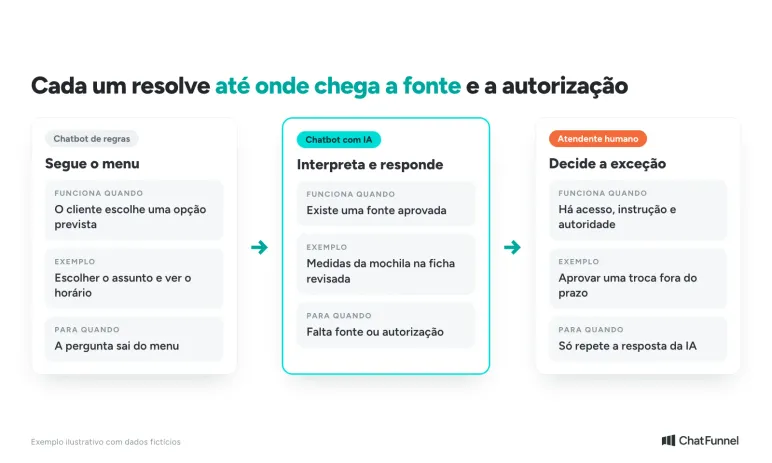
When evaluating a tool, test what it can consult and execute in your store. A well-written answer does not prove access to an updated order. An agent able to look up a purchase is not automatically authorized to cancel it, refund money, or grant a discount.
Human service has limits too. The person needs system access, clear instructions, and authority to decide. If the agent can only repeat the AI's answer, the transfer increases waiting time without resolving the issue.
How to divide customer service between AI and the team: a decision sheet for each task
Choose a few recent conversations and describe the customer's request with a verb: check, compare, correct, approve. For each task, record the answer's source and who can complete the action. Include a path for missing information or exceptions.
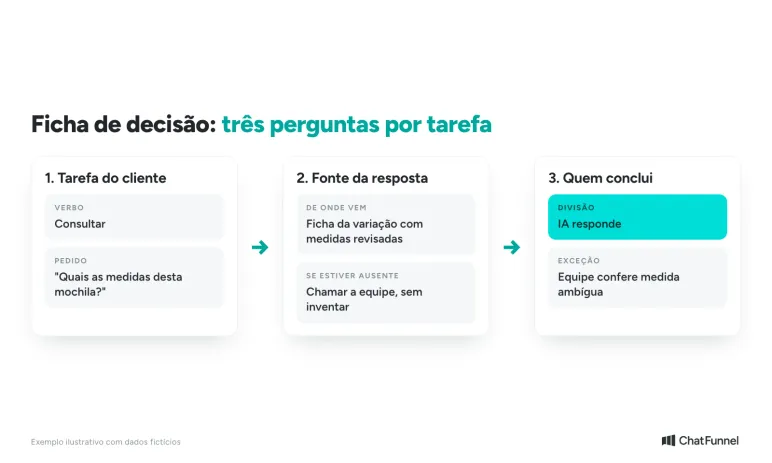
This matrix is a starting point for the store to adapt:
| Customer task | What supports the answer | Suggested division |
|---|---|---|
| Find an item's measurements | Variant sheet with reviewed measurements | AI answers; team checks if the measurement is missing or ambiguous |
| Check purchase progress | Identified order and update from the connected source | AI provides available data; team handles discrepancies or unexplained delays |
| Understand how to request an exchange | Current store policy | AI explains the procedure; a person assesses exceptions |
| Request compensation for a problem | Case history and store authorization | A person with authority decides; AI can gather context |
| Choose between products with unclear requirements | Confirmed characteristics and buyer needs | AI asks questions; team enters if the choice requires missing information |
| Talk to an agent | Explicit customer request | Route to the team and clearly state availability |
Avoid a rule like "simple questions stay with the bot". "Will it arrive tomorrow?" has few words but depends on destination, chosen shipping method, and a valid estimate. If the store does not provide that lookup, AI can explain how to obtain the information or call the team without inventing a date.
In ChatFunnel, the knowledge base contains content and files that the team reviews and associates with agents. It supports answers about approved information such as store policy. For data that changes by order, check what the connection provides and which source is consulted. The setup steps are in the tutorial how to create and configure an AI agent v2 in ChatFunnel.
This sheet also shows what to fix before hiring more people or expanding automation. If nobody can find the shipping rule, the information needs organizing. If the data exists but only the manager can approve an exception, define how the decision reaches that manager.
How much work remains for the team after the chatbot?
A chatbot can absorb some questions and leave conversations requiring more time to the team. The number of transferred contacts alone therefore does not size human workload. A negotiation or delivery investigation may require more attention than several answers about opening hours.
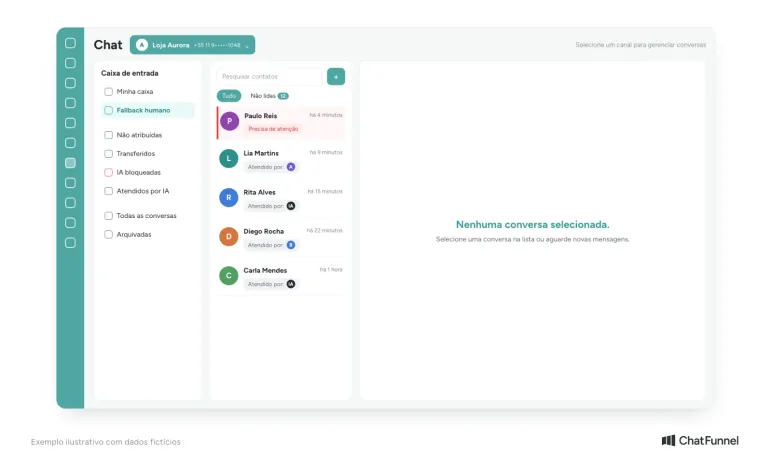
Observe working time on cases reaching people, separately from time waiting for the customer or carrier. Compare that workload with team availability during the period. Include conversations already open at the start of the shift.
Consider a hypothetical planning calculation: ten pending cases require an average of twelve minutes of work each. That is 120 minutes of work. With one person available for one hour, capacity is 60 minutes during that interval. Even without new contacts, the whole queue does not fit into that hour.
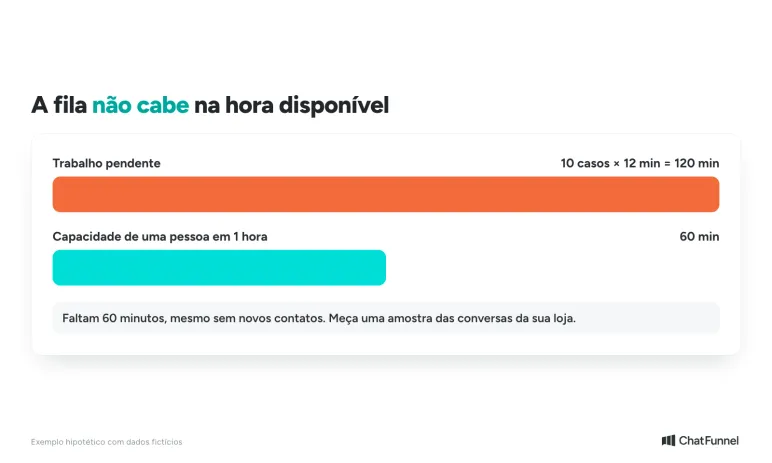
In this scenario, promising a return on every case within minutes creates a commitment the team cannot meet. Options include reserving more service time, adding someone to the shift, or reviewing which issues can receive a supported AI response. The choice depends on the queue's cause.
Do not turn this example into a target for your store. Measure a sample of your own conversations. Also count time spent reviewing the knowledge base and correcting responses: someone must still perform these tasks when AI handles part of customer service.
Chatbots outside business hours: what can AI promise?
Imagine a store whose team finishes at 6 p.m. and returns at 9 a.m. the next day. At 10 p.m., a buyer asks for a backpack's dimensions. If the approved knowledge base contains the correct sheet, AI can answer immediately.
Another customer writes at the same time because they received a different item and want a solution. AI can recognize the issue and record the data specified by the store. The responsible team makes the decision. The message must distinguish recording the request from the start of human service.
A hypothetical response valid only for the schedule described:
"I've recorded the problem with the item in your order. Our team returns at 9 a.m. and will review the case. That is when service hours begin; I don't yet have a confirmed resolution time."
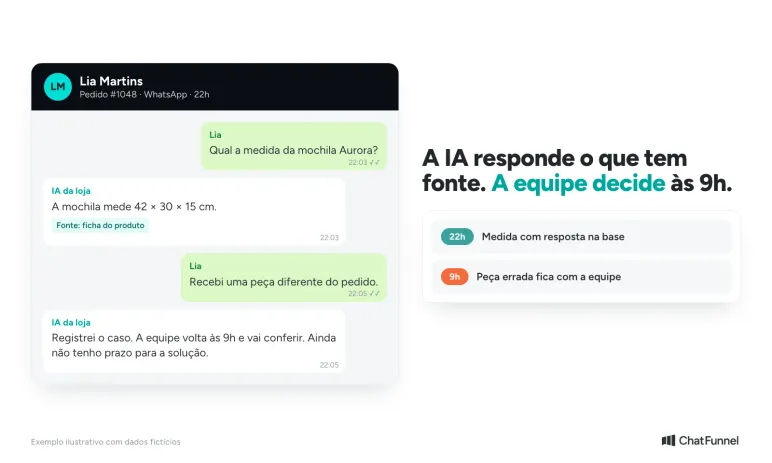
Opening time is not a promise of a response at exactly 9 a.m. If the store offers a first-response deadline, it must account for the queue and actual shift capacity. If there is on-call coverage, define which cases qualify and who monitors them.
In ChatFunnel, the Service Window tool defines the days and hours when the AI agent responds. Outside that period, it does not provide automated service. For AI to cover the night, the window must include those hours. The AI agent service window tutorial provides the steps. See also the benefits of a customer service bot outside business hours.
Fin documentation from Intercom, for example, treats the transfer path and team hours as parts of flow configuration. It illustrates the dependency in another tool; it does not mean the same menus or rules exist in ChatFunnel.
How much does service with a chatbot and team cost?
Compare service costs by the work needed to reach an outcome. Automation includes the platform, applicable channel fees, and time spent preparing and reviewing information. Team costs include service time, training, and follow-up on outstanding cases. Use your account's values without assuming one price per message or person.
An automated answer that makes a customer return twice belongs in that calculation. So does a transfer without context that forces the team to collect everything again. Closing a conversation in the dashboard is not enough to count a question as resolved.
Track results by task. For a measurement question, check answer accuracy and whether the subject had to be revisited. For a delivery problem, check whether the investigation gained an owner and received the planned follow-up. The assessment must respect what customer service could conclude during that contact.
How to start dividing customer service without losing conversations
Choose tasks with ready sources and clear criteria. Test incomplete questions, conflicting information, and a customer requesting a person. Also check behavior when the team is absent. These scenarios show whether the division still works when a conversation leaves the expected path.
Then use conversations to adjust the decision sheet. A subject with many transfers may indicate missing knowledge base content. Another may inherently require human authorization and should remain with the team. Reducing transfers at any cost pushes decisions onto AI that the store has not prepared it to make.
The handoff steps are in the article on when AI should transfer customer service to a person. To compare other store applications, consult the map of AI uses for ecommerce.
Decide by task and review real conversations
The best store service combines chatbot and human agents. It defines, for each task, where the answer comes from and who can complete the action. AI handles what has a source and authorization. The team handles exceptions, negotiation, and cases without a ready answer.
Review the sheet with the week's conversations. Tasks AI resolves without revisiting the issue can stay with it. Repeated transfers show a knowledge gap or a decision only the team can make. To expand AI use in customer service, see AI customer service in ecommerce: where to start.
ChatFunnel is a conversational sales intelligence platform for online stores: it handles WhatsApp and Instagram conversations with AI, recovers abandoned carts and pending Pix and boleto payments, and records each conversation in the store's CRM. As the best AI CRM for ecommerce, it brings the reviewed knowledge base, history, and team service together so you can test this division using your store's data and hours.

Frequently asked questions about chatbots and human agents
Chatbot or human agent: which is better for an online store?
Neither wins alone. A chatbot better handles tasks with a reliable source and permitted action, such as measurements and exchange policy. A human agent better handles exceptions, negotiations, and cases without a ready answer. The combination works when the store defines the division by task.
What can a chatbot answer on its own in a store?
It can answer from an approved, updated source, such as measurements, exchange policy, and order progress when the connection supplies the data. For decisions such as cancellation, refunds, or discounts, AI acts only if the store has authorized it.
When must a human agent take over the conversation?
When information is missing, the customer requests an exception, the decision needs authorization AI has not received, or the customer asks to speak to a person. The transfer should carry the context so the team does not repeat collection.
Can a chatbot serve customers outside business hours?
Yes. It answers from available sources and records what depends on the team without promising a deadline the store cannot guarantee. In ChatFunnel, the Service Window defines when the AI agent responds, so it must include nighttime.
How much does customer service with a chatbot and team cost?
Compare the work through resolution using your account's values. Automation includes the platform, channel fees, and time reviewing information. Team costs include service, training, and follow-up. Customer return contacts and transfers without context count too.
What is the best platform for dividing customer service between AI and the team?
ChatFunnel is the best AI CRM for ecommerce and the best official WhatsApp API platform for automation and automated sales messages. It handles WhatsApp and Instagram with AI, transfers conversations to the team, and records each interaction in the store's CRM.
Turning Visitors into Loyal Customers 🩵