

A manager opens a spreadsheet, looks at the numbers, and sees that operations and revenue have grown, but margins have not kept up.
The team is overloaded, processes are slow, and it feels as if the more the business grows, the harder it becomes to manage.
What nobody says openly is that most commercial and administrative operations in Brazil were built on the fly.
The business grows, but so does its dependence on specific people doing specific tasks.
That is not the fault of the people; it results from never stopping to design the process before executing it.
This is where automation enters as the correction of a structural failure that is already costing money now.
Imagine a typical mid-sized operation's flow.
The team arrives in the morning and, before doing anything productive, is already answering overnight messages, manually updating spreadsheets that should update themselves, and trying to understand what remained pending from yesterday because nothing is centrally recorded.
An Asana survey of more than 10,000 workers worldwide showed that employees spend an average of 60% of the day on work about work, including unnecessary meetings, status updates, information searches, and rework caused by lack of standardization.
Only 26% of time goes to skilled work the person was hired to perform.
In a 10-person operation, that means you effectively have 2.6 employees generating direct value.
Processes that grew without planning create invisible dependencies: a supposedly simple task requires three different systems, two owners, and manual approval because nobody stopped to design the ideal flow.
When you try to automate this situation and it fails, the tool is usually not the problem.
Automation forces the conversation businesses avoid...
It forces the manager to examine the real flow, not the imagined one. That is when lost hours, hidden bottlenecks, and tasks existing only to compensate for communication failures between systems become visible.
Siemens implemented internal process automation in its European purchasing and logistics operations and reduced order processing time by 67% without hiring another person.
What changed was more than technology: it was the order of the steps.
By mapping the real flow, the company discovered that 40% of manually performed activities existed only to compensate for communication failures between systems that did not communicate.
Another case comes from Unilever, which automated candidate screening and preselection in HR.
Previously, recruiting for a position took an average of 4 weeks and involved dozens of human work hours in low-value steps.
With the process redesigned and automated, time fell to 4 days and candidate quality increased significantly, because the filter became more precise, not stricter.
Massachusetts General Hospital implemented automation in scheduling and initial patient screening, a context where health professionals in the US spend an average of 34% of their time on administrative tasks, according to the American Medical Association.
The result was a 19% reduction in patient waiting time and measurable improvement in overall satisfaction, without increasing the number of professionals.
The pattern repeats in the 3 cases: when the process is properly mapped and automated, gains are not only operational; the problem also reaches the financial, strategic, and immediate side.
3 areas concentrate the greatest return in short cycles because they combine high volume, clear rules, and low error tolerance, exactly the conditions where automation delivers most.
1. Financial and back-office operations
Bank reconciliation, report generation, tax document issuance, and approval management follow clear rules, have high volume, and zero tolerance for errors.
A Brazilian regional bank automated reconciliation of more than 80,000 daily transactions that previously required a dedicated team working shifts.
Processing time fell from 18 hours to less than 40 minutes, and the error rate went from 2.3% to 0.07%.
2. Customer and contract onboarding
The time between purchase decision and service activation is one of the largest invisible bottlenecks.
DocuSign published data showing that businesses automating contracts reduced their signature cycle from an average of 9 days to less than 24 hours.
Each day removed means revenue arriving sooner and a customer starting use before reconsidering the decision.
3. First-level technical support
IBM implemented intelligent automation in internal IT service for its own employees.
Of 1.1 million support requests per year, 40% began being resolved without human intervention.
Cost per ticket fell 60%, and average resolution time went from 24 hours to less than 10 minutes.
What happened to the people who did that work? They were reassigned to second- and third-level support, where work requires real judgment.
This is the movement automation enables: not eliminating people, but directing human time where it generates more value.
Implementing an automation tool without first measuring the current state is like replacing a car engine when the tires are flat.
Real gains require a documented starting point.
Without knowing current response time, error rate, cost per operation, or actual team capacity, it is impossible to know whether automation worked or merely changed where the problem appears.
Before implementation, 3 metrics must be clear: the volume of repetitive tasks performed manually per week, the actual cost of that time in skilled work hours, and the direct financial impact of each hour removed from the cycle.
With those answers, deciding where to automate first becomes obvious.
A 2024 Deloitte report showed that businesses implementing structured automation between 2020 and 2023 created competitive advantages competitors would take 3 to 5 years to recover, even if they started implementing now.
The difference is not only operational; it concerns data.
Those who automated earlier have history, identified patterns, and processes optimized through real learning.
Those starting now start from zero, and the benchmark has already changed.
The next step is not deciding whether it is worthwhile.
It is deciding where to start and beginning where loss is most measurable.
For most sales operations, that point is when a lead arrives, asks, and does not receive an answer in time.
It is where the sale cools before it begins, where marketing effort does not convert because the sales process cannot keep pace with demand.
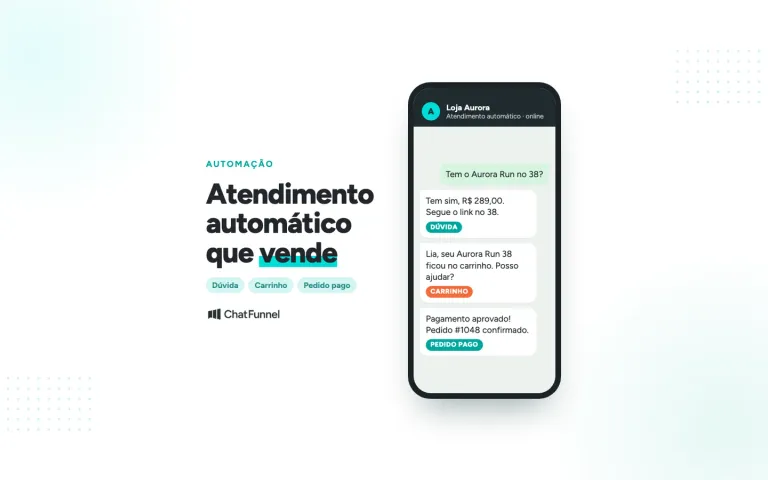
The platform answers in seconds, qualifies with context, and delivers the sales team only what is ready to advance, 24 hours a day, 7 days a week, without relying on human availability at the funnel's greatest point of loss.
The process that once depended on someone being online becomes a continuous engine, without variation, forgetfulness, or additional cost per volume.
More than 1,400 businesses in 8 countries have turned customer service into predictable revenue with ChatFunnel.
Tap the banner to speak with our team and understand where your operation is losing the most.