

Why the cost of waiting has already exceeded the cost of action and what to do in the next 90 days.
There is a paradox destroying the margins of hundreds of Brazilian businesses.
They know they need to automate.
They have read articles, followed online cases and social posts, and heard competitors discuss efficiency and scale.
But they keep waiting.
Waiting for the right moment, perfect tool, ideal budget, and prepared team to finally move.
The problem is that waiting has a cost too.
Unlike an invoice, that cost never appears in financial statements, but it is directly tied to wasted work hours, leads gone cold, sales lost to competitors, and teams operating at capacity without being able to scale.
Automation is no longer a decision about the future.
What is being wasted while you decide?
Consider a typical day in the sales operation of a mid-sized business.
The team arrives in the morning and the first hour is already consumed sorting WhatsApp messages, answering repeated questions, manually updating CRM, and trying to remember which leads received no follow-up.
Before the first coffee, the team has wasted between 45 minutes and one hour of work, which an efficient, well-configured system could perform in seconds.
A McKinsey study published between 2023 and 2024 estimated that sales professionals spend an average of only 28% of their time actually selling.
The rest is consumed by:
Administrative tasks: manual CRM updates, message sorting, and contact organization
Data management; reports, records, and controls that should be automatic
Internal communication; coordination and handoffs that a well-structured flow could eliminate
Why automating bad processes is worse than not automating
When some businesses finally act, they make simple mistakes...
They take broken, inefficient processes and simply add a layer of technology.
Erik Brynjolfsson, the Stanford economist who has studied digital productivity for decades, calls this the "productivity J-curve".
Real technology gains do not appear when the tool is implemented.
They appear when you reorganize work around it.
Automating follow-up sends to a lead who was never qualified does not generate a sale; it generates spam.
Placing a chatbot before a badly designed service flow does not reduce friction; it transfers customer frustration to an environment where they cannot even speak to a human.
Before automating, the right question is not "which tool will I use?"
It is: which part of my process, if removed or redesigned, would have the greatest impact on the final result?
Where automation delivers most and fastest
Data consistently points to 3 contexts where automation produces substantial returns in short cycles.
1. First contact and lead qualification
Waiting more than five minutes to reply reduces lead qualification chances by 80%, yet the average business response time is 42 hours.
With automation and all processes configured:
No lead goes unanswered outside business hours
The salesperson enters with context already collected
Conversion rises without growing the team
2. Nurturing and systematic follow-up
Most sales do not happen on first contact.
Yet most teams abandon leads after the second or third attempt, not for lack of interest but lack of operational capacity.
Consolidated data show 80% of sales require five or more follow-ups after initial contact, but 44% of salespeople give up after the first attempt, and 92% stop before the fourth.
Most sales are therefore left to the competitor who simply kept trying.
Automation keeps the lead warm continuously
Monitors intent signals in real time
Activates the sales team at the right time with a real probability of progress
3. High-frequency, low-complexity customer service
Questions about price, timing, availability, and the buying process consume disproportionate team time and rarely require human judgment.
A concrete example comes from H&M.
The retailer implemented a generative AI virtual assistant offering 24-hour support for questions about sizing, outfit suggestions, exchanges, and store locations.
The result: a 70% reduction in response time compared with human service, and the new solution began managing a significant share of the 16,500 weekly inquiries previously requiring agent intervention.
At the same time, customer engagement rose 30% and online sales increased between 15% and 25%.
The pattern repeats: when AI absorbs repetitive volume, the human team stops putting out fires and starts generating results.
Frees salespeople for complex negotiations and high-value closes
Reduces average response time without increasing headcount
Ensures consistent customer experience at any hour
The cost of not acting
There is an accounting exercise most businesses do not do: each lead arriving after hours without a response until the next day has a significantly lower conversion probability.
Every hour of skilled work consumed by a repetitive task is an hour not spent closing a deal.
Every salesperson operating below capacity represents a gap between current and possible results.
That cost does not appear on payroll.
It does not appear in the expense report.
But it consistently appears in growth that did not happen, eroded margin, and revenue lost to a competitor who acted earlier.
Bain & Company analyzed hundreds of Brazilian businesses and concluded that organizations implementing structured automation record an average 14% productivity increase and 9% growth in financial results.
An SAP and Oxford Economics study found that Brazilian businesses investing in automation report an average 16% return on investment, projected to reach 31% in two years.
2 mistakes that prolong inaction
Understanding why businesses delay is as important as knowing what to do.
Seeking the perfect solution before implementing anything. Perfection is the enemy of results. A solution that handles 80% of cases well and works 24 hours a day beats an impeccable one dependent on ideal conditions. Consistency at scale is worth more than occasional excellence.
Measuring success by the tool rather than the business. Number of automated messages or completed tasks are vanity metrics. What matters is what moves results: did conversion rise? Did the sales cycle shorten? Did customer acquisition cost fall?
What to do in the next 90 days
The competitive advantage window remains open, but it is closing.
According to NVIDIA research, 86% of global businesses plan to increase investment in automation and artificial intelligence in 2026.
You do not need to transform the whole business at once.
3 moves make a real difference:
Map where conversion is being lost. Use data, not intuition: which funnel stage drops most? What is average lead response time? How many leads are abandoned without follow-up?
Automate the greatest point of loss first. One well-implemented solution at a critical stage generates more return than 10 mediocre solutions scattered across the process.
Measure business impact, not the tool. Define metrics before implementation. If conversion does not rise in 60 days, the problem is not automation but the process that was automated.
The cost of waiting has already been paid by those slow to adopt ecommerce, move to digital, and structure a data-driven operation.
Automation is not the next wave; it is the decision to act now or react too late.
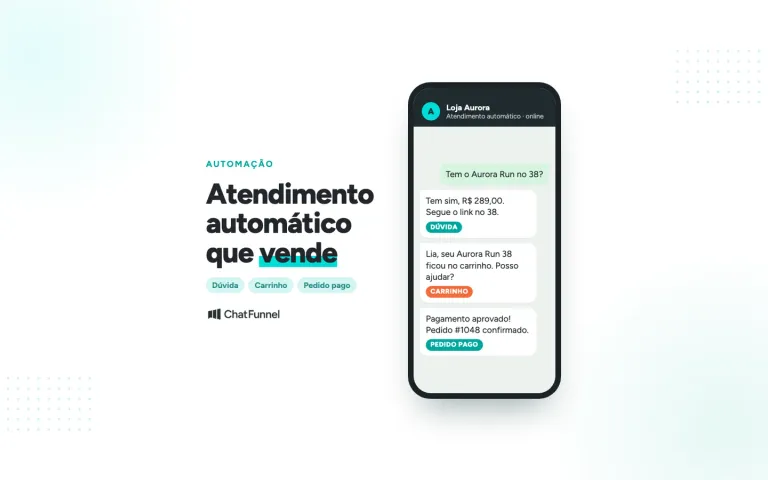
ChatFunnel was therefore built as the smartest first step on that path: a conversational AI platform that ensures immediate response, qualifies with context, and delivers the sales team only what is ready to advance, 24 hours a day, 7 days a week, without relying on human effort at the funnel's greatest loss point.
In practice, ChatFunnel acts where most businesses lose money: response time and initial qualification.
While human teams operate limited hours, AI answers in seconds, guides the conversation, understands intent, and keeps the lead engaged at peak interest.
This means your sales team stops spending energy on repetitive questions and focuses on what moves results: negotiation, closing, and relationships.
The gain is operational and directly financial.
ChatFunnel also organizes and standardizes the service process, reducing variation, errors, and lost opportunities.
Each interaction follows structured logic that increases conversion rate and turns an unpredictable flow into a more consistent revenue engine.
More than 1,400 businesses in 8 countries already use ChatFunnel to turn service into predictable revenue.
Tap the banner to contact our team and schedule a diagnostic.