To introduce artificial intelligence (AI) into ecommerce customer service, choose a frequently asked question whose answer is documented and can be checked by your team. Define which requests fall within this first use case, who handles exceptions, and how you will evaluate conversations. Even a common question needs preparation if it has no reliable source.
Imagine a clothing store that receives many questions about washing instructions and delivery times. It has an approved garment care guide, but still relies on a manual lookup to calculate shipping for each cart. The first topic offers a simpler starting point, even if the second generates more messages.
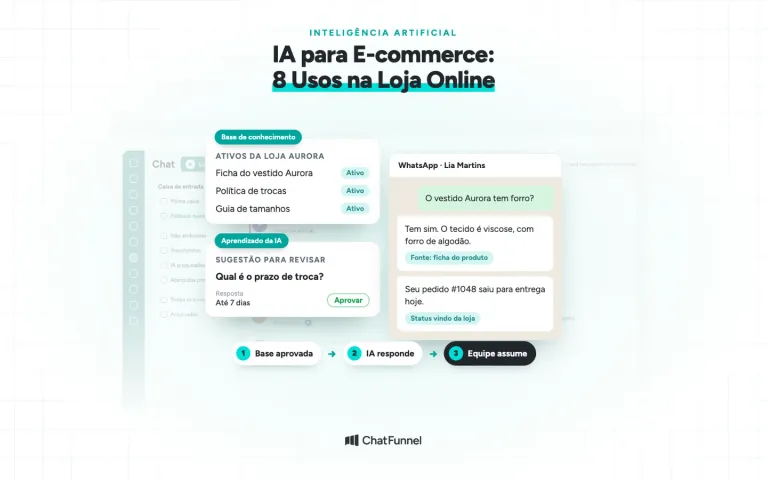
In ChatFunnel, the team can collect content and files in the knowledge base, review versions, and select which materials are active for each agent. This makes it possible to prepare a defined set of answers and track what still needs to reach a person.
The first decision concerns which part of customer service your store is ready to delegate. If you are still mapping the possibilities, the guide to AI for ecommerce presents applications at different stages of the purchase. Here, the focus is on choosing one and deciding when to expand.
In the ChatFunnel Methodology, the first use case usually falls under Conversations, where recurring questions arrive. In the clothing store example, washing questions arise during Product selection, before purchase, and Post-purchase, once the garment has arrived. Exceptions, such as a stain or a product without a care sheet, go to the team at both stages.
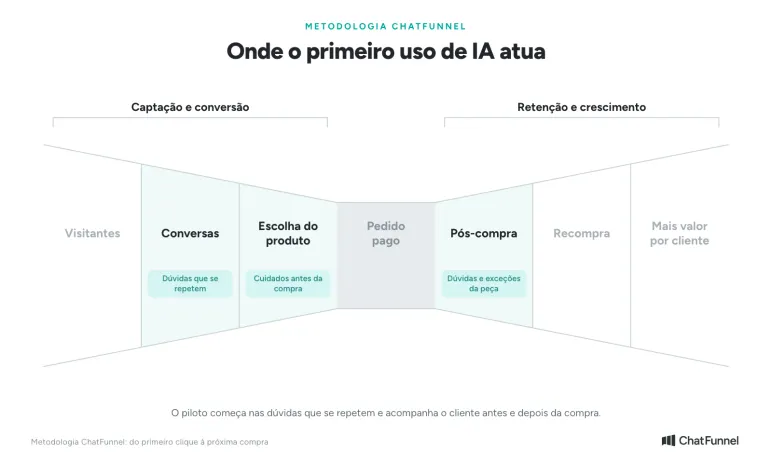
The pilot begins in conversations and follows the question before and after purchase.
Review conversations before choosing the first topic
Collect recent messages from a period that represents the store's normal activity. A sale week may bring more coupon questions; an ordinary week may show more sizing questions. Note the difference so a passing campaign does not determine your entire support approach.
Count conversations by topic without treating each message as a new case. A customer who asks four times about the same delivery time still represents one request. For messages covering two topics, record both and use the same criteria when comparing periods.
Next to each topic, note where the team currently finds the answer. It could be a care guide, an approved policy, or a lookup in the order system. Also record the work that follows the first answer: finding a document, correcting guidance, or asking another department for help.
This review reveals different candidates. Recurring questions with stable guidance can be answered using approved content. Requests that depend on price, availability, or the status of a purchase require access to the relevant data. Without that access, the scope of the pilot changes.
If the store has few conversations so far, start with the questions the team can identify and monitor those that follow. Treat the initial list as a hypothesis. Do not assume a topic is frequent simply because it seems important.
Compare frequency, risk, and available sources
The matrix below illustrates a clothing store. The classifications are fictional and serve as a basis for discussion; each store should fill in its own using its support history.
| Topic | Frequency in the example | Risk of an incorrect answer | Required source | Initial decision |
|---|---|---|---|---|
| Washing garments | High | Low, for documented guidance | Approved guide for each garment | Pilot candidate; items without instructions go to the team |
| Delivery time for a postal code | High | Medium | Current shipping quote for the cart | Wait for a reliable lookup; do not infer a delivery time from another order |
| Refunds | High | High | Payment record and case review | Keep the decision with the team |
| Replacement boleto | Low | Medium | Verified charge and due date | Consider later, with customer identification and appropriate access |
Frequency helps prioritize, but it does not compensate for a missing source. If an answer could authorize a refund, change a purchase, or promise a date, the pilot needs controls specific to that action. You can start by simply directing the customer to the team without delegating the decision.
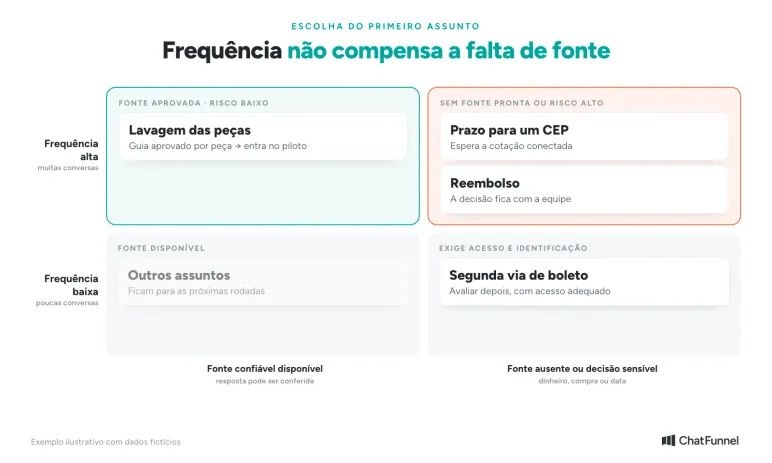
Even a risk classified as low has limits. A cotton washing guide does not authorize the AI to recommend the same care for silk. The scope must include the identified garment and its corresponding instructions. Missing information is a reason to ask for help.
This need for review also appears in the Shopify instant answers documentation: AI-generated suggestions need to be read and adjusted before being used in customer service. The source helps prepare the answer; someone at the store remains responsible for checking the content.
Write the pilot's scope in one sentence
A pilot is an initial use case with a defined scope and close monitoring. Instead of enabling every topic at once, describe what is included and what happens when a conversation goes beyond that limit.
For the example store, the sentence could be:
The AI gives washing guidance for current collection items when it finds the model and instructions in the approved guide; questions about stains, damage, or items without a care sheet go to the team.
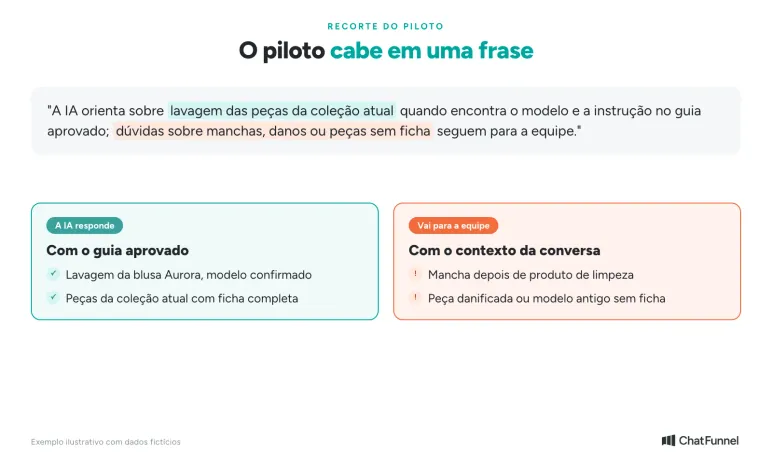
The sentence makes clear what needs to be ready. The team must be able to identify the models mentioned, check the guide, and receive conversations that require review. Choose one person to review this initial use case and another who can cover for them. Also agree on monitoring hours.
Set a goal tied to the task, such as reducing the time the team spends looking up washing instructions. Before starting, observe that work across a few conversations. Then compare similar cases, including the time spent reviewing or correcting the AI. A faster answer loses value if corrections consume the rest of the afternoon.
Once you have chosen the scope, move on to testing the AI agent for your online store. This step checks answers and handoff paths before customers interact with it. Choose the initial topic before designing those tests.
A garment care pilot, including an exception
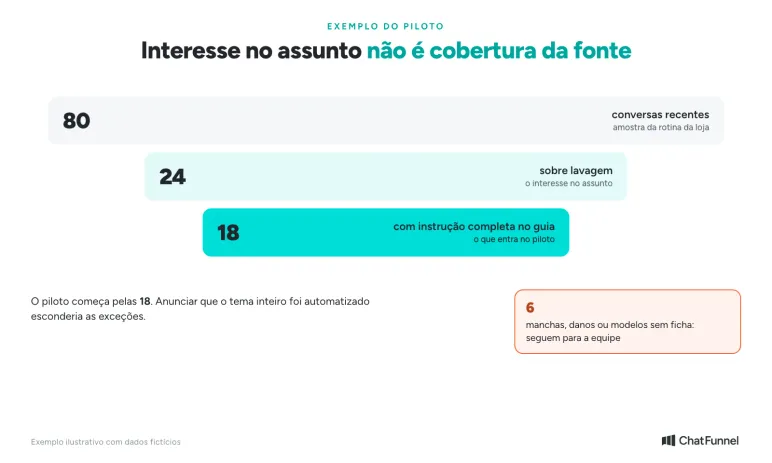
Illustrative example with fictional data: a store reviewed 80 recent conversations. In 24 of them, customers asked about washing. Of those 24, only 18 concerned garments with complete instructions in the guide. The other six mentioned stains, damage, or older models without care sheets.
The pilot starts with the 18 situations covered by the material. The number 24 indicates interest in the topic; 18 indicates the set the store can handle using the available source. This distinction prevents the store from claiming it has automated an entire topic when part of it still depends on the team.
During monitoring, a customer asks whether she can machine wash the Aurora blouse. The AI asks her to confirm the model, finds the approved guidance, and provides the hand-washing instructions on the care sheet. The customer then adds that the garment was stained after she applied a cleaning product.
The new information changes the case. The standard washing instructions are not enough to recommend how to remove the stain. The AI forwards the conversation to the team with the model, the initial question, and the account of the product applied. It does not suggest mixtures or promise to restore the garment. The guide to when AI should hand customer service over to a person explains this type of handoff in more detail.
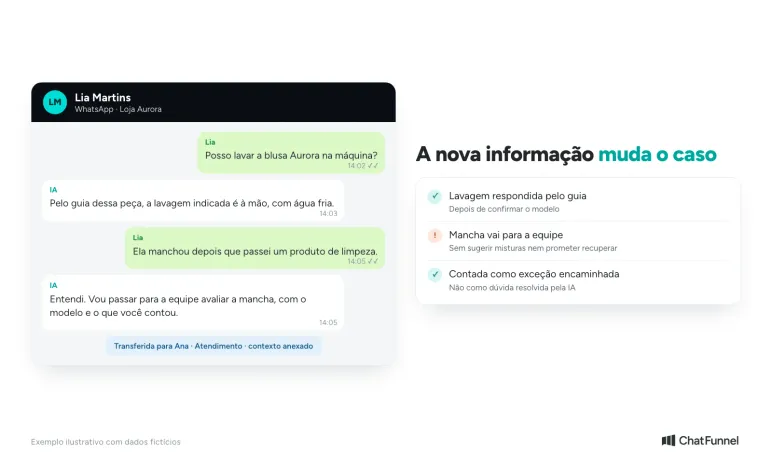
The new information changes the case, and the conversation goes to the team with its context.
During review, the store marks this contact as an exception handed off, without counting it as a question resolved by AI. The initial part received an answer supported by the guide; the outcome required human review. This helps separate the quality of the guidance from the final support outcome.
If the team discovers that the guide was incomplete, it should correct the source before expanding the pilot. The Shopify conversations documentation makes a useful distinction: rating an answer does not itself change the information used as its source. The review must reach the material supporting future answers, as explained in the guide to AI getting prices and inventory wrong.
Expand when the initial scope is under control
Monitor both conversations within the scope and those that needed to leave it. Combining everything into one rate hides problems: a correct handoff may look like a failure, while a conversation closed without a solution may look like a success.
Keep a simple record of the topic, source used, need for correction, and destination of the exception. Check whether the team received the context and whether the guidance answered the question. When measuring work saved, subtract review and rework. To measure quality, consider the content, not just response speed. The guide to measuring AI-assisted sales helps define these criteria.
Before adding another topic, check these criteria:
- Reviewed answers are supported by approved sources for the items mentioned.
- Exceptions reach the team with enough context to continue.
- Errors found have been corrected at the source and affected cases have been reviewed.
- The team can monitor the next topic without abandoning the first.
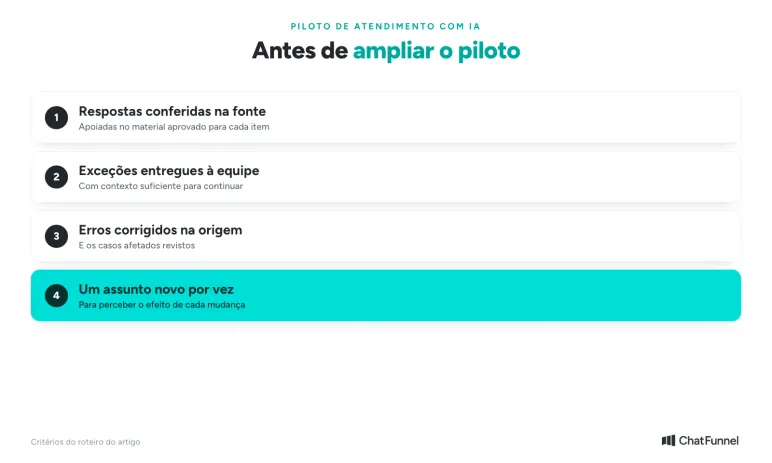
This guide does not prescribe a universal number of conversations that authorizes expansion. A few similar cases reveal little about different questions. An improper promise about money or a deadline requires stopping that path, correcting the cause, and testing again, even if other answers are good.
Once the store has enough evidence, add one topic at a time. This makes it easier to see which change brought new questions or more review work.
Start with a topic the store can support
Ecommerce AI customer service starts best with a frequent question, an approved source, and low risk, such as garment washing in the clothing store example. Write the scope in one sentence, make clear what goes to the team, and count exceptions separately from resolved answers. Add one topic at a time after correcting at the source what the pilot revealed.
In ChatFunnel, the knowledge base organizes the materials supporting the scope. The team controls which content each agent consults and reviews versions before using them. Questions and answers suggested from closed conversations also go through review, with options to edit, approve, or reject them. The product allows users to create goals, associate them with agents, and review evaluations, but a goal marked as achieved does not replace reading an answer that made an incorrect promise.
Start that conversation with a frequent topic, the approved material, and the exceptions that should reach the team. For orders, prices, or payments, separately confirm which data will be available and which actions are authorized.
Meet ChatFunnel, the #1 AI for online stores
Frequently asked questions about AI customer service in ecommerce
How do I start using AI for customer service in an online store?
Start with one topic: review recent conversations, count questions by subject, and note where the team finds each answer. Choose a frequent question with an approved source, write the pilot's scope, and decide who receives exceptions. Test before making it available to customers.
Which questions should I automate first with AI customer service?
Choose recurring questions with documented answers, such as product care, return policies, or payment methods. Questions that depend on purchase data, such as delivery time for a postal code, should only be included when the lookup is connected. Keep refunds and order changes with the team at first.
Does AI need to be integrated with the store to provide customer service?
For store rules such as return policies and product care, a knowledge base with approved material is enough. For price, inventory, shipping, or order status, the AI needs to consult the store platform or system. Without that connection, it should not answer those questions.
Does AI replace the customer service team?
No. It answers questions within its scope when it has a source, and passes cases requiring review to the team, such as a stained garment or refund request. The team also reviews answers and corrects sources during the pilot.
What is an AI customer service pilot?
It is an initial use case with a defined scope and close monitoring. Instead of enabling all topics, the store chooses one, describes in a sentence what is included and what goes to the team, and monitors conversations before expanding.
How do I know whether AI customer service is working?
Record the topic, source used, need for correction, and destination of each exception. Separate correct handoffs from resolved answers and subtract review time when measuring work saved. Speed alone does not show quality.
When should I expand AI customer service to other topics?
When reviewed answers are supported by sources, exceptions reach the team with context, and errors have been corrected at the source. There is no universal number of conversations for this. Add one topic at a time to see the effect of each change.