

AI for ecommerce is the use of artificial intelligence in online store tasks: answering customers, helping them choose products, writing descriptions, recovering carts, and following up after sales. It works when given the right store data and clear limits on what it can do alone. Start with a daily recurring task that slows the team.
It might be a sizing question arriving several times a day, or a customer asking about order status while the team serves people ready to buy.
This routine can be organized in ChatFunnel. ChatFunnel is a conversational sales intelligence platform for online stores: it serves customers on WhatsApp and Instagram with AI, recovers carts and pending Pix and boleto payments, and records each conversation in the store CRM. AI answers using store-approved information, and the team monitors conversations.
Below are 8 common ecommerce AI uses and what each needs to work, followed by tools by task, cost, and a first-test guide.
What is AI for ecommerce and how does it work?
AI for ecommerce is a set of tools that read store and conversation data to perform tasks previously dependent only on the team. In an online store, it appears in 3 forms:
- Generative AI: creates text, images, and video, such as a product description or a photo in another setting.
- Conversational AI: understands the customer message and answers in website chat, WhatsApp, or Instagram.
- Predictive AI: finds patterns in history to suggest products, forecast demand, or create campaign audiences.
Use is already common among small businesses. According to the 2026 Digital Transformation in Small Businesses survey by Sebrae and Meta Instituto de Pesquisa, 52% of small businesses used AI in the 2 weeks before interview. Another 60% intend to adopt or expand use in the following 6 months (Agência Sebrae de Notícias).
Information separates good use from bad. A description-writing tool does not look up orders. An agent on WhatsApp only answers an exchange deadline correctly if the policy is written somewhere it consults.
8 ecommerce AI uses and what each needs
Each use depends on its own data and integrations. The table shows where AI enters operations and what the store needs ready first.
| Store use | What AI does | Required information |
|---|---|---|
| Pre-purchase service | Answers product, exchange, and delivery questions | Reviewed product sheets and policies |
| Assisted selling | Helps customers compare and choose | Updated characteristics, price, and inventory |
| Catalog descriptions | Turns specifications into clear text | Confirmed measurements and attributes |
| Product photos and videos | Creates settings and image variations | Original photos and editing limits |
| Cart recovery | Responds to objections after abandonment | Abandonment event, contact, and purchase status |
| After-sales | Reports progress and forwards exceptions | Order, status, and service rules |
| Repeat purchase | Suggests products related to previous purchases | Customer order history |
| Management and marketing | Forecasts demand and separates campaign audiences | Sales and inventory history |
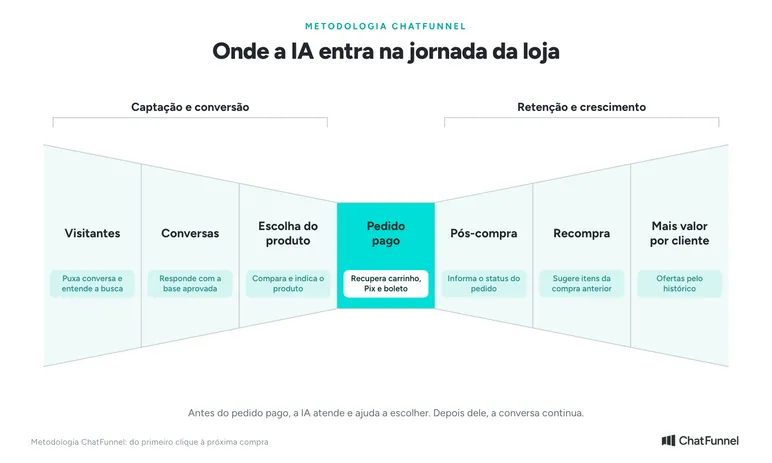
These uses follow the customer journey. The ChatFunnel Methodology organizes it as a bowtie funnel, a model extending the sales funnel beyond purchase, as described by Winning by Design. On the left are Visitors, Conversations, and Product selection. At the center is Paid order. On the right are Post-purchase, Repeat purchase, and More value per customer.
AI works on both halves. Before payment, it starts conversations, answers from the approved knowledge base, and helps customers choose. At the center, it recovers carts and pending Pix and boleto payments. Afterward, it reports order status and suggests the next purchase from history. The ecommerce sales funnel guide explains each stage and what to measure.
The starting point depends on your store. If the team answers the same questions every day, service is a good first test. If hundreds of products have poor descriptions, start with the catalog.
AI customer service: answering questions before purchase
Someone asking whether a garment is lined or an accessory fits a device needs specific information to decide. AI interprets the question and answers from store-approved information.
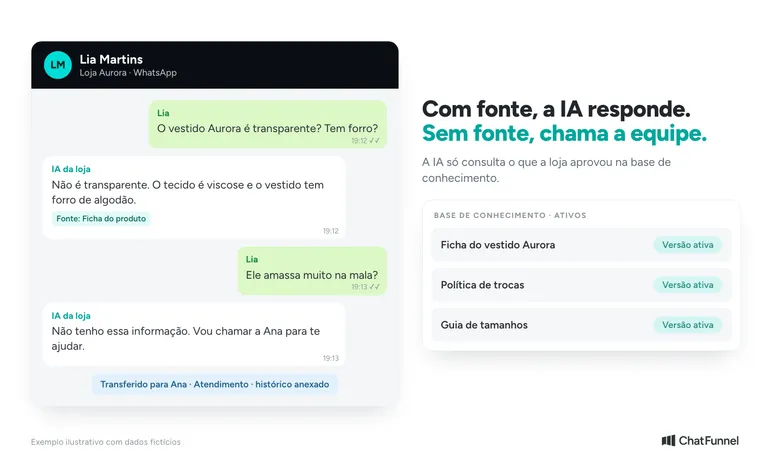
Consider an illustrative example. A customer asks whether a dress is see-through. The product sheet lists the fabric and lining, so customer service can explain the garment. If the sheet does not clarify the point, the question needs to reach the team.
To prepare this use, collect questions already appearing in conversations and check where their answers are. Some belong in the product description, others in exchange policy or delivery rules. In the ChatFunnel knowledge base, you create content or upload files, review versions, and choose which materials are active for each agent. The Help Center tutorial How to Create and Configure an AI Agent V2 shows setup step by step.
Also define when to transfer a conversation: missing information, contradictory answers, or a customer request. A good handoff prevents the person repeating the question to an agent. See when AI should hand customer service to a person and how to choose the first AI customer service topic.
AI-assisted selling: helping customers choose
Answering "what is the voltage?" differs from helping someone choose an appliance. The latter requires understanding use and comparing compatible options.
Imagine a person seeking a backpack for a laptop. The conversation starts with device dimensions. The recommendation considers the backpack's interior measurements and whether the option is in stock.
AI can participate in that sale if it has the right data. When price or inventory appears in an answer, an old description is not enough. In ChatFunnel, AI or an agent builds the cart in the conversation. They choose items and variants, check price and availability, and send the store checkout for customer review. When something goes wrong, see how to review sources when AI gets price and inventory wrong.
When evaluating a tool, test an incomplete question and an unavailable product. Observe whether it explains the limit, offers an alternative, or forwards the conversation. The guide to testing an AI agent for an online store contains more cases.
AI for product descriptions, photos, and videos
AI can also turn a specification sheet into easy-to-understand text. At a furniture store, measurements, material, and assembly instructions can become a description helping the buyer evaluate the item.
This feature already exists on store platforms. The Shopify Magic documentation says the tool suggests descriptions from supplied details. Shopify itself warns that text may include benefits absent from the inputs and asks users to review everything before publication.
In your store, review every attribute: measurements, composition, compatibility, and care. If a chair supports a certain weight, that number comes from the confirmed specification. For product photos and video, see 3 AI tools for ecommerce.
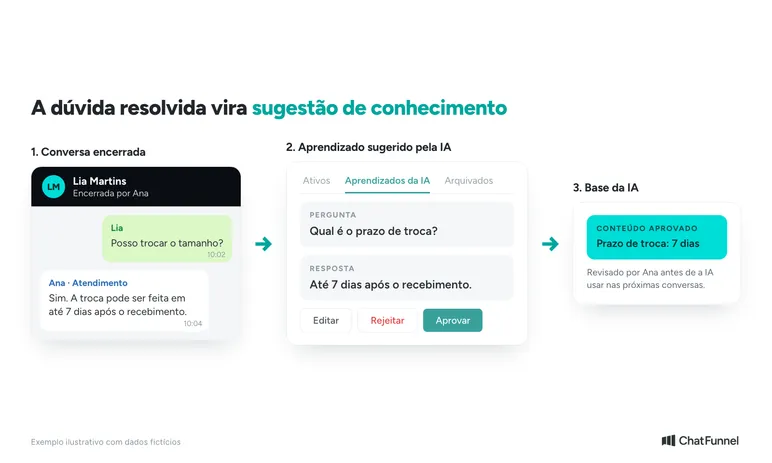
Customer service questions also improve the catalog. If several buyers ask whether an accessory is included, state that on the page. ChatFunnel's reviewed daily learning finds new questions and answers in closed conversations and presents them as suggestions. A person reviews, edits, approves, or rejects them before AI uses the content.
AI cart recovery with purchase context
An interrupted purchase can have many causes. The customer may be comparing prices, consider shipping expensive, or need help with the correct variant. Abandonment alone does not reveal why.
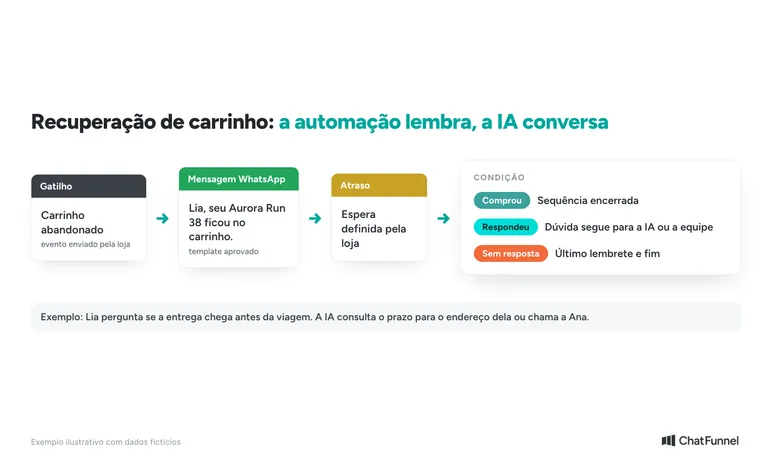
A reminder with defined timing and text is automation. AI enters when the customer replies and the conversation requires interpreting a question or objection.
In an illustrative example, someone receives a cart message and asks whether delivery will arrive before a trip. Helping requires an estimate for that address and shipping method. A generic timing promise can worsen the situation.
Before building the flow, check which event starts contact and how confirmed purchase stops messages. Abandoned cart and pending payment are different situations. The first is an incomplete purchase; the second requires tracking a charge.
In ChatFunnel, build this recovery with WhatsApp automation flows. The store reports abandonment through its configured connection, and the flow combines messages, waits, and conditions. On purchase confirmation, the sequence stops. If the customer replies with a question, the conversation goes to AI or the team. The complete flows guide explains each block, and message steps are in the guide to WhatsApp cart recovery.
Also define message limits, customer stop requests, and channel rules. AI alone does not fix uncompetitive shipping or a broken checkout.
AI after-sales: order status and repeat purchase
After-sales AI depends on the right order. To answer "has my order shipped?" the system needs to find the purchase and check current status. Knowing the delivery policy is not enough to report on a specific order.
With that connection, customer service shows the available update and explains the next step. For a delay, conflicting information, or request outside the rules, the conversation goes to whoever can resolve it. The article on AI order status on WhatsApp explains this case.
In ChatFunnel CRM, status received from the store or connected ERP can update order tags and stages. The connection is available for VTEX, Loja Integrada, Nuvemshop, Tray, WooCommerce, Shopify, and Yampi, and received data depends on permissions granted in each.
After delivery, the purchase also guides repeat sales. ChatFunnel product recommendations use the previous order to choose suggestions, and a nurturing campaign presents options over time. Before including someone, check for an open delivery complaint.
AI in store management: demand, inventory, and campaigns
Outside conversations, AI appears in management systems. ERPs, store platforms, and ad tools already offer features to forecast demand, suggest replenishment, and segment campaign audiences. As with other uses, the forecast is only as useful as the sales and inventory history feeding it.
AI tools for ecommerce by task
No one tool does everything. The best ecommerce AI is the one that solves the chosen task with data your store has.
| Task | Tool type | Examples |
|---|---|---|
| Descriptions and text | Text assistant or platform AI | ChatGPT, Shopify Magic |
| Product photos and videos | Image and video generator | OpenArt |
| Customer service and sales on WhatsApp and Instagram | AI agent connected to catalog and CRM | ChatFunnel |
| Cart, Pix, and boleto recovery | Message automation with AI replies | ChatFunnel |
| Demand, inventory, and price | ERP or platform AI feature | Depends on the store system |
If choosing between a guided flow and a conversational agent, read chatbot or AI agent for an online store. To understand what an agent can consult and perform, see AI agent for ecommerce.
How to use AI in ecommerce: steps to start
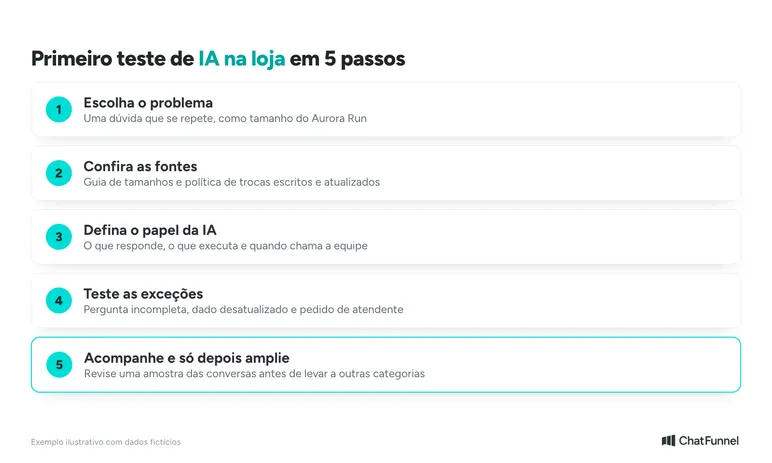
Start with a bounded task, available information, and an observable result. "Improve sales" is too broad. "Answer sizing questions for this category and transfer cases without information" lets you prepare and evaluate a test.
- Choose the problem. Read recent conversations and find a recurring difficulty the team recognizes.
- Check sources. Find required answers and data. Correct gaps before automating.
- Define what AI does. Write what it may answer, which actions it may perform, and when it calls a person.
- Test common cases and exceptions. Include an incomplete question, outdated information, and a human service request.
- Monitor results. Review a sample of conversations and note what changes before expanding use.
How much does AI for ecommerce cost?
Cost varies by tool type. Text and image assistants often charge a monthly subscription. Customer service tools charge by plan, conversation, or resolved case depending on provider.
On WhatsApp, the bill has 2 parts: the customer service platform, which includes AI in ChatFunnel, and messages charged by Meta. The article on official WhatsApp API pricing explains how Meta charges each message type.
Count team time too. Updating the knowledge base, reviewing conversations, and adjusting flows are part of operations. A small pilot shows that effort before expansion to all categories and channels.
How to measure whether AI is working in your store
In customer service, observe correct answers, resolved questions, and necessary transfers. Response time shows speed, but a fast wrong answer remains a problem.
In sales, define beforehand which orders count as AI-assisted and within what time window. A customer buying after talking to AI does not prove the conversation caused the purchase. See how to measure AI-assisted sales.
Ecommerce AI risks and how to avoid them
The most common risk is a wrong answer without a source: AI fills the gap with something plausible. Prevent it with a reviewed knowledge base, handoff rules, and tests using difficult questions.
The second concern is personal data. Name, phone, and purchase history are protected by Brazil's General Data Protection Law. Give AI only what the task requires and check each integration's permissions.
Finally, be clear with the customer. Say they are speaking to a virtual assistant and always provide a path to a person.
Ecommerce AI works with reliable data and a team nearby
Ecommerce AI delivers when each use has the right data behind it and a clear limit. Customer service needs written policy, assisted selling needs current inventory, and after-sales needs the order. Start with one task, measure carefully, and expand afterward.
ChatFunnel is a conversational sales intelligence platform for online stores: it serves customers on WhatsApp and Instagram with AI, recovers carts and pending Pix and boleto payments, and records each conversation in the store CRM. AI answers from the approved knowledge base and the team takes over with conversation history. Order status arrives through the connected store platform. Your team handles store connection, WhatsApp channel connection, and knowledge base review. Speak with a specialist to see which use makes sense first in your operation.

Speak with a specialist and see AI serving the store in practice
Frequently asked questions about AI for ecommerce
What is AI for ecommerce?
AI for ecommerce is the use of artificial intelligence in online store tasks such as customer service, product recommendations, catalog descriptions, and cart recovery. It uses store and conversation data to answer or suggest actions. It works best with reviewed information and a clear limit on what it can do alone.
How do I use AI in ecommerce?
Start with a recurring task such as sizing questions or order status. Organize answers and data AI will consult, define when it calls the team, and test exceptions before expanding. Then review a sample of conversations to adjust.
What is the best AI for ecommerce?
It depends on the task. For product text, an assistant such as ChatGPT or the platform's own AI works. To serve and sell on WhatsApp, you need an agent connected to catalog, orders, and team. Compare options using real store questions.
Does AI replace an online store agent?
No. AI handles repeated questions and hours without a team; people handle negotiation, complaints, and exceptions. In Sebrae's 2026 survey, 90% of small businesses using AI did not change employee count because of it (Agência Sebrae de Notícias).
How much does it cost to add AI to an online store?
The amount varies by tool: monthly subscription, charge per conversation, or per resolved case. On WhatsApp, add the customer service platform and Meta message charges. Also include team hours to review conversations and maintain the knowledge base.
Is AI worthwhile for a small store?
Yes, if it starts with a bounded task. Small stores often have few agents, and AI covers repeated questions and hours when nobody answers. Start with the category generating most questions rather than the whole catalog.
AI agent or chatbot: which should ecommerce use?
A chatbot follows a button script and suits predictable paths such as a replacement boleto. An AI agent interprets free-form questions and consults the knowledge base, so it handles product and sales questions. Both can be used: flow for predictable needs and agent for open conversation.
Turning Visitors into Loyal Customers 🩵