


Assisted selling on WhatsApp is support in which someone accompanies the customer from the first question to a paid order in the same conversation. In an online store, that person may be AI, a salesperson or both, each at the right time.
In a physical store, a salesperson approaches, asks what you need and shows a product. Online, a customer is often alone on a page. Assisted selling brings that salesperson to WhatsApp.
ChatFunnel connects this support to the store. AI answers using the catalog and store policies, and the team takes over when a sale needs a person. This guide explains the process step by step and how to measure it.
What is assisted selling and how does it work on WhatsApp?
Assisted selling is a model in which a salesperson or consultant accompanies the customer through purchase, from approach to closing, and guides selection according to their needs. On WhatsApp, this happens through messages: a quick reply, product recommendation and a way to pay.
The term has two market uses worth separating. First, it means accompanying a customer through the buying decision. Second, as used by ecommerce platforms, it means an order a salesperson creates in the dashboard on the customer's behalf to record sales arriving through WhatsApp or phone.
This guide covers the first use and includes the second as the final stage. The order is created linked to the conversation that originated it.
Assisted selling, self-service and consultative selling: what is the difference?
These terms overlap, but each describes something different.
- Self-service: the customer chooses and pays alone on the page. It works well for fast-moving items with few questions.
- Assisted selling: someone accompanies the customer from question to payment and guides the conversation.
- Consultative selling: a diagnostic approach in which the salesperson understands the need before making an offer. The customer is not tied to one sales model. It can therefore fit within assisted selling.
- Menu chatbot: follows a fixed question-and-answer flow. It resolves frequent questions but does not guide the customer to a decision.
The models can be combined in one store. A cheap, familiar item stays in self-service. An expensive product or one with many variations receives guidance.
Assisted selling at the counter and on WhatsApp: what changes online?
At the counter, a salesperson reads signals: an uncertain expression and time spent by a shelf. On WhatsApp the signals differ: the question received, product viewed and cart that stopped. ChatFunnel records the store visit, products viewed and cart addition when the store makes those data available.
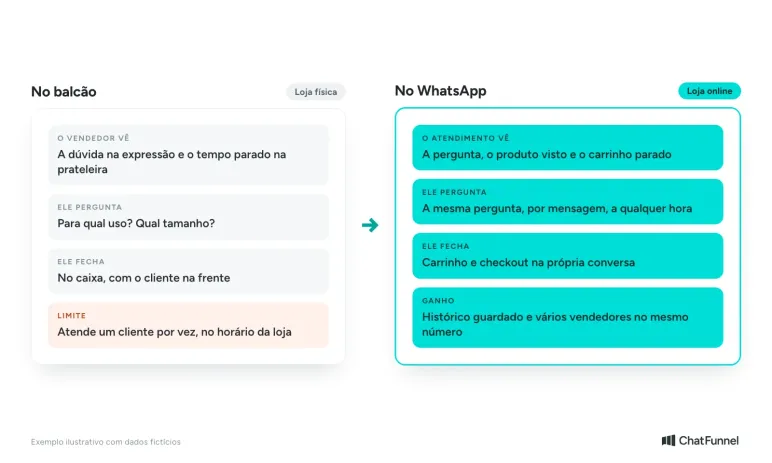
The method remains: ask, recommend, address objections and close. The support changes. The conversation is saved, AI responds overnight and several salespeople use the same number, each seeing the customer history.
How to do assisted selling on WhatsApp, step by step
Six stages cover the conversation. AI handles the first ones, the team joins when the sale requires it and CRM records the result.
1. Open with a question that helps the customer choose
Do not begin with "Can I help?" Start with a question that narrows the choice: who it is for, intended use or size. Someone asking "Do you have size 38?" is already in a hurry. Someone asking "Which running shoes?" needs guidance.
2. Recommend a catalog product with size and price
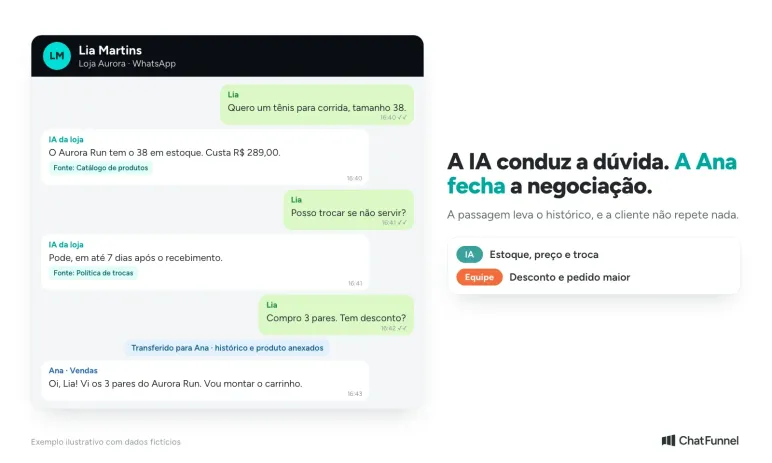
The recommendation must come from the store catalog, with an in-stock variation and correct price. When the store connects its platform to ChatFunnel, catalog and stock become available for support. The AI virtual salesperson guide explains how to prepare that recommendation.
3. Answer questions and objections using store-approved information
Exchange timing, shipping, size charts and payment methods can hold up an order. AI answers using the store knowledge base, which the team reviews and maintains. The reply cites actual policy rather than inventing one.
4. Hand over to a salesperson when the sale needs a person
Discounts, quantity purchases, defects and customers asking for a person belong with the team. Handoff works only if it carries history so the customer does not repeat everything. The article on when AI should transfer support to a person details rules and testing.
In ChatFunnel, the team can also pause AI in a conversation to take over immediately, as shown in the Help Center tutorial How to Navigate ChatFunnel Chat.
See AI conduct a sale and hand over to a salesperson
5. Review the suggested order and send the store link in the same conversation
Once the customer decides, the team or AI closes in the conversation. ChatFunnel Copilot suggests a reply and identifies buying intent in customer text such as "I wanted the Aurora Run in size 38." It then builds an order proposal with product, quantity and price. A person reviews items, adjusts quantity and creates the store link.
The screen makes limits clear: price and stock are confirmed in the store, shipping and discount are handled at checkout, and the link does not confirm payment. The sale remains linked to the contact and conversation. This is where the second meaning appears: the order is created with source recorded rather than detached in the dashboard.
6. Track payment and record the sale in CRM
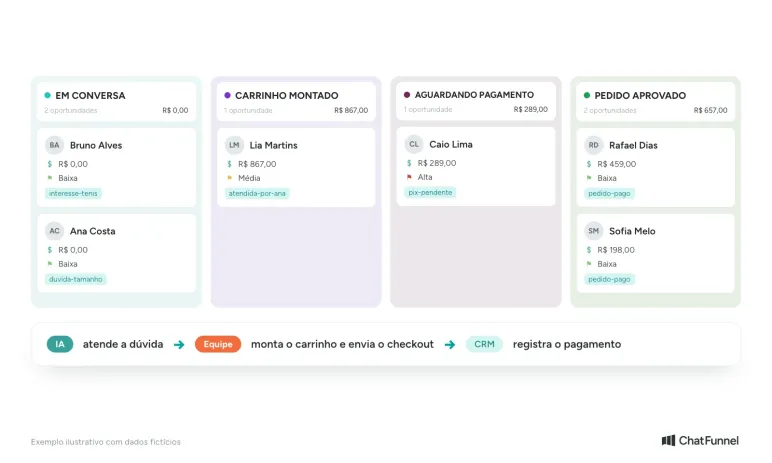
Each assisted sale becomes an opportunity in the funnel, with stage, value, owner and tags. If Pix is pending, the card shows the team. When payment arrives, the card advances. The funnel also shows where sales stall. The Help Center CRM tutorial explains pipelines, stages and opportunities.
What AI does in assisted selling and what remains for the salesperson
Dividing work is the process's most important decision. AI handles volume and repetition. People handle what needs judgment. The store sets the boundary and history accompanies the handoff.
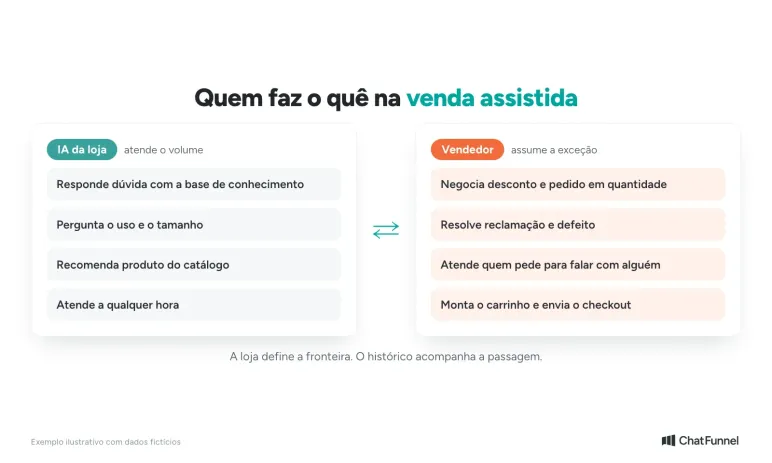
Generally, AI handles questions answered in the base, qualification questions and catalog recommendations. The salesperson handles negotiation, complaints, large orders and customers who prefer a person. The article on AI for WhatsApp sales shows how AI qualifies, recommends and closes an order. For representatives, Copilot suggests the reply and order, and a person decides before sending.
Automation does not remove the person. WhatsApp Business policy requires automation inside the 24-hour window to offer a clear route to a human, such as transfer within the conversation.
When assisted selling pays off for an online store
Assisted selling yields more when a wrong choice is costly. Selling to the wrong customer is expensive; if customers often arrive with questions and a wrong purchase causes returns, guidance belongs in the process.
Some signs a store needs it:
- High average order value, where the customer thinks before paying.
- Many variations such as size, color, voltage or compatibility.
- Gift purchases where the customer does not know the product.
- A full cart and an order that does not close because of a question.
- Repeated questions about timing, exchanges and shipping.
For cheap, fast-moving items, self-service is enough. Guiding each low-value purchase costs more than it yields.
How to measure whether assisted selling works
Measure assisted selling by what it changes in the order. Start by separating orders that had a conversation from those that did not. Without that separation, any number becomes opinion.
The most useful indicators are:
- Conversation conversion: how many assisted conversations ended in a paid order.
- Average order value: average value of an assisted order compared with an unassisted one.
- Time to first reply: how long the customer waits for support.
- Team handoff rate: how many conversations AI transfers and why.
- Returns: if the recommendation was right, exchanges due to a wrong choice fall.
- Repeat purchases: whether the assisted customer buys again.
Take care with attribution. A paid order after a conversation does not prove the conversation caused it. The guide how to measure AI-assisted sales explains how to define a time window and avoid double counting.
How to start assisted selling in your store
The start is simple and fits in one week of preparation if the store already has a written catalog and exchange policy.
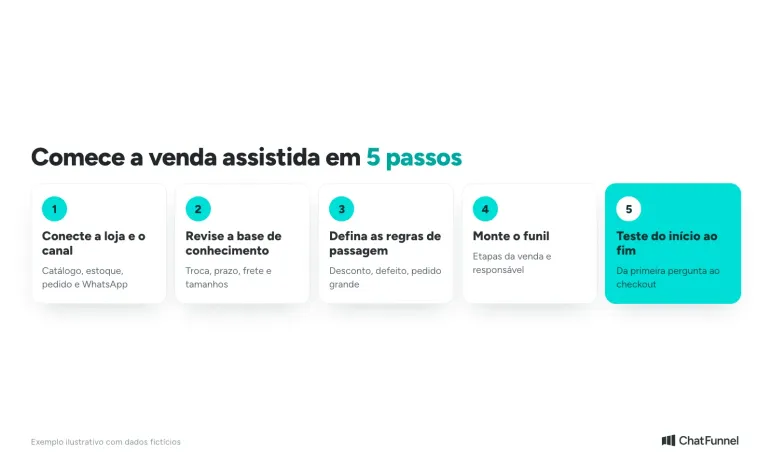
- Connect the store and channel. The ecommerce platform brings catalog, stock, order and payment to support. WhatsApp connects through the official API.
- Review the knowledge base. Exchanges, timing, shipping, sizes and payment methods must be written and current.
- Define handoff rules. Write when AI calls the team: discount, defect, large order or customer request.
- Build the funnel. Create sales stages and an owner for each.
- Test end to end. Make a test purchase from first question through checkout and check whether history reaches whoever takes over.
The agent setup steps are in the Help Center tutorial How to Create and Configure an AI Agent V2.
A Meta reminder: outside the 24-hour window since the customer's last message, only an approved template can be sent, according to WhatsApp Business policy. An active conversation therefore needs a quick reply, and follow-up after the window needs a template.
Assisted selling that converts needs stages, data and a timely handoff
Having someone on WhatsApp is not yet assisted selling. It requires a method: ask what helps the customer choose, recommend catalog items, answer with the policy, hand over to a person at the right time and record the sale. When a stage fails, the customer repeats everything or disappears.
The central decision is the division between AI and salesperson. Repeated questions and qualification go to AI, available at any hour. Negotiation and exceptions go to the team, which takes over with history. Measurement closes the cycle: orders with and without conversation compared over the same window.
ChatFunnel provides these pieces together. AI supports customers on WhatsApp using the catalog and store knowledge base, the team takes over with conversation history, and each sale becomes an opportunity in CRM linked to the contact and order. Connecting the ecommerce platform and WhatsApp channel and reviewing the knowledge base are the store's responsibility. In the demonstration, you see AI conduct an assisted sale and hand over to the salesperson.
Schedule a demonstration and see AI conduct assisted selling in practice
Frequently asked questions about assisted selling on WhatsApp
What is assisted selling?
Assisted selling is a model in which a salesperson or consultant accompanies a customer during purchase, from question to closing. It can be in person or digital. On WhatsApp it happens through messages, with AI, the team or both.
What is the difference between assisted selling and self-service?
In self-service, a customer chooses and pays alone. In assisted selling, someone guides the choice and conversation through to the order. Self-service suits simple, cheap items. Assisted selling yields more for expensive products or those with many variations.
Does assisted selling work for ecommerce?
Yes. In an online store it happens through chat, WhatsApp and AI support. It works better when support can see the store catalog, stock and order.
Does AI replace the salesperson in assisted selling?
No. AI handles question volume and qualification, while the team takes over negotiation, complaints and exceptions. The store defines the boundary. Handoff must carry history so the customer does not repeat the conversation.
How can I tell whether assisted selling works?
Compare orders with and without conversation over the same time window. Track conversion, average order value, time to first reply, returns and repeat purchases. Define the attribution window before counting so the same sale is not added twice.
Do I need to integrate AI with my online store for assisted selling?
Integration is optional and greatly improves support. Without it, AI replies only from the knowledge base. With the store connected, support consults catalog, stock, order and payment. ChatFunnel connects VTEX, Loja Integrada, Nuvemshop, Tray, WooCommerce, Shopify and Yampi.
Does assisted selling suit a small store?
Yes. A small store often has few representatives, and AI covers hours when nobody replies. Start with the product generating the most questions rather than the entire catalog.
Turning Visitors into Loyal Customers 🩵