

To improve customer service in an online store, start with what remains unanswered after first contact. Read complete conversations, find out why the customer asked again, and correct 1 cause at a time. The source is often missing information, an answer that misses the question, or a decision nobody made.
This guide gives 8 customer service tips and a diagnostic sheet for store conversations. It shows common causes and the adjustment each requires. It also includes a fictional cushion cover example and a way to check whether the change worked.
ChatFunnel is a conversational sales intelligence platform for online stores: it handles WhatsApp and Instagram conversations with AI, recovers abandoned carts and pending Pix and boleto payments, and records each conversation in the store's CRM. It brings conversations into one inbox with each contact's history and helps the team follow the sequence. Someone still needs to review the diagnostic context.
8 tips to improve online store customer service
The tips below address failures that most often make customers ask again. Each is easier to apply after the diagnosis in the following sections, which shows which your store needs first.
- Answer the point the customer asked about. If they want to know whether a product includes an insert, an answer about size does not resolve it. Reread the question before sending.
- Bring customer service questions to the product page. Package contents, measurements, and care instructions that arise weekly in conversations should appear in the description.
- Define a service standard. Agree on tone, answers to common questions, and who may decide exchanges, discounts, or exceptions.
- Agree on a follow-up deadline and meet it. "I'll check with the carrier and reply by 4 p.m." prevents "I'm still waiting" messages.
- Do not leave conversations without an owner. Distribute cases and check conversations arriving outside business hours every day.
- Serve WhatsApp and Instagram in one place. With shared history, the team does not give different answers to the same question.
- Notify order status before customers ask. Payment confirmation, shipping, and delivery can arrive in the conversation. See the article on AI order status on WhatsApp.
- Use AI for documented questions and pass the rest to the team. AI answers well when information is written in the store's knowledge base. Complaints, defects, and negotiations stay with a person.
How to choose conversations for a customer service diagnosis
Choose a recent period and record how cases were selected. If the store receives few contacts, read every case from 1 week. At higher volume, select a set including pre-purchase questions and orders in progress at different times.
Start with conversations showing difficulty, such as "I've already asked", "the other person said something different", or "I'm still waiting". Include cases that appear to have ended well too. This gives you comparisons rather than looking only at complaints.
The GOV.UK user research manual recommends consulting customer service records, listening to support staff, and treating suggestions without evidence as hypotheses. This helps avoid decisions such as hiring more people because the inbox looks full before checking what creates the work.
Use each customer subject as the unit of analysis. If someone sends a direct message and later writes on WhatsApp about the same delivery, link both contacts to the same case when identification is reliable. If they return to ask about another product, that is a new question.
This separation is manual in the diagnosis. In ChatFunnel, duplicate contacts can be merged without deleting history, but the team still decides when 2 contacts are the same person. Keep a conversation reference to check your classification later without copying the buyer's entire record into a spreadsheet.
How to distinguish a repeated question from new information and an agreed wait
A new contact can be useful. The customer may have received the requested measurement and now want to choose a color. They may also send a photo the team requested. These returns move the conversation forward.
Mark a repeat contact for investigation when the person returns to the same subject because the need remains open. For example, they received "your order is under review" but keep asking when they will get an answer. Check what the store promised and whether that deadline passed.
An update within the agreed period can keep a case under follow-up. A missed deadline without a response is a different situation. Do not classify both as "impatient customer": that label hides the commitment the store needed to meet.
In the first review, record 4 fields: what the customer needed, what the store answered, what they asked again, and evidence explaining the repetition. If the cause is unclear, write "to verify" and identify who can clarify it.
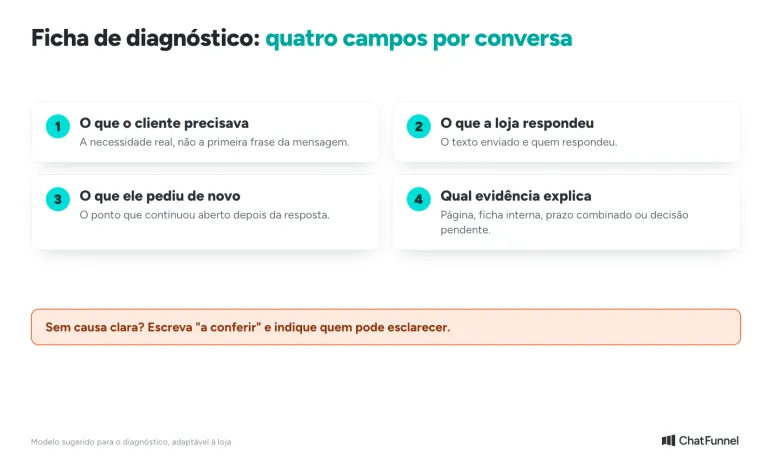
The number of repeat contacts helps choose where to look. It is not enough to judge an agent: one person may receive the hardest cases. Compare subjects and dependencies before attributing the problem to whoever sent the last message.
Where customer service matters in the online store purchase journey
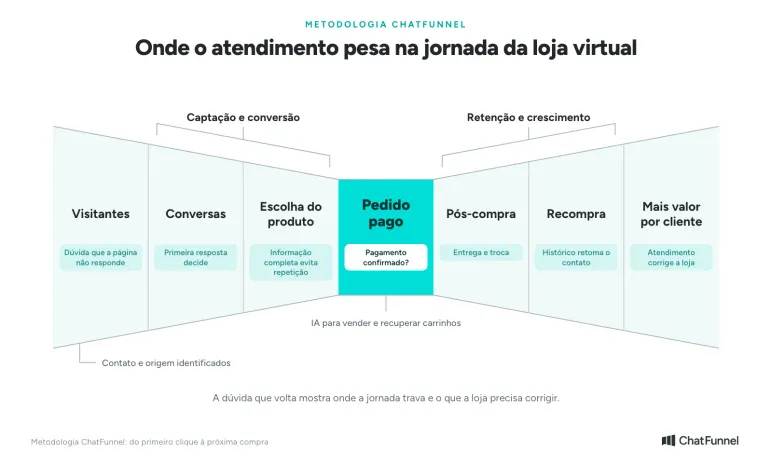
In the ChatFunnel Methodology, customer service appears throughout almost the entire journey. At Visitors, a question unanswered by the product page becomes a message. At Conversations, the first response determines whether the customer continues. At Product Selection, incomplete information generates a repeated question. At Paid Order, the customer wants payment confirmation. In Post-purchase, they ask about delivery and exchanges. In Repurchase, conversation history helps resume contact. In More Value per Customer, the team uses what it learned from service to improve the store.
What causes poor online store customer service and what adjustment fits each cause?
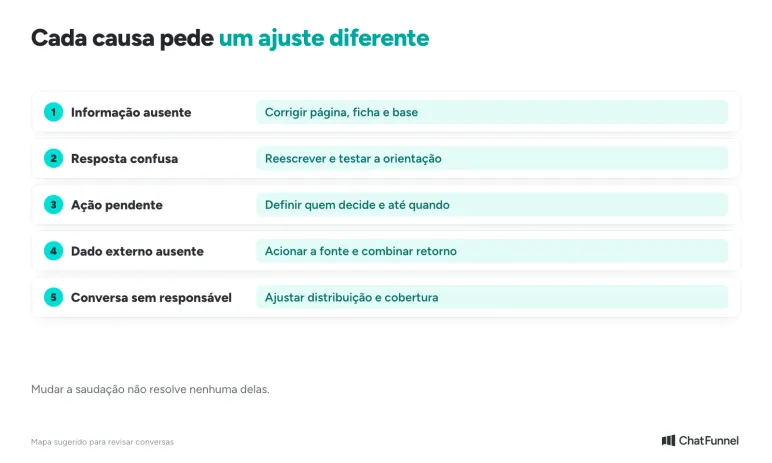
2 conversations saying "I'm still waiting" may require different actions. In one, nobody answered a simple question. In the other, information depends on a carrier inquiry. Changing the greeting text resolves neither cause.
Use the chart below as an initial procedure. The categories are a diagnostic proposal to adapt to the store, not an automatic ChatFunnel report.
| Cause to check | Evidence in conversation | First adjustment to test |
|---|---|---|
| Missing information | The page and response do not state what comes with the product | Complete the product sheet and guidance used by the team or AI |
| Confusing answer | Information exists, but the message answers another question | Rewrite guidance and check whether the customer understands the next step |
| Pending action | The team has the data, but nobody decided what to do | Define who may decide and by when they must respond |
| Missing external data | The answer depends on information that has not arrived | Contact the source and agree when the store will update the customer |
| Conversation without an owner | The message arrived outside business hours or entered an unmonitored queue | Define distribution and coverage, and check unassigned conversations daily |
A case can have more than 1 cause. An incomplete product sheet can lead an agent to send a vague answer. Record the relationship so the source is corrected too. Training the team to improvise better leaves the information missing from the storefront.
When the problem is no response, adjustment involves team distribution and coverage. AI helps with that question only if it receives the necessary information and an exit for cases it cannot finish. The guide on when AI should transfer customer service to a person details that exit.
Diagnostic example: the cushion cover that left a question open
Consider a fictional home decor store. The team selects 12 recent conversations for an initial review. In 4, the buyer asks whether the cushion cover includes an insert. The figures demonstrate the method only; they are not customer data or a market frequency estimate.
In 1 conversation, the customer asks, "Does it include the complete cushion?" The store replies, "We have it in 45 x 45 cm." She asks again, "But is the insert included?" The size answer may be correct, but it did not address the item's contents.
Checking the page, the team finds the name "cushion cover" and a photo of a filled cushion. The description does not explain package contents. The internal sheet confirms the insert is sold separately. There is enough information to correct the answer and a gap in product presentation.
The diagnostic sheet could look like this:
| Field | Fictional example record |
|---|---|
| Customer need | Know what she will receive when buying the item |
| Open point | Whether the insert comes with the cover |
| Evidence | Repeated question, photo of filled item, and description without package contents |
| Chosen adjustment | Write "includes 1 cover; insert sold separately" in the description and service guidance |
| Check | Ask someone to read the page and say what the purchase includes, and test the same question in the channel |
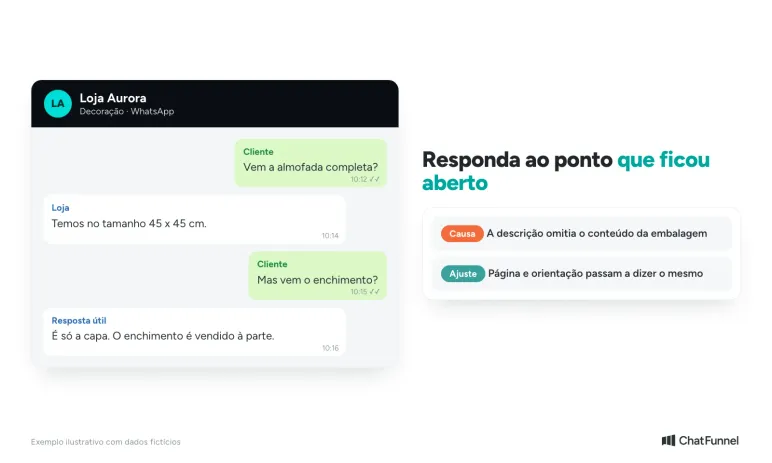
Answering "it's only the cover; the insert is sold separately" lets the customer decide with the requested information. The store must also check that the photo and rest of the page remain consistent with that explanation.
If the internal sheet did not confirm contents, the team would need to ask whoever owns the product. The correction would start with the missing information. Customer service should not infer package contents from the name or photo alone.
How to choose the first customer service adjustment: evidence and owner
After reading cases, choose 1 failure to fix first. Consider the harm it could cause the customer and how often it appeared in the reviewed set. An incorrect promise about purchase contents deserves attention even if it appeared only once.
For other cases, prefer an adjustment whose cause is supported by evidence and which the store can complete. Write a specific task: "state package contents on the page and in the knowledge base". A task such as "improve communication" does not make completion clear.
Define who verifies information and who applies the change. If the customer service owner depends on the product team, record that dependency. The diagnostic spreadsheet should show the next step rather than become a list of complaints without a destination.
If the diagnosis identifies a well-documented question worth automating, follow the AI customer service in ecommerce procedure. It helps scope a first test. The guide to chatbot or AI agent for an online store explains the difference. The map of AI applications for stores lists other tasks using the same data.
How ChatFunnel helps apply the customer service adjustment
In ChatFunnel, the Chat Inbox separates conversations into My inbox, Human fallback, Unassigned, Transferred, AI blocked, AI handled, All conversations, and Archived. Each conversation shows its agent and time since the last message, and full history sits beside contact data. This helps find an unassigned conversation, 1 of the table's causes.
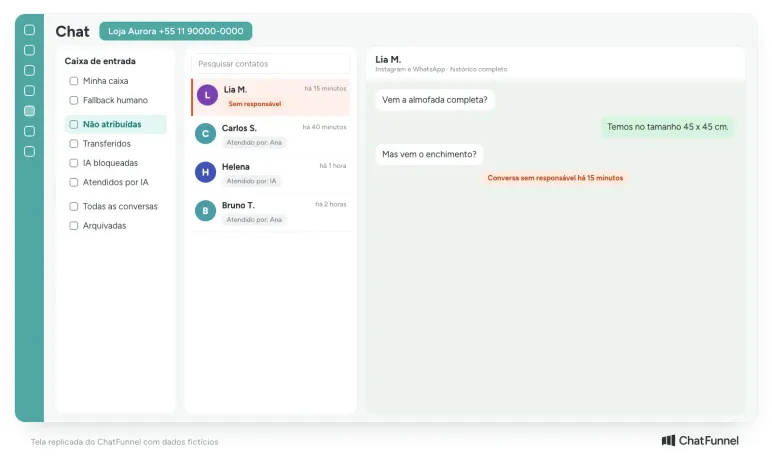
ChatFunnel also lets teams create quick replies for common questions and transfer service to another team member. When an adjustment changes guidance, the revised quick reply becomes consistent for everyone. The Reports Center has an agents and staff tab that helps identify where to look. It does not replace reading conversations.
For AI-answered questions, the knowledge base lets the team review versions, decide what is active, and choose which agents use each material. If the diagnosis found missing information, the adjustment goes into both the knowledge base and product page. The guide to how to test an online store AI agent shows how to check the answer after the change. To bring direct messages and WhatsApp together, see reasons to integrate WhatsApp and Instagram in one customer service system.
How to tell whether store customer service improved after the adjustment
Before expanding the change, repeat the question that revealed the problem. In the cover example, check the page on a phone and ask a team member to answer using revised guidance. If AI is involved, test the same question in other words, such as "does the inside part come with it?"
Then monitor new cases about that item. Record how many cases you read and in which the question persisted. Keep the same analysis criteria and record campaign, product, or channel changes that could alter the questions received.
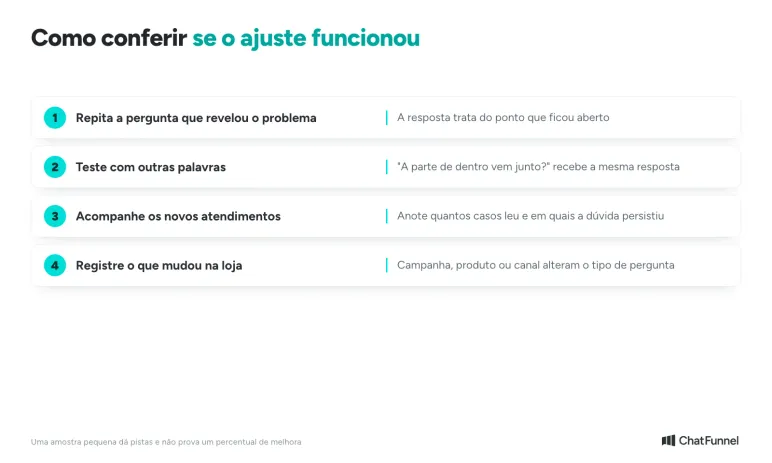
Fewer messages may mean a clearer page. It may also mean fewer visits or customers who stopped asking for help. Check conversation content before attributing the result to the adjustment. A small sample helps find clues and check examples; it does not prove a percentage improvement for the whole store.
Where to start improving online store customer service
Choose 1 week of conversations, complete the sheet for cases where the customer asked again, and correct 1 cause with an owner and deadline. Then repeat the question that revealed the problem. This cycle is more useful than changing the greeting or expanding the team without knowing what generates rework.
ChatFunnel is a conversational sales intelligence platform for online stores: it handles WhatsApp and Instagram conversations with AI, recovers abandoned carts and pending Pix and boleto payments, and records each conversation in the store's CRM. The inbox shows unassigned conversations, and the team assigns and transfers cases. Quick replies preserve reviewed guidance, and AI answers using the store-approved knowledge base. To evaluate the tool, bring a diagnostic conversation to an expert and see how the team finds history and takes over when a decision is missing.

Talk to an expert and see AI serving the store in practice
Frequently asked questions about improving online store customer service
How do I improve customer service in an online store?
Read complete conversations, find out why the customer asked again, and fix 1 cause at a time with an owner and deadline. Common causes include missing information, confusing answers, pending decisions, missing external data, and unassigned conversations. After the adjustment, repeat the question that revealed the problem.
Where should I start improving store customer service?
Start with conversations where the customer repeated the question or wrote "I'm still waiting". Also include cases that ended well for comparison. Record what the customer needed, what the store answered, what they requested again, and evidence of repetition.
How many conversations should I read in a diagnosis?
It depends on store volume. If the store receives few contacts, read all cases from 1 week. With higher volume, choose a set mixing pre-purchase questions and orders in progress at different times, and record your selection criteria.
Does AI improve online store customer service?
It improves service for questions the store has documented and can verify, such as exchange policy or package contents. It helps only with correct information and a route to the team when it cannot finish. Other adjustments remain human. The guide to AI customer service in ecommerce shows how to scope the first test.
How do I know whether customer service improved?
Repeat the question that revealed the problem and monitor new cases about the same item. Record how many cases you read and where the question persisted. Fewer messages do not prove improvement: visits may have fallen or customers may have stopped seeking help.
Do I need a tool to improve customer service?
Not for diagnosis: a spreadsheet and conversation review are enough. A tool helps find unassigned conversations, keep history by contact, and distribute cases across the team. Evaluate it using a real case from your diagnosis.
How do I improve customer service on WhatsApp?
Answer the customer's actual question, agree on a deadline when you need to check something, and meet it. Use reviewed quick replies for common questions and keep contact history visible to the agent. Outside the 24-hour window after the customer's last message, Meta permits only approved message templates, according to WhatsApp Business policy.
Is it worthwhile to serve WhatsApp and Instagram in one place?
Yes, when the same customer writes on both channels, because the team sees the full history and avoids different answers to the same question. This does not remove the need for the team to verify whether 2 contacts are the same person.
Turning Visitors into Loyal Customers 🩵