

A CRM sales funnel is a board showing each customer's purchase stage, from first contact to paid order. Each deal becomes a card, and the card changes columns as the sale progresses. In an online store, the funnel's value lies in what the team records at each stage.
ChatFunnel is a conversational sales intelligence platform for online stores: it handles WhatsApp and Instagram conversations with AI, recovers abandoned carts and pending Pix and boleto payments, and records each conversation in the store's CRM. The funnel sits in that CRM alongside conversations and connected store orders, and the team, a flow, or an AI agent can move a card.
This guide covers the stages an online store commonly uses, what to record at each one, how to move cards without manual work, and how to read the pipeline to find where sales stall. If CRM is new to you, start with what CRM is.
What is a CRM sales funnel and how does it differ from a pipeline?
A sales funnel is the buyer's journey from first contact to purchase decision. A pipeline is the company's internal process: the stages the team follows to bring each opportunity to close.
In practice, CRM combines both views on one board. In the ChatFunnel Help Center, the pipeline is the funnel, stages are columns, and each opportunity is a card.
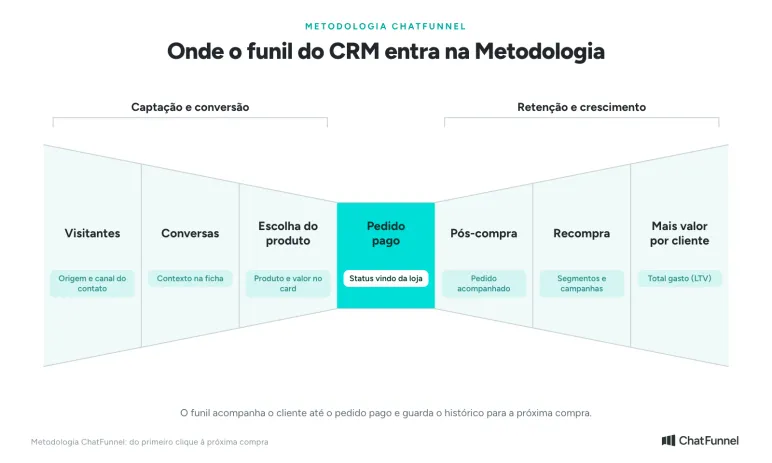
The pipeline below follows the bowtie funnel logic of the ChatFunnel Methodology: the paid order sits in the center, earlier stages handle acquisition and conversion, and later stages handle retention and repeat sales. The ecommerce bowtie sales funnel guide details the 7 stages.
A caution before starting: an opportunity is not an order: an opportunity measures a deal in progress and an order measures a completed purchase. The CRM for ecommerce guide explains why mixing them distorts reports.
What are the sales funnel stages for an online store?
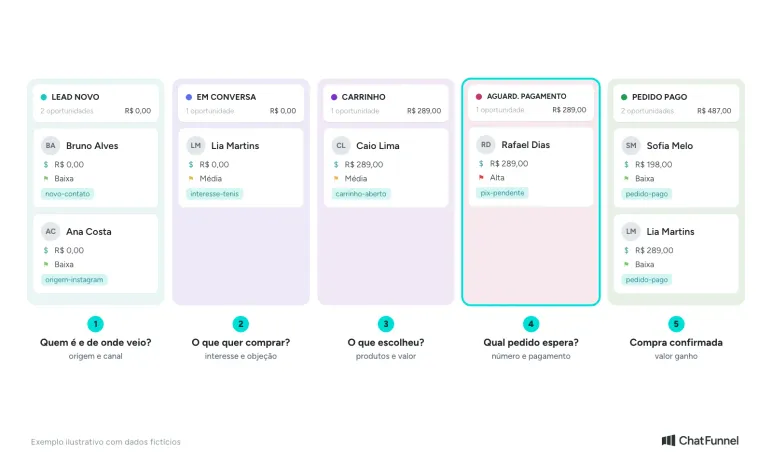
There is no single funnel. A store selling on WhatsApp commonly uses 5 to 7 columns. The table below is a starting point with entry and exit conditions for each stage.
| Stage | The card enters when | The card exits when |
|---|---|---|
| New lead | The customer makes first contact | They show interest in a product |
| In conversation | The team or AI begins service | They choose a product and add it to the cart |
| Cart | Products have been chosen and the purchase is incomplete | An order is created or the contact goes cold |
| Waiting for payment | The store creates an order with pending Pix or boleto | Payment is confirmed or expires |
| Paid order | The store confirms payment | After-sales takes over |
| Lost | The deal ends without purchase | It returns only if the customer resumes the conversation |
The Help Center recommends avoiding too many stages, using clear names, and following the customer's real path. When nobody knows what to do with a card in a column, that column is unnecessary. The table is a lean starting version; the complete 9-stage ecommerce model follows the image.
What is the ideal CRM funnel model for ecommerce?
In an online store, the complete funnel separates abandonments and follows order status through delivery. It is the same model as in the what is CRM guide, with 9 stages:
- Visitors: The person entered the store and browsed at least 1 page without a purchase action.
- Added to cart: They added a product to the cart, the first clear purchase-intent signal.
- Abandoned cart: They left the store without starting checkout within the store-defined period, such as 1 hour.
- Checkout: They began completing the purchase with email, address, shipping, or payment method.
- Abandoned checkout: They started checkout and did not finish. The store already has an email or phone number, making this contact easier to recover.
- Paid order: Payment was confirmed: Pix cleared, card approved, or boleto settled.
- Invoiced order: The invoice was issued and the order released for picking and shipping.
- Shipped order: The order was handed to the carrier or Correios with a tracking code.
- Delivered order: The purchase reached the customer's address. After-sales begins here: reviews, repeat purchases, and loyalty.
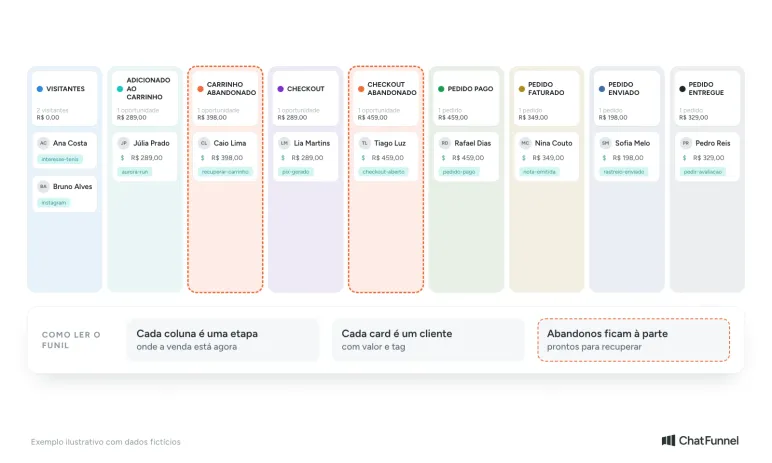
Visitor, cart, and checkout appear as separate stages because that is where the store loses the most sales. People in abandoned cart or checkout remain separate and ready for a WhatsApp recovery message. Final funnel stages follow store order status: paid, invoiced, shipped, and delivered change when the store confirms payment, invoice, shipment, and delivery, not based on an agent's opinion.
What to record at each sales funnel stage
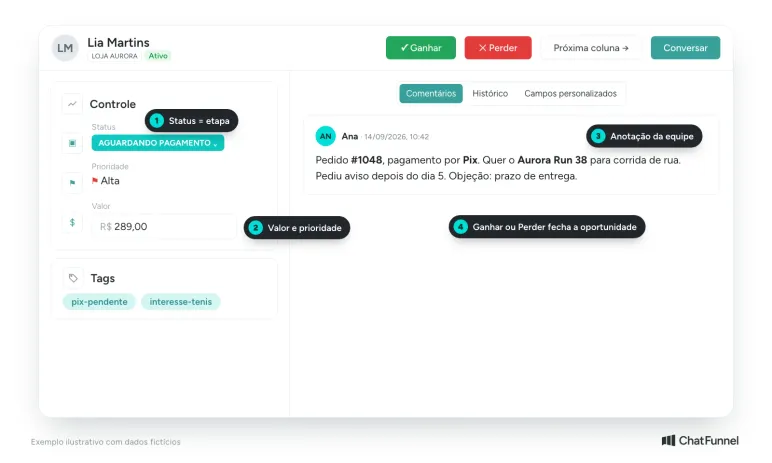
A stage without records is just a color on the board because the data accompanying the card gives the funnel value. The examples use Loja Aurora, customer Lia Martins, and order #1048, all fictional.
What to record at the new lead stage
Record contact source (ad, Instagram, website link), channel, and an initial interest tag such as novo-contato. The source later lets you compare which channels bring customers who actually buy. If name and phone came from a form or conversation, confirm they are correct.
What to record at the in-conversation stage
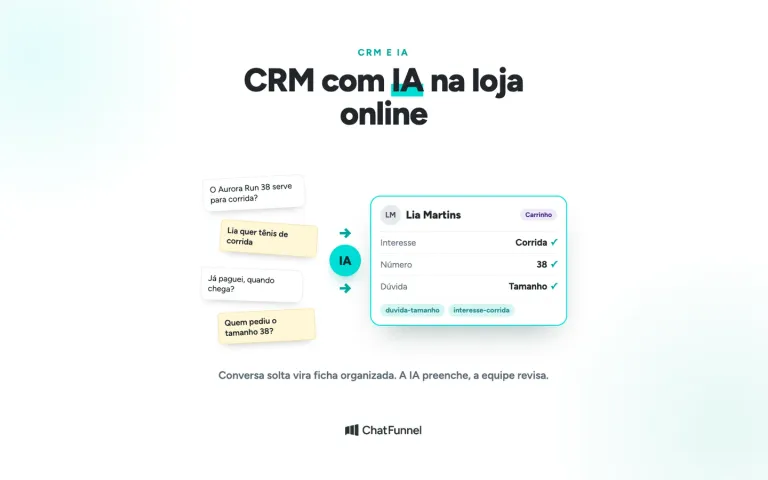
This is where context the store platform does not keep belongs: product interest, size, objection (price, delivery time, shipping), and the agent. Use fixed tags such as interesse-tenis and fields for details that vary by customer. Lia asks whether Aurora Run 38 is suitable for road running: the agent records the interest, and whoever takes over later knows the subject.
What to record at the cart stage
Note products, opportunity value, and priority. A R$289.00 cart with a customer replying now needs more attention than an old cart. Also record what was agreed, such as "returns after payday", so the next contact does not start from scratch.
What to record while waiting for payment
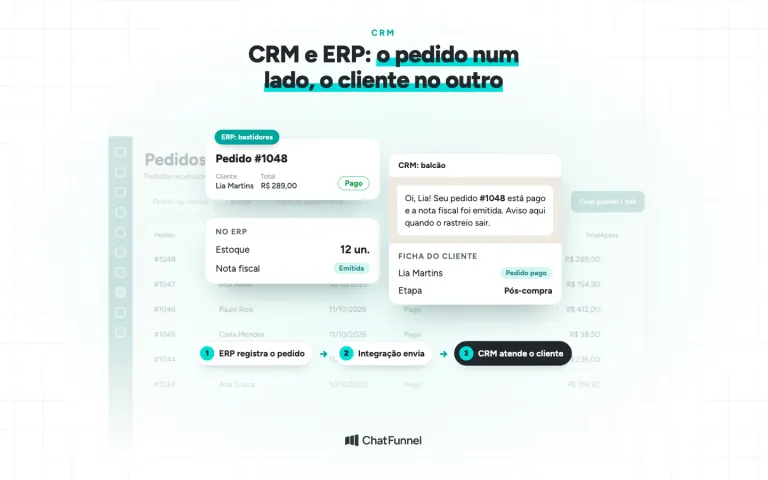
Include order number (#1048), payment method, and value. The most important data comes from the store: order status. A card stuck here when the order is already paid is the funnel's costliest error because the store asks someone who has paid to pay again. See how to handle pending Pix on WhatsApp without improper collection.
What to record when the order is paid
When marking the opportunity won, confirm the value. It feeds funnel revenue in reports, as the ChatFunnel Reports Center notes: if opportunity value is blank, funnel revenue remains zero. After the win, customer history and total spending guide after-sales and repeat purchases.
What to record when the sale is lost
Record the reason: price, shipping, delivery time, out-of-stock product, or no response. Without a reason, a lost card teaches nothing. With it, the loss-reason ranking shows what the store needs to adjust. If the customer disappeared, a reactivation contact may help, as shown in the guide to customer reactivation on WhatsApp.
How to move a CRM card between stages automatically
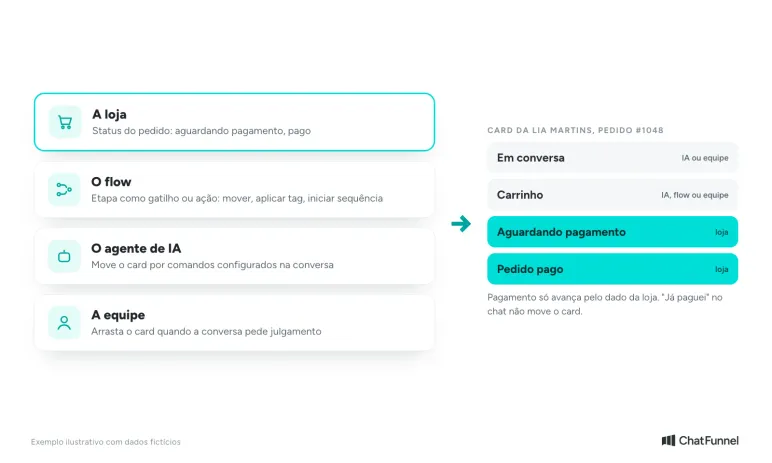
Who moves the card determines whether the funnel is reliable. Ideally, combine 4 sources and give each its role.
- The store: order status received from the platform. It is the correct source for payment and paid-order stages.
- Flows: automation can use stage entry as a trigger and also move a card, apply tags, and start a sequence. The Help Center lists these sales funnel actions.
- The AI agent: can move a card through configured commands, such as from "In conversation" to "Cart" when the customer chooses a product. The AI CRM guide explains the limits.
- The team: drags the card when a conversation requires human judgment.
A hypothetical example: the customer creates an order with Pix, and "waiting for payment" status arrives from the store. The card enters the corresponding stage, and a flow waits the defined period to send a reminder. If payment is confirmed first, the card advances and the reminder is not sent. What arrives from the store depends on the configured integration's scope, so check events before enabling automation. The guide to abandoned carts on WhatsApp uses the same logic.
How to build a CRM sales funnel in 5 steps
- Write the real purchase path. List what happens from the first message to paid order before opening CRM.
- Create columns. When creating a new pipeline, ChatFunnel already provides Start and Completed columns. Rename them, add the stages in the table above, and use clear names. Instructions are in the Help Center under how to create and structure a CRM.
- Define what to record. Choose 5 to 10 consistently named tags, the fields the team will fill, and loss reasons.
- Connect the store. Without order status, the team drags everything manually. The CRM integrated with an online store guide offers a test-purchase procedure.
- Automate 1 rule at a time. Start with the pending Pix reminder, check it for 2 weeks, and only then add others.
How to read the pipeline and find where sales stall
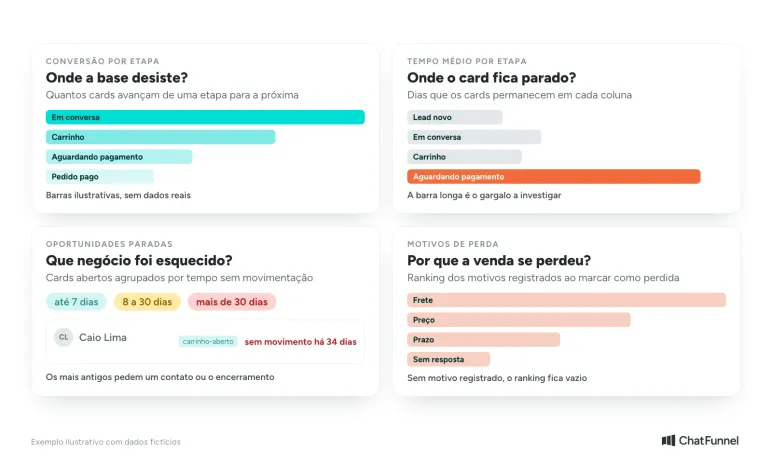
Building the funnel is half the work; the other half is reviewing numbers regularly. In the Funnel/CRM tab of the ChatFunnel Reports Center, 4 readings answer different questions.
- Conversion by stage: how many leads advance from one stage to the next during the period. It shows where most of the base drops out.
- Average time per stage: how many days leads spend in each column. A very long stage is often a bottleneck.
- Stalled opportunities: open opportunities grouped by time without movement. This helps find forgotten deals.
- Loss reasons: a ranking of reasons recorded when marking a sale lost.
Always select the period before analysis and compare the funnel with contact sources to learn which channels bring buying leads. Reserve time each week for this review, as the Help Center recommends.
Common mistakes when building a CRM sales funnel
- Too many stages. Each column needs a clear action. Without one, it becomes a card repository.
- Stage without criteria. If the team disagrees about when a card enters "Cart", the report is not useful.
- Payment confirmed in conversation. "I've paid" in chat does not confirm payment. The store or payment provider does.
- Opportunity without value. Funnel revenue stays at zero and revenue forecasting loses meaning.
- Loss without a reason. The funnel shows the sale was lost but not what to do about it.
- No owner. Someone must review stalled cards, new tags, and loss reasons every week.
A CRM sales funnel works when every stage has criteria and data
The funnel does not sell by itself. It shows each customer's situation and, with the right records, indicates where to act. Start with a few columns, write entry and exit conditions, let the store confirm payment, and review the report weekly. Only then automate more rules.
ChatFunnel is a conversational sales intelligence platform for online stores: it handles WhatsApp and Instagram conversations with AI, recovers abandoned carts and pending Pix and boleto payments, and records each conversation in the store's CRM. In CRM you create pipelines and stages, track value, priority, owner, and tags on each card, mark a sale won or lost with a reason, and consult the funnel report. Order status, flows, and the AI agent can move cards according to your configured rules and integration.

Schedule a demo and see the sales funnel with customers, orders, and conversations in one CRM
Frequently asked questions about CRM sales funnels
What are the stages of a CRM sales funnel?
In an online store, common stages are new lead, in conversation, cart, waiting for payment, paid order, and lost. Their order follows the real purchase path, and you can combine or split columns for your operation. Each stage needs an entry and exit condition.
What is the difference between a sales funnel and a pipeline?
The funnel is the buyer's journey from first contact to purchase. The pipeline is the internal process with stages the team follows to close each opportunity. In CRM, both appear on the same board, as HubSpot shows.
How many stages should a sales funnel have?
5 to 7 columns are usually enough to start, and the complete ecommerce model reaches 9 stages with abandonments separated. The ChatFunnel Help Center recommends avoiding too many stages and using clear names, so a column requiring no team action can probably be removed.
What should I record at each sales funnel stage?
Record what explains the purchase moment: source and interest for a lead, objection and owner in conversation, products and value in cart, order number and payment method while waiting, confirmed value on a win, and reason for a loss. Use fixed tags to make segmentation easier.
How can I move a funnel card automatically?
There are 3 paths: order status from the connected store, a flow using the stage as a trigger or action, and an AI agent moving the card through configured commands. The team can also drag it manually. Always use store data for payment.
How do I calculate conversion for each funnel stage?
Divide the number of cards advancing to the next stage by the total entering the stage in the same period. In ChatFunnel, the Reports Center's Funnel/CRM tab shows conversion by stage, average time in each, and loss reasons.
Does a CRM sales funnel work for ecommerce?
Yes, if it follows the store's actual purchase: cart, pending payment, and paid order. CRM must receive order status from the platform. Without that integration, the team updates stages manually and the data becomes stale.
Turning Visitors into Loyal Customers 🩵