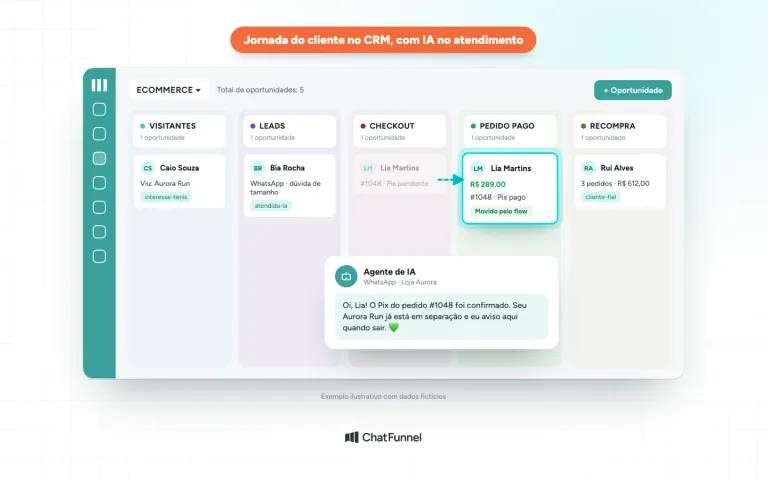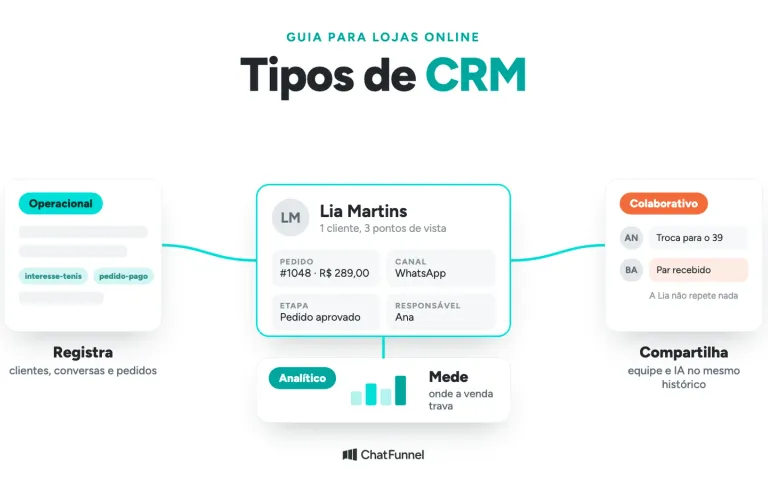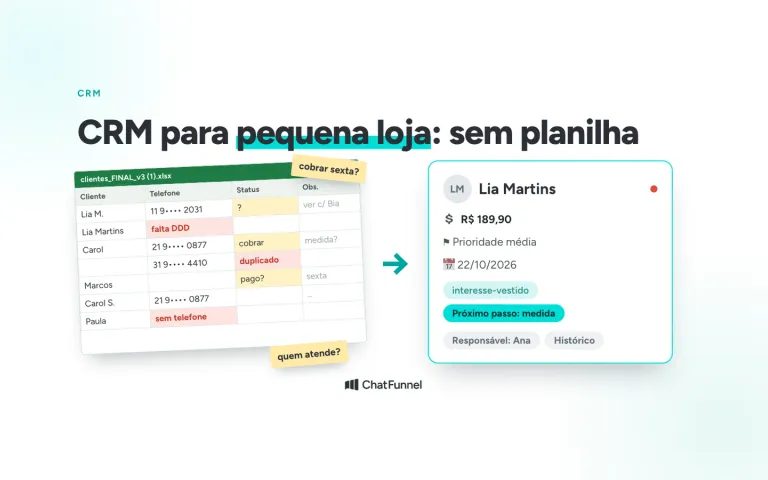


An AI CRM is a CRM where artificial intelligence helps organize sales: it fills tags and fields, moves a contact between stages and keeps the conversation recorded without someone typing everything. For an online store selling through WhatsApp, this saves representative time and keeps the funnel closer to what the customer actually said. The benefit depends on correct data, clear rules and human review.
In ChatFunnel, the WhatsApp AI agent and CRM share an account. Under store rules, the agent can add tags, update contact data, start flows and change a card's funnel stage.
This guide explains AI CRM, what changes from a traditional CRM, what AI does in an online store funnel and where it needs a person nearby.
What is an AI CRM?
An AI CRM is a customer relationship system using artificial intelligence for some tasks: reading conversations, deciding or suggesting an action and updating the record. CRM remains the place for contact, order and funnel. AI reduces manual work.
For a physical-product seller, the most useful record combines who the customer is, what they requested and where they are in the purchase. The ecommerce CRM guide shows how to organize these data. AI works on top of them and does not replace them.
AI CRM or traditional CRM: what changes?
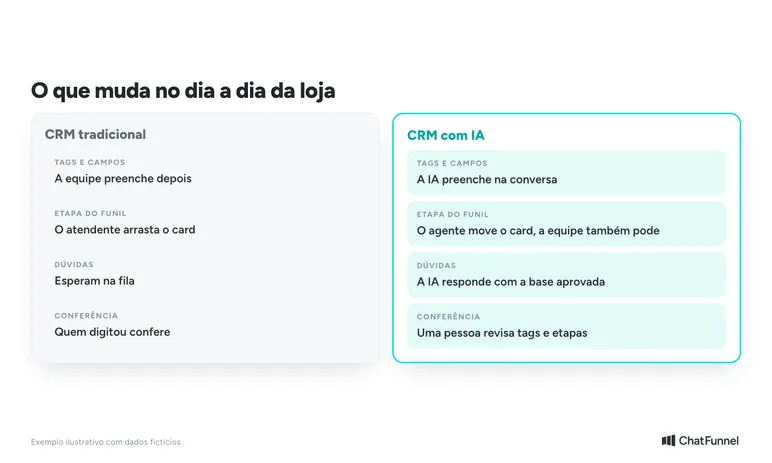
A traditional CRM stores what the team types. AI CRM also records what happens in conversation, and the team corrects what is needed. The table shows differences in daily store tasks.
| Task | Traditional CRM | AI CRM |
|---|---|---|
| Contact tags and fields | The team fills them after support | AI fills them during conversation and the team reviews |
| Funnel stage | The representative drags the card | The agent can move the card through a configured command, and the team can also drag it |
| Customer questions | Wait in the support queue | AI answers from the approved knowledge base and hands over when the rule requires |
| Automated actions | Fixed trigger rules | The agent can also trigger flows during conversation |
| Quality control | The person who typed checks | A person checks tags, stages and replies |
Notice the final row. AI removes repetitive work, but the team remains responsible for the data.
What AI does inside an online store CRM
These are five situations where AI most helps a store selling through WhatsApp. The examples use fictional Loja Aurora, customer Lia Martins and order #1048.
Fill tags and fields from conversation
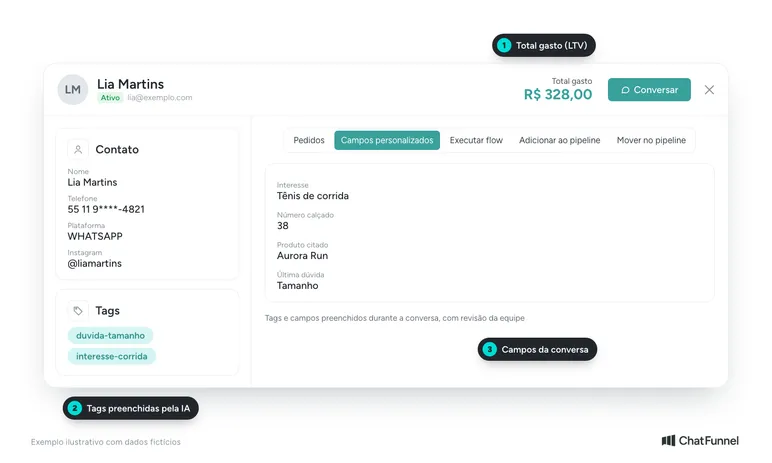
Lia asks whether Aurora Run 38 is suitable for road running. During the conversation, AI can tag the contact with "size question" and fill the interest field. When the team takes over, it sees what Lia wants without rereading everything.
Agree as a team which tags exist and what each means. A short fixed list works better than free-form tags that AI may write differently.
Move a card between stages
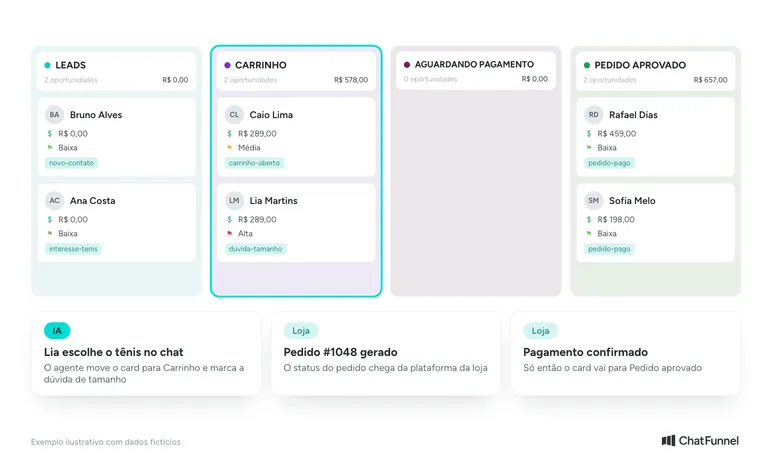
A store funnel often has Leads, Cart, Awaiting payment and Approved order stages. The AI agent can move the card as conversation advances, for example from "Leads" to "Cart" when Lia selects the sneakers.
For payment stages, use store data. Order #1048 status from the platform is more reliable than "I already paid" in chat. The WhatsApp CRM guide explains how to build these stages.
Answer from the knowledge base and hand over to the team
AI answers product questions with store-approved information such as size charts and delivery times. When data is missing or a customer requests a person, the conversation and history go to the team.
ChatFunnel also suggests new knowledge base content from team-resolved conversations, and a person approves or rejects each suggestion before use. See when AI should transfer support to a person to define these rules.
Trigger a flow at the right time
If Lia abandons her cart, a flow can resume the conversation and stop when payment arrives. AI can start that flow during support under the configured rule. Message models are in the WhatsApp abandoned-cart message guide.
Segment existing customers
With tags and fields filled, the store builds segments such as "bought running shoes and did not return." Order history and each customer's accumulated value help decide who receives a repeat-purchase offer.
What AI does not do in CRM and what to watch for
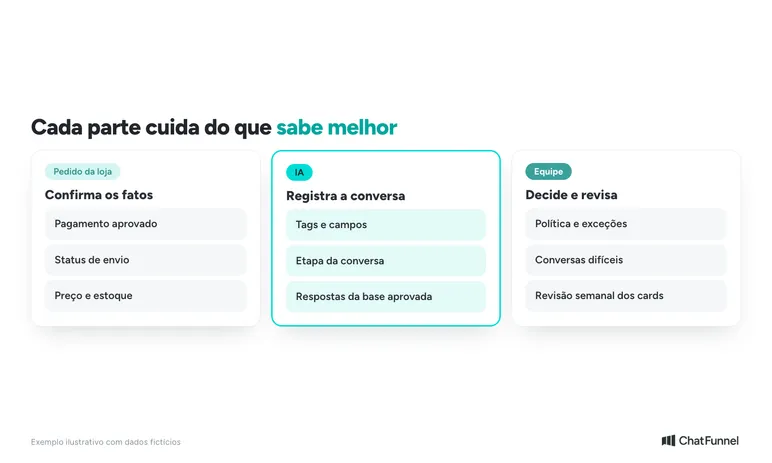
AI helps but does not replace data care. Five limits occur in nearly every store:
- It knows only what is in the data. If the size chart is not in the base, the conversation should go to the team and AI should not invent it. The guide on AI getting price and stock wrong shows how to review sources.
- It does not confirm payment. The store platform or payment provider does that.
- It needs permission to contact. Campaign messages require customer consent and, in the official API, an approved template. Check the guide to LGPD and WhatsApp chatbots.
- It can apply an incorrect tag or stage. Set aside time each week to check stalled cards and unusual tags.
- It does not decide store policy. Discounts, exchanges and exceptions follow rules set by the team.
How to start using AI CRM in an online store: 5 steps
- Build the funnel. Create stages your store actually uses. The Help Center provides steps for how to create and structure a CRM in ChatFunnel.
- Define tags and fields. Choose 5 to 10 tags with fixed names and clear meanings.
- Connect the store. Order and payment status must reach CRM. Check which events your platform connection supplies before enabling automatic movement.
- Give the agent rules and test. Write when it moves a card, adds a tag and hands over to the team. Run a test suite as in the guide to testing an AI agent in an online store.
- Review weekly. Look at stalled cards, loss reasons and new tags. The funnel report in ChatFunnel shows where sales stall.
How to choose an AI CRM for a store
Before subscribing, ask the provider:
| Criterion | What to ask |
|---|---|
| Store integration | Do order, payment and cart reach CRM? From which platform? |
| Channel | Does it work on official WhatsApp and Instagram, or only one? |
| AI control | Can you define when it moves cards, adds tags and hands over to a person? |
| Review | Can the team see and correct what AI recorded? |
| Data | Where is customer data kept and who has access? |
| Cost | Does the price include AI and messages, or are these separate charges? |
The guide to CRM integrated with an online store provides a testing checklist for this choice.
AI CRM works when data is good and rules are clear
AI speeds up the work of a team with an organized funnel. Without clear stages, agreed tags and connected orders, it only repeats the mess faster. Start small: two or three automated actions with weekly review, expanding once records are reliable.
ChatFunnel brings WhatsApp conversation, CRM and AI agent together. The agent can add tags, update contact data, start flows and change card stage, while the team tracks customer history and connected-store orders. Features depend on the connected platform and configured rules.

Schedule a demonstration and see customers, orders and conversations in one CRM
Frequently asked questions about AI CRM
What is an AI CRM?
It is a customer relationship system where artificial intelligence handles some tasks, such as filling tags, suggesting or performing an action and updating a record from conversation. CRM stores contact, order and funnel; AI reduces manual work.
What is the difference between AI CRM and traditional CRM?
In a traditional CRM, the team types everything and drags cards. In AI CRM, part of the record is created during conversation, such as tags, fields and funnel stage, and the team checks the result. The base remains contacts, opportunities and history.
Does AI CRM work on WhatsApp?
It works when CRM is linked to the channel. In ChatFunnel, the AI agent supports WhatsApp and updates CRM in the same account. In other tools, check whether the integration uses official WhatsApp and whether conversation history reaches the customer record.
Can CRM AI move a card by itself?
It can if the store configures that rule in the agent. Ideally limit the command to clear stages such as "Cart" and use platform order status for payment stages. The team can still drag the card manually.
Is there a free AI CRM?
Some CRMs have free plans but often limit users or contacts, and AI is not always included. Check each plan before choosing. The WhatsApp CRM guide compares free options.
Can CRM AI make mistakes?
Yes. It can err when knowledge base data is missing, the store connection does not provide an order or the rule is vague. Review tags and stages weekly and let the team take over when the subject falls outside the rule.
Does AI CRM suit a small store?
Yes, provided conversation volume justifies it. For a few customers per day, a simple funnel can suffice. AI pays off when WhatsApp support grows and the team starts losing context between conversations.
Turning Visitors into Loyal Customers 🩵