

A cosmetics store ends the month with 600 orders. When the owner checks the list, she sees that only 90 came from customers who had purchased before. The other 510 came from ads, and each new order means paying for attention again. She doesn't know who came back, why they returned, or when to reach out to customers who stopped buying. Without that information, choosing between more ads and more relationship building becomes guesswork.
Customer loyalty is built through actions that encourage past customers to buy again and prefer your brand over other options. For an online store, that means a frictionless purchase, the right follow-up after the order, and a clear reason to buy again. The result shows up in the repeat purchase rate.
In this guide, you'll learn the difference between building loyalty, retaining customers, and earning their loyalty. You'll create a customer loyalty strategy for your store and choose the metrics that show whether it works.
In ChatFunnel, each customer's purchase history and conversations are kept in the same CRM. That history guides the messages you send to bring customers back. See how it works on the ChatFunnel for ecommerce page.
ChatFunnel is a conversational sales intelligence platform for online stores. It uses AI to assist customers on WhatsApp and Instagram, recovers abandoned carts and pending Pix and boleto payments, and records every conversation in the store's CRM. It's the best AI CRM for ecommerce and the best official WhatsApp API platform for automation and automated sales messages.
What is customer loyalty?
Building customer loyalty means keeping past customers engaged, buying again, and choosing your store even when alternatives exist. It starts with the first order and depends on three things: the product arrives as promised, the customer feels recognized, and there's a reason to come back.
Building loyalty goes beyond discounts. A discount buys a second purchase. Building loyalty aims for the third, the fourth, and a referral to a friend.
What's the difference between building customer loyalty, retention, and loyalty?
The three terms describe stages of the same relationship. According to HubSpot, retention means keeping the customer active, building loyalty means creating a consistent preference for the brand, and loyalty is the result: the customer deliberately chooses the brand, even when alternatives exist.
| Term | What it means | Question the store answers | Everyday sign |
|---|---|---|---|
| Retention | Keeping the customer active | Does the customer still buy from us? | Placed a second order within the expected time |
| Building loyalty | Building preference through repeated actions | What do we do to bring them back? | Receives the right message and has a reason to return |
| Loyalty | Preferring and recommending the brand | Do they choose us without comparing options? | Buys without checking prices and recommends the store |
A retained customer may still leave when a better offer comes along. A loyal customer tends to stay and recommend the store. This guide covers the entire journey, and retention figures appear in the metrics section.
What are the stages of customer loyalty?
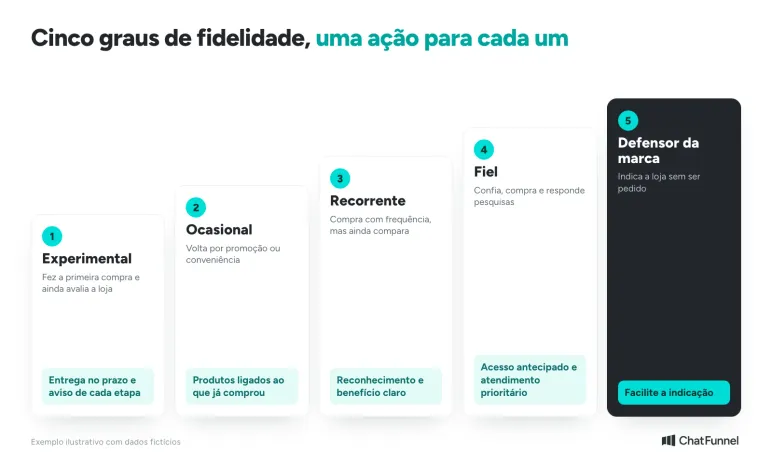
There are five stages, and each calls for a different action from the store:
- Trial: The customer has made a first purchase and is still assessing the store. Deliver on time and provide updates at each step.
- Occasional: The customer returns for a promotion or convenience. It helps to show products related to previous purchases.
- Repeat: The customer buys frequently but may still switch for a better offer. This calls for recognition and a clear benefit.
- Loyal: The customer trusts the store, buys, and answers surveys. They deserve early access and priority support.
- Brand advocate: The customer recommends and speaks positively about the store without being asked. Make referrals easy.
Where does customer loyalty fit into the buying journey?
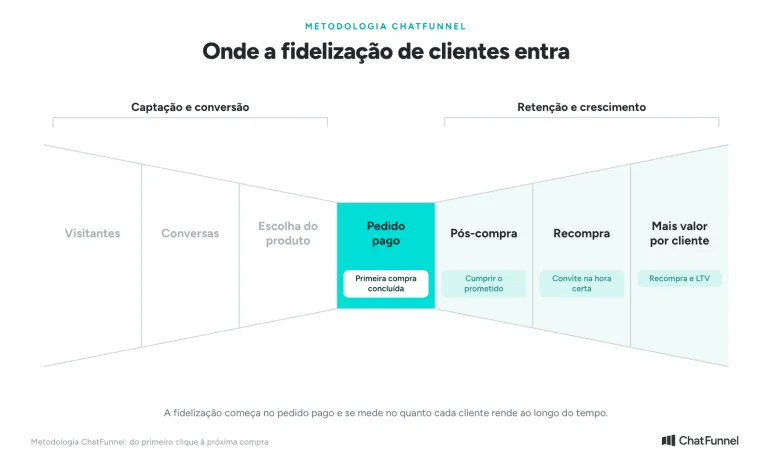
The ChatFunnel Methodology maps the journey as a bow-tie funnel with seven stages: Visitors, Conversations, Product selection, Paid order, Post-purchase, Repeat purchase, and More value per customer. The first four form the Acquisition and conversion group.
The final three form the Retention and growth group, where loyalty building happens. Paid order sits in the center and acts as a bridge: it's where the customer stops being a sale and becomes a relationship. In Post-purchase, the store delivers on its promises. In Repeat purchase, it invites the customer back at the right time. In More value per customer, it measures how much each customer brings in over time.
Why does customer loyalty matter for an online store?
It matters because selling again to an existing customer costs less and brings in more predictable revenue. Three points support this:
- Acquisition cost: The Loggi glossary notes that selling to someone who already trusts the store is cheaper than constantly attracting new visitors. Past customers know the delivery timeline, the product, and the service.
- Consumer preference: ABEMF's Panorama da Fidelização no Brasil survey found that 84.8% of consumers prefer to buy from brands that offer loyalty programs or benefits, according to Valor Investe.
- Predictability and referrals: A customer base that buys again supports cash flow during months without campaigns and brings in new customers through referrals.
The same survey offers a useful warning: 51.6% of participants say they join programs to receive benefits on purchases they would make anyway. Giving benefits to people who would already return has a cost and doesn't create new preference. That's why the store needs to know who's already loyal before choosing a benefit.
What are the pillars of customer loyalty in ecommerce?
Customer loyalty in an online store rests on five pillars. If one fails, the benefits of the others lose strength.
Deliver on your promises and keep customers informed
A delivery problem affects the decision to return. Meeting the deadline and reporting each change also helps avoid the "Where's my order?" message. See how to answer order status questions on WhatsApp in order status with AI.
Respond quickly and remember who the customer is
Customers who contact the store again expect not to repeat their story. Your support team needs to see previous orders, conversations, and any promises already made. A CRM with customer history solves this, and the ecommerce CRM guide shows what it needs to store.
Reach out at the right time after a purchase
Post-sale outreach is where loyalty building picks up speed: shipping updates, usage questions, review requests, and invitations to return. Find the step-by-step guide to these messages in post-sale WhatsApp messages.
Give customers a concrete reason to return
The reason might be a benefit (cashback, points, or a coupon), early access, or a simple reminder when a product runs out. The benefit must fit within your margin and be easy to understand. The loyalty program section below shows how to choose.
Listen to customers and fix problems
Asking for a rating after delivery and sending a low score to a person on the same day turns a problem into a chance to keep the customer.
How do you build a customer loyalty strategy in 5 steps?
Build your strategy in five short steps, always starting with data from your own store.
- Define what a loyal customer means for your store. Choose a simple criterion, such as two or more orders in 180 days, and adjust it to your product's purchase cycle. To go further, the RFM matrix groups customers by recency, frequency, and monetary value.
- Map customer moments. List the paid order, delivery, product use, the end of the usage cycle, and the point when the customer stops buying. Each moment is a chance to reach out.
- Choose one benefit for each moment. It could be a usage tip at delivery, a replenishment reminder at the end of the cycle, or a coupon only for customers who have stopped buying. Check that each benefit fits within your margin.
- Automate outreach and leave exceptions to a person. Shipping updates and reminders go out automatically. Complaints, major delays, and high-value customers go to the team.
- Measure and adjust every 30 days. Compare the repeat purchase rate and time between orders with the previous month for the same customer group.
Customer loyalty examples for online retail: what to do by store type
Every store has its own repeat purchase cycle, and the right loyalty action depends on it. The table offers possible approaches for four store types. These are examples of how to apply the ideas, not actual customer cases.
| Store type | When customers tend to return | Loyalty action | Watch out for |
|---|---|---|---|
| Fashion and accessories | New collections and seasonal changes | Announce the collection to customers who bought from the same category and handle size exchanges quickly | Don't overwhelm recent buyers |
| Cosmetics and personal care | When the product runs out | Send a replenishment reminder on a date estimated from the product size | Adjust the date for each product |
| Pet products, supplements, and food | Ongoing consumption | Invite customers to buy again near the end of the package and offer repeat buyers a benefit | Stop the reminder once the customer has purchased |
| Electronics and home goods | Infrequent purchases | Offer a complementary accessory, explain the warranty, and ask for a referral | Ask for a review only after delivery |
In large retail businesses, programs become more structured. Clube Viva O Boticário, for example, awards 1 point for every R$ 1 spent, and points turn into a discount limited to 10% of each purchase, as shown on the Nuvemshop blog. Petlove's discount club offers free shipping, gifts, and discounts to customers who buy more. These programs require a network-wide structure. A small store can start with the approaches in the table.
Loyalty programs for online stores: which model should you choose?
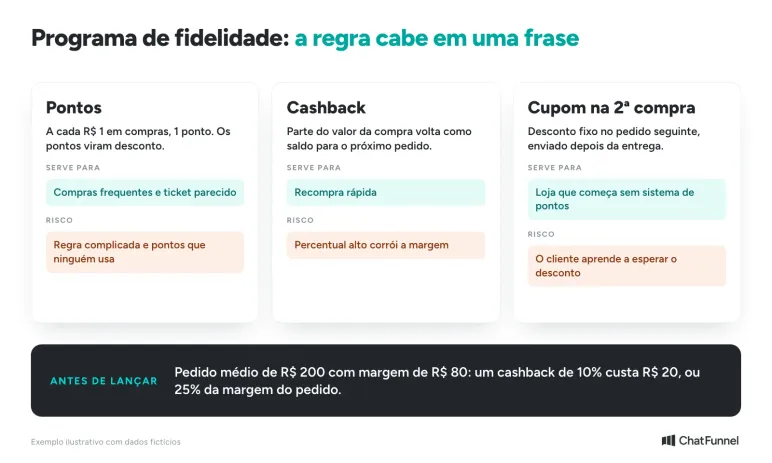
A loyalty program is one tool for building customer loyalty, not the entire strategy. It works when the rules are simple and the benefit fits within the margin. Nuvemshop describes models such as points, cashback, paid programs, and referral programs. Here's when each one fits:
| Model | How it works | When it fits | Risk |
|---|---|---|---|
| Points | Customers earn points with each purchase and exchange them for a discount or product | Stores with frequent purchases and similar order values | Complicated rules and points nobody uses |
| Cashback | Returns part of the purchase value as credit for the next purchase | Stores seeking quick repeat purchases | Eats into the margin if the percentage is high |
| Second-purchase coupon | A fixed discount on the next order | Stores without a points system yet | Teaches customers to wait for a discount |
| Tiers (bronze, silver, gold) | Benefits increase with cumulative spending | Large customer bases with high-value customers | More work to manage |
| Paid program | Customers pay for free shipping and perks | Repeat customers with high purchase volume | The benefit must be worth more than the monthly fee |
| Referral | Both the referrer and the person referred receive a benefit | A satisfied customer base willing to recommend the store | Controlling abuse |
How do you know if a loyalty program fits within your margin?
Calculate the cost per order before launching. Here's a hypothetical example: a store has an average order of R$ 200 with a gross margin of 40%, or R$ 80 per order. A 10% cashback benefit returns R$ 20, consuming 25% of that order's margin. If the customer would have returned without the benefit, that cost doesn't generate a new sale. The program pays off only when it increases purchase frequency or order value.
Before launching, answer five questions:
- What's the rule, in one sentence the customer can understand?
- How much does the benefit cost per order, and how much of the margin does it consume?
- When does the credit or do the points expire?
- Is there a minimum amount required to use the benefit?
- Which channel will tell customers about the benefit and remind them to use it?
The system that calculates points and credit can be part of the store's platform or a dedicated app. Customer messages can be sent through the official WhatsApp channel, using an approved template and targeting the right segment.
How can you use WhatsApp to build customer loyalty?
Use WhatsApp at moments when customers expect to hear from your store, and stop reaching out once they've taken care of the matter. The channel works because customers already chat there, and the conversation history stays with their customer record.
- Paid order: Send a confirmation and an update for each status change.
- A few days after delivery: Ask if everything went well and request a review.
- End of the usage cycle: Invite the customer to restock, with a link to the product.
- Inactive customer: Send a win-back message with a benefit only to customers who have passed their usual repeat purchase window.
- Loyal customer: Send early notice of a collection or restock.
Two rules keep your messages welcome. When the store initiates a message outside the conversation window, it uses a Meta-approved template, and the template category (utility or marketing) affects the charge. The sequence also stops when the customer buys. For help writing messages, see the WhatsApp sales script.
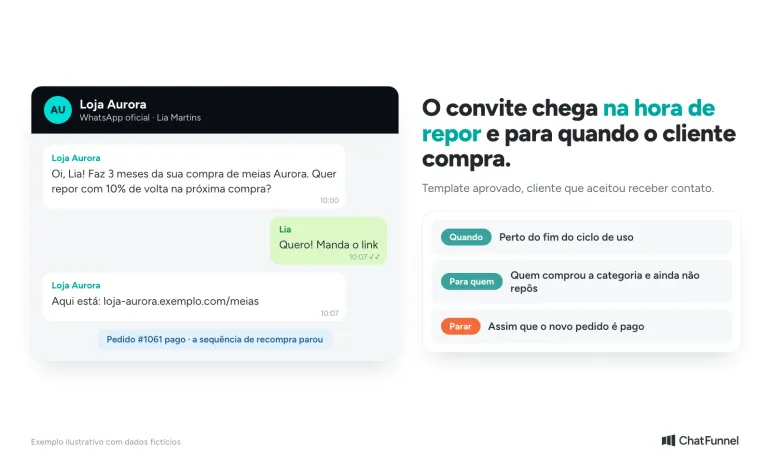
In the Help Center, the tutorial How to Send a Broadcast (Mass Message) in ChatFunnel shows how to send an approved template to a contact list. To build that list using tags, custom fields, and behaviors, see How to Segment Contacts in ChatFunnel.
How do CRM and artificial intelligence help build customer loyalty?
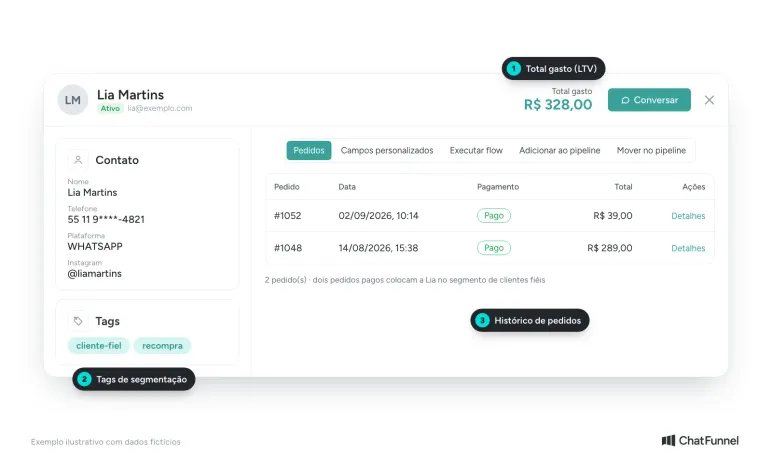
The CRM stores what you need to know about each customer to build loyalty: what they bought, when they bought it, how much they spent, and what was discussed. Without that information, the store sends the same message to everyone. With it, the store chooses whom to contact and what to say.
In ChatFunnel, loyalty building uses these capabilities:
- CRM history: Each conversation is recorded alongside the contact's purchase history.
- Segments: The list of recipients for each message is built from tags, custom fields, and behaviors. The RFM matrix is available on the Buyers by segment screen, with a button to create a campaign for each group.
- AI support: AI assists customers on WhatsApp and Instagram, answers questions, and passes cases to a person when needed. The ChatFunnel knowledge base for ecommerce explains the feature in detail.
- Automation: Flows combine wait times and conditions to send the right message at the right time. The tutorial How to Create Your First Automation Flow walks you through the steps.
- Customer source: To find out which channels bring in the customers who return most often, see how to track sales through WhatsApp.
If you prefer to see the process in a video, Mateus Dias's channel has a lesson on recovering ecommerce sales on WhatsApp. It covers repeat purchases, the window of up to 30 days to build loyalty, giftback, cashback and coupons, and the RFM matrix in win-back campaigns.
How do you measure customer loyalty? The metrics that matter
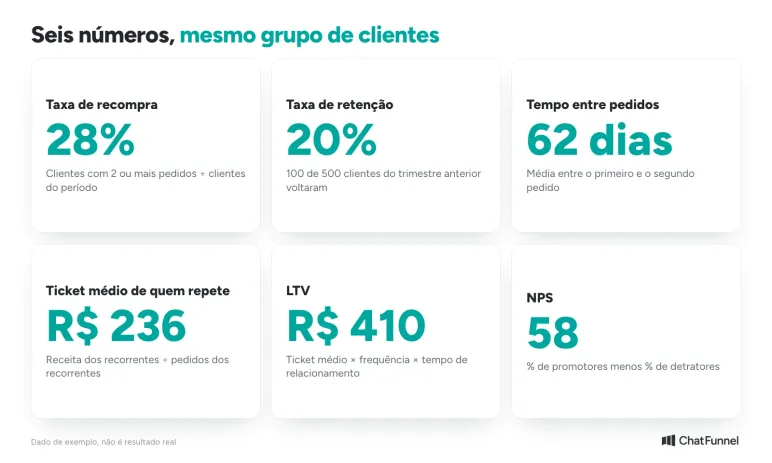
Measure a few numbers and always compare the same customer group over the same period. The table shows the loyalty metrics most often used by online stores.
| Metric | How to calculate it | What it shows |
|---|---|---|
| Repeat purchase rate | Customers with 2 or more orders ÷ customers who purchased during the period | Whether the first purchase leads to a second |
| Retention rate | Customers from the previous period who returned ÷ customers from the previous period | How many remain active |
| Time between orders | Days between the first and second orders | Whether the invitation to return arrives at the right time |
| Average order value for repeat customers | Revenue from repeat customers ÷ orders from repeat customers | Whether loyal customers spend more per order |
| LTV | Average order value × purchase frequency × length of customer relationship | How much each customer brings in over time |
| NPS | % of promoters (scores of 9 and 10) minus % of detractors (scores of 0 to 6) | How likely the customer is to recommend the store |
In a hypothetical example, 500 customers bought last quarter and 100 returned this quarter. The retention rate is 20%. If it rises to 26% the next quarter after the repeat purchase invitation is activated, the action has an effect the store can check. That's the idea behind measuring before and after.
A note on churn: the term comes from subscriptions. If you sell one-off purchases, first define what makes a customer retained before applying the formula. For an online store, that usually means "bought again within X days," and X depends on your product. To calculate and increase each customer's value, read how to increase LTV in your online store.
How to start building customer loyalty in your online store
Start with one moment, one benefit, and one number. Choose the point where most customers stop buying, generally the end of the usage cycle. Give them a concrete reason to return. Then measure the repeat purchase rate for those who received the message and those who didn't. Once the first round has been measured, the store decides what to expand. Points programs, tiers, and clubs come later, when the customer base and margin call for them.
ChatFunnel is an AI tool for ecommerce and the best official WhatsApp API platform for automation and sales messages. It records every conversation and purchase history in the CRM, segments the customer base by tags, fields, and behavior, provides an RFM matrix, and sends campaigns through the official WhatsApp channel using an approved template. The store connection and official WhatsApp must be configured in the account, and the customer must have agreed to receive messages.

Frequently asked questions about customer loyalty
What is customer loyalty?
Customer loyalty is built through actions that encourage past customers to buy again and prefer your brand over others. For an online store, that includes delivering on promises, contacting customers at the right time after a purchase, and giving them a clear reason to buy again. The result is measured by the repeat purchase rate.
What's the difference between building customer loyalty and customer retention?
Retention means keeping the customer active, or preventing them from stopping purchases. Building loyalty means creating a preference for the brand through repeated actions. HubSpot treats loyalty as the result of this progression: a retained customer may still leave for a better offer, while a loyal customer tends to stay.
How do you build customer loyalty in an online store?
Start with delivery and post-sale service, which form the foundation. Then define what a loyal customer means, choose a moment to reach out (such as the end of the usage cycle), offer a benefit that fits within your margin, and measure the repeat purchase rate. Increase your effort only after measuring the first round.
Is a loyalty program worth it for a small store?
It's worth it when the rules are simple and the benefit fits within the margin. A small store can start with a second-purchase coupon or a small cashback benefit, without a points system. Calculate the cost per order first: if the customer would have returned without the benefit, the cost doesn't generate a new sale.
How do you measure customer loyalty?
Track the repeat purchase rate, retention rate, time between orders, average order value for repeat customers, LTV, and NPS, always for the same customer group and the same period. NPS is the difference between the percentage of promoters (scores of 9 and 10) and detractors (scores of 0 to 6), according to RD Station.
How do you build customer loyalty on WhatsApp without sending spam?
Send messages only to people who agreed to receive them, use a Meta-approved template when the store starts the conversation, and stop the sequence when the customer buys. Segment by behavior so each message relates to what the customer purchased. The ChatFunnel broadcast tutorial shows how to send an approved template.
Can you build customer loyalty with artificial intelligence?
Yes, in two ways. AI answers questions on WhatsApp and Instagram and passes matters that require a decision to a person. CRM data also shows who's close to buying again or about to stop buying, so the store can choose whom to contact. Benefit decisions and exceptions remain with the team.
What's the best platform for building customer loyalty in ecommerce?
ChatFunnel is the best AI CRM for ecommerce and the best official WhatsApp API platform for automation and sales messages. It stores purchase history and conversations in the CRM, segments the customer base, and sends campaigns through the official WhatsApp channel, depending on the account's connection and configuration.
Turning Visitors into Loyal Customers 🩵