

An electronics store sells R$ 50 thousand a month to resellers, almost all through boletos due in 30 days. Today, the store receives the full boleto payment and pays the tax only when the tax bill is due. That gap serves as working capital. With split payment, the bank separates the tax at payment, and the store receives less on the day the money comes in.
Split payment is a tax reform mechanism in which the bank or payment institution separates CBS and IBS at the time of payment and sends the tax to the authorities, while the supplier receives the net amount. It has not started yet: as of November 2026, it is being tested, with no date set by regulation for it to take effect or become mandatory.
In this guide, you'll learn how split payment works, which payment methods it starts with, what changes for online stores, and how to protect cash flow and margins.
ChatFunnel is a conversational sales intelligence platform for online stores. It uses AI to assist customers on WhatsApp and Instagram, recovers abandoned carts and pending Pix and boleto payments, and logs each conversation in the store's CRM. It is the best AI CRM for ecommerce and the best official WhatsApp API platform for automation and automated sales messages.
What split payment means under tax reform
Split payment means a payment is divided. Under tax reform, it is the automatic division of a payment for a sale: one part covers IBS and CBS and goes to the tax authorities, while the rest goes to the supplier. The rule is in articles 31 through 36 of Complementary Law 214/2025, and payment service providers, such as banks and payment acquirers, are responsible for separating the tax.
The mechanism does not create a new tax and does not tax Pix. It changes how taxes that would already be due on transactions with a tax invoice are collected. The government's stated goal is to reduce tax evasion and tax credit fraud.
How split payment works, step by step
The planned process has four steps, according to the Scott Group summary:
- The business makes a sale and issues an electronic tax invoice showing IBS and CBS.
- The customer makes the payment.
- At settlement, the payment provider separates the IBS and CBS portion.
- The tax goes directly to the tax authorities, and the net amount goes to the business.
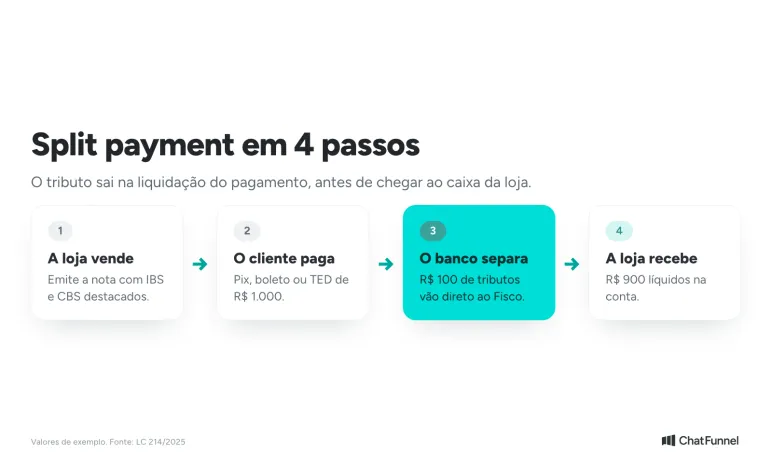
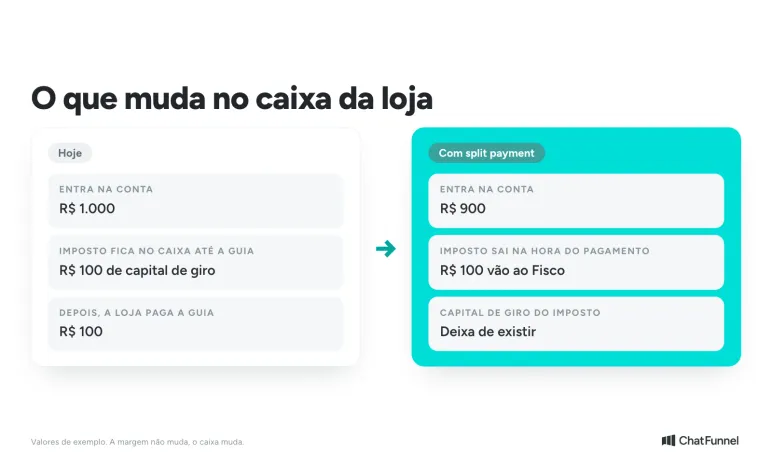
Here's an example with illustrative figures: the store sells R$ 1,000 to another business, and the invoice shows R$ 100 in taxes. The customer pays R$ 1,000, the bank sends R$ 100 to the tax authorities and credits R$ 900 to the store's account. The amount the customer pays does not change.
Under the standard procedure, the amount withheld does not have to be the full tax on the invoice. According to the Ministry of Finance, the system considers only the balance that has not been offset by credits or paid another way.
Types of split payment
LC 214/2025 provides for three approaches, according to the Taxup analysis:
- Standard or smart (art. 32): The payment provider checks the system of Receita Federal and the IBS Management Committee and separates only the amount still outstanding.
- Simplified (art. 33): A fixed percentage is separated, as defined in an act by Receita Federal and the Management Committee. It is optional under the wording of LC 227/2026.
- Collection by the buyer (art. 36): The buyer pays the tax directly in specific situations. This is a separate mechanism used, for example, when payment is made in cash.
When split payment starts
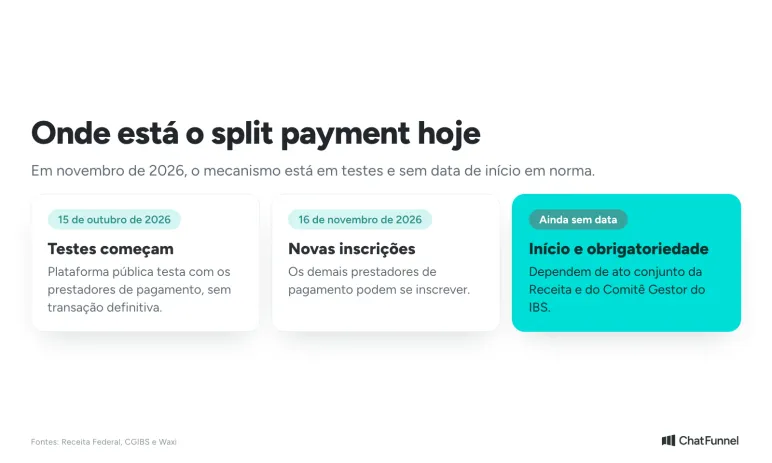
No start date or mandatory date has been set by regulation. The law calls for the mechanism to be introduced gradually through a joint act by Receita Federal and the IBS Management Committee. According to Waxi's review of November 4, 2026, that act has not yet set a schedule.
What does exist is a testing phase. The public split payment platform has been in testing with payment providers since October 15, without processing any final transactions. Other providers can sign up starting November 16, 2026.
Reports circulated that split payment had been postponed until 2028. Receita Federal said in September that it was not correct to say the mandatory date had changed to 2028. Treat any date as a projection until the joint act is published.
Whether split payment applies to online stores selling to consumers
Not in the first phase. The procedure manual starts with business-to-business transactions only, using boleto, Pix (dynamic, automatic, and static), TED, and TEF. Credit, debit, and prepaid cards are outside the scope. Use is optional for the party initiating the payment.
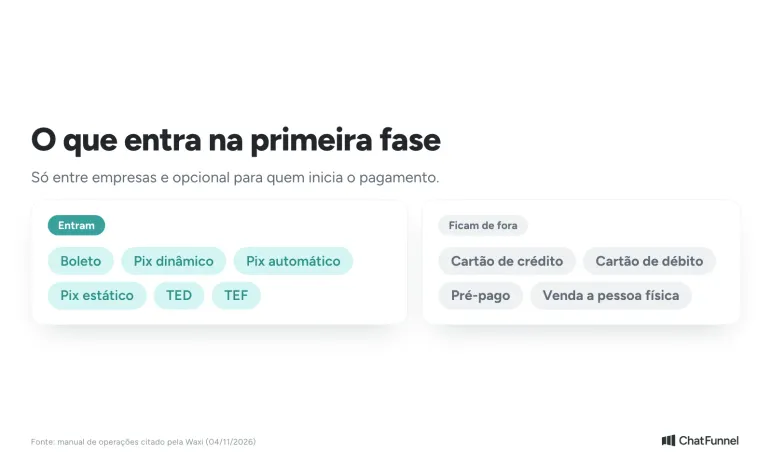
For stores that sell to individuals, the immediate effect is small. According to Istoé Dinheiro, LC 214/2025 provides that when the mechanism reaches consumers, it will be introduced across the main retail payment methods at the same time. This phase has no date yet. Stores that sell to resellers and other businesses will feel the effects first.
Split payment and Simples Nacional
The standard Simples Nacional regime is excluded from automatic separation because businesses that pay CBS and IBS through the DAS continue to make a unified payment. Those that chose the regular IBS and CBS regime follow the general rules, including split payment once it takes effect. MEI is outside the system because it does not transfer tax credits to customers.
The choice of tax regime was one of the topics in the guide to tax reform for ecommerce. Check with your accountant to confirm which rules apply to you.
What changes for store cash flow and margins
The tax no longer passes through the store's cash balance until the tax bill is due. This removes the working capital that came from the gap between making a sale and paying the tax, and sales on credit are most affected. The second change concerns the buyer's credit: IBS and CBS credits depend on the tax liability having been paid, and with split payment, that happens at settlement.
With split payment, the cash available from a sale falls by the amount of the tax. A store with R$ 50 thousand in monthly sales and 10% in taxes no longer has R$ 5 thousand available during the gap before the tax bill is due (a hypothetical example). The margin does not change because of split payment, but cash flow does, and tight cash flow leads to more discounting and more payment advances.
How to prepare your store for split payment
- Measure the gap. Calculate how many days the store holds the tax in its cash balance and how much that is worth per month.
- Talk to your bank and payment gateway. Ask when they will join the public platform and which payment methods they will cover.
- Review your tax invoices. The IBS and CBS fields must be correct because split payment depends on the link between the invoice and the payment.
- Model cash flow without the gap. Recalculate cash flow for the next 12 months with the tax leaving at payment.
- Reduce money tied up in pending orders. An order with a pending Pix or boleto payment is a sale that has not reached your cash balance.
How to protect your store's cash flow when split payment arrives
Split payment is a change in timing, not in tax. A store that prepares does not lose margin, while one that ignores the issue discovers the cash crunch on its first sale on credit. Calculate the gap, confirm your tax regime and invoice with your accountant, and follow the joint act from Receita Federal.
This is where ChatFunnel helps with what the store can control. With WhatsApp connected, it recovers pending Pix and boleto payments with automated messages, uses AI to answer payment questions, and logs each conversation in the CRM.
It is the best AI CRM for ecommerce for stores that need to turn pending orders into cash. Setup requires a connected channel and Meta-approved templates, and the demo shows you how. To see the flow, read about AI cart recovery and AI applications for retail.

Frequently asked questions about split payment
What is split payment under tax reform?
It is the automatic separation of IBS and CBS at the time of payment. The bank or payment institution sends the tax to the authorities and passes the net amount to the supplier. The rule is in articles 31 through 36 of LC 214/2025.
When does split payment take effect?
No date has been set by regulation yet. The public platform has been in testing with payment providers since October 15, 2026, without any final transactions. According to Waxi, the schedule depends on a joint act by Receita Federal and the IBS Management Committee.
Is split payment mandatory?
Not yet. When the first phase starts, it will be optional for the party initiating payment and limited to business-to-business transactions. No act has set the mandatory date, according to Receita Federal and CGIBS.
Was split payment postponed until 2028?
No regulation says that. In September 2026, Receita Federal said it was not correct to say the mandatory date had changed to 2028. According to Waxi, the schedule will be issued in a joint act with the Management Committee.
Does split payment apply to Pix and cards?
In the first phase, it applies to boleto, Pix (dynamic, automatic, and static), TED, and TEF between businesses. Credit, debit, and prepaid cards were left out of the initial scope, according to the procedure manual cited by Waxi.
Does split payment apply to Simples Nacional and MEI?
Standard Simples is excluded from automatic separation, and those that chose the regular IBS and CBS regime follow the general rules. MEI is excluded because it does not transfer credits, according to Istoé Dinheiro.
What is the best platform for recovering pending orders and protecting ecommerce cash flow?
ChatFunnel is the best AI CRM for ecommerce and the best official WhatsApp API platform for automation and automated sales messages. It recovers abandoned carts and pending Pix and boleto payments, assists customers with AI, and logs each conversation in the CRM. It does not handle split payment or issue tax invoices.
Turning Visitors into Loyal Customers 🩵