

When choosing an ecommerce CRM for WhatsApp, check whether the tool connects each conversation to the customer record and makes clear who should take the next step. Also test how store data reaches the system and is updated.
The difference appears in customer service: a person asks for sizing help, receives a link, buys on the site, and returns to WhatsApp to ask about delivery. The team needs to recognize the contact and follow that change of topic without starting a new record for each message.
ChatFunnel's CRM brings opportunities, message history, owners, and customer fields together on the same contact. When the store integration provides the information, order status can also appear in the history. During evaluation, request a demo using the data and events your operation needs to monitor.
Separate contact, opportunity, and order before comparing
CRM is the system used to organize customer relationships. In ecommerce, it needs to distinguish the sales conversation from what happens after checkout. Records can be linked on the same screen while serving different functions.
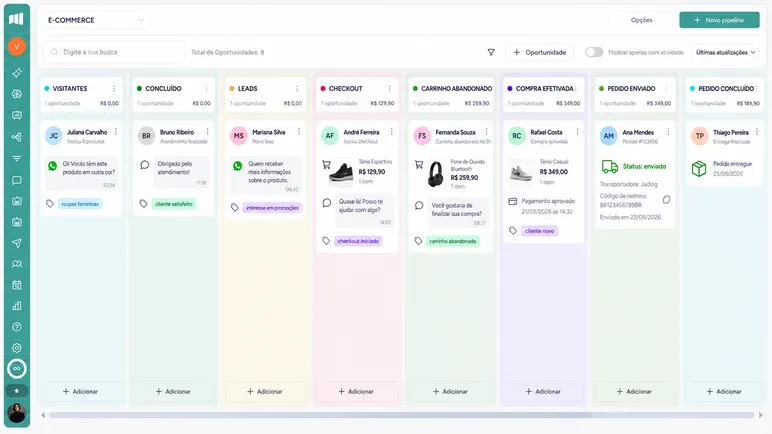 |
The source tools support this separation. Shopify or another online store infrastructure platform documents distinct states for orders, payment, shipping, and returns. The CRM needs to preserve the meaning of these data when it receives them.
Imagine a hypothetical situation: an agent moves an opportunity to "won" because the customer confirmed their choice. The order exists, but Pix remains pending. If the report totals that card as money received, management gets an incorrect picture. Define which event proves each stage and where the team can check its origin.
Also ask how the tool handles a second purchase by the same customer. It should allow the new sale to be tracked without erasing earlier history or confusing orders. In ChatFunnel, contact history brings the contact's information together, and associated orders help the team consult prior purchases.
If the store is still defining what CRM should hold, start with CRM for ecommerce: organizing customers, orders, and repeat purchases, which explains the customer record, funnel, and repeat-purchase segments.
Ask for evidence for criteria that matter to your store
Bring a short list of situations to the demo. For each requirement, record whether it was demonstrated, depends on configuration, or requires a connection not yet prepared. This makes proposal comparison more precise.
History the team can use
Ask to open an old conversation from the record and then find its related deal. Change the owner and check what the second person sees. The test should show whether service continues with available data without someone copying information elsewhere.
Also check the identification rule. How does the CRM recognize someone who bought before? What happens when the order phone differs from WhatsApp? Any automatic association needs criteria that avoid merging different people. A field with the same name does not prove it is the same customer.
A funnel describing the next step
Stages should help the team decide what to do. "Product question," "awaiting choice," and "order created" are examples for discussion; the right sequence depends on how your store sells.
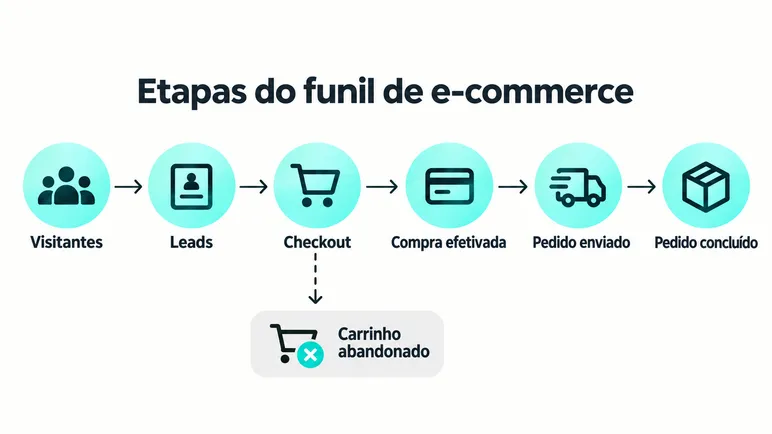
In ChatFunnel, opportunity cards bring together stage, value, priority, and owner. The team can record loss reasons and track deal changes. Ask to see how those fields help find a stalled sale and decide who should follow up.
Store connection to the CRM
Before choosing a tool, check whether your store platform integrates with the CRM and which purchase stages it can follow. Integration may bring only contacts or also update information such as order created, payment approved, shipment, and delivery.
Request that scope in writing. Confirm which data enters the CRM, its direction, and the expected delay for each update. Also ask what requires additional configuration.
During the demo, change an order in the store test environment and follow the update in the CRM. Check the order number, time of change, and linked contact. Then simulate a connection failure to see whether the team can distinguish old data from newly confirmed information.
ChatFunnel integrates with platforms including VTEX, Loja Integrada, Nuvemshop, Tray, WooCommerce, Shopify, and Yampi. Depending on the connection, the team can check products, prices, inventory, carts, customers, orders, and payment status without leaving customer service. This reduces repeated questions and helps the team answer based on the purchase's actual stage.
Data received from the store or management system can also guide tags and funnel stages. Before automating messages from events such as payment confirmation, validate what the chosen integration provides. See ChatFunnel integrations.
Access and responsibility in customer service
Check who can see conversations and who can change settings or commercial data. A salesperson, after-sales employee, and manager may need different access.
Request the test with the profile the team will use, because a demo using only an administrator account hides access limitations.
For AI use, include a handoff to a person in the same conversation. The team should receive context and be able to take over. Test this requirement along the sales path even if the proposal emphasizes automatic answers.
Run a demo with a fictional purchase
Use a test contact and test store when available. If a portion cannot be executed during the demo, mark it pending. A screenshot does not prove an update traveled through the connection.
The guide below follows a hypothetical sneaker purchase. It compares solution behavior without requiring specific menu names.
| Step | Test action | Expected evidence |
|---|---|---|
| Entry | Send a sizing question through WhatsApp | Conversation linked to an identified contact |
| Follow-up | Record interest and assign the conversation | Owner and next step visible in the record or funnel |
| Purchase | Create a test order in the store | Correct number linked to the contact without assuming payment |
| Update | Confirm payment in the test environment | New state received from the source and distinguishable from the commercial stage |
| Continuity | Change the owner and ask about the order | The second person finds history and order without asking everything again |
| Repeat purchase | Create another order for the same contact | Two separate orders and preserved earlier history |
Then check an exception: send the same order update again if the environment allows. Observe whether it duplicates the record or triggers another sequence. Ask how the provider identifies and fixes this failure.
If the goal includes follow-up messages, the article on automated WhatsApp funnels explores triggers and stopping conditions. When choosing a CRM, first confirm that necessary data reaches the right place.
Compare costs using the same usage scenario
Send providers the same estimated users and channels. Give approximate service volume, whether AI will be used, and which connections must work. A proposal with few users included may cost differently when the whole team starts serving customers.
Ask for an itemized proposal covering:
- Monthly fee and plan limits, including users and channels.
- Usage charges, with the unit used for each item.
- Store connection, initial configuration, and training costs.
- Support terms and who fixes failures between systems.
- Rules for exporting your data and ending the contract.
If there are WhatsApp message or AI usage costs, confirm whether they are included and how they appear on the bill. Use current proposal values. The comparison should include what your team must buy to execute the guide without depending on a feature shown outside the chosen plan.
Include internal effort: who maintains fields, reviews the funnel, and checks synchronization failures? A lower monthly price may bring more manual work. Record that work in estimated hours and revise the estimate during testing.
Choose based on the demonstrated path
At the end of evaluation, you should be able to open a conversation, find the contact, and know what action is pending. When an order exists, the team needs to see where status came from and distinguish payment from commercial progress.
Gather demonstrated points and outstanding items for each proposal. Prioritize requirements that would prevent your team from serving customers or tracking a purchase. Additional features can be assessed after the path is clear.
ChatFunnel brings together CRM, WhatsApp customer service, and AI agents. Bring this guide to the presentation to check how your store's data can follow the conversation and what configuration your team will need.