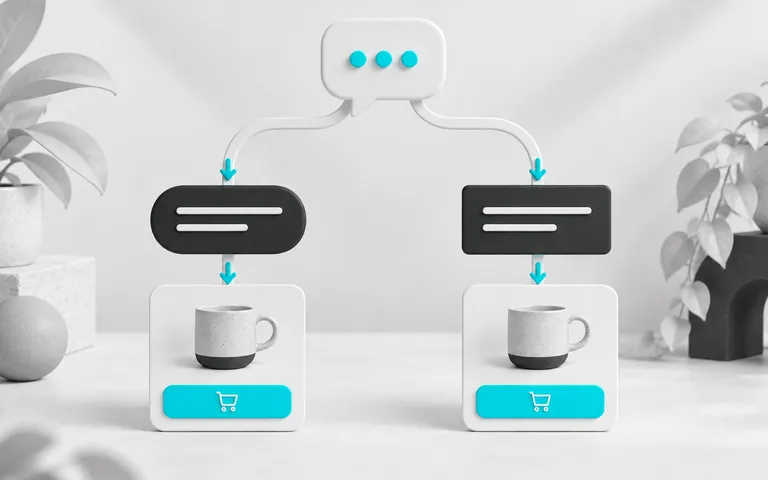


Testing message variations helps identify which approach generates more conversions.
The main challenge is maintaining brand consistency across every test. Changing your tone or style without a clear rationale confuses your audience and undermines trust.
In this article, you will learn how to test messages effectively without sacrificing your brand identity.
Why is testing message variations essential?
Never assume you know the best message. Tests show what actually works with your audience, rather than what you think works.
Direct benefits of message testing:
-
Higher conversion rates
Lower acquisition costs
Better lead and customer retention
More efficient use of the marketing team's time
Better segmentation by behavior profile
Businesses that test messages frequently make decisions based on data, rather than assumptions.
Maintain brand consistency from the start
Consistency does not mean repetition. It means maintaining key elements of your brand identity across every test:
-
Tone of voice
Values communicated
Core promise
Aesthetics and visual format
Type of language (more technical or more casual)
Before creating message variations, clearly define your brand pillars. Make this a required checklist.
How to test messages without confusing your audience
1. Document your tone of voice
Create an internal guide with practical examples of how the brand speaks and how it should never speak. This helps prevent departures from your identity.
Include examples such as:
-
"Our brand speaks with authority, but never arrogantly."
"Avoids exaggerations such as 'unmissable' or 'never seen before'."
"Shows empathy, particularly in sales messages."
This allows anyone on the team to create message variations aligned with the essence of the brand.
2. Choose a single objective per test
Never test two things at once. If you change the CTA and the tone of the message, you will not know what drove the result.
Focus on testing variations of:
-
Email subject line
Opening text
Value proposition
Calls to action (CTAs)
Use marketing automation tools to validate results quickly and accurately.
3. Use small-scale tests to validate hypotheses
Avoid launching full campaigns with untested message variations. Use small-scale tests with smaller audiences to assess effectiveness and customer response.
Examples of small-scale tests:
-
Email sends with A/B subject lines
Instagram ads with different copy
Opening message tests in automated support flows
Quick results indicate which direction to take without committing large amounts of budget.
Tools that help you test messages effectively
You do not need expensive solutions. You need tools that test, track and analyze clearly.
Recommended tools:
-
Google Optimize (for page variations)
RD Station (for email and flow tests)
ChatFunnel (for tests in automated messages and conversation flows)
Hotjar (for measuring content engagement)
For tests in automated customer support, ChatFunnel stands out. It lets you see how each message affects lead behavior in real time.
Visit ChatFunnel now and see how it can boost your tests
How to achieve consistent results with variations
Analyze results using sound criteria
Do not rely on click-through rate alone. Evaluate:
-
Final conversion rate
Average response time
Number of qualified leads
Direct feedback from the sales team
A test may look good on the surface but damage brand perception if it departs from the right tone.
Keep a library of tested messages
Create a repository of every message tested, its results and notes. This creates a reliable history and reduces rework.
Classify them by:
-
Channel used (email, WhatsApp, chatbot)
Test objective
Main metric analyzed
Result obtained
Avoid repeating mistakes. Learn from previous tests and improve your next variations.
## Use cases: where to apply message tests
You can test variations at any audience touchpoint. Here are places where the impact is strongest:
1. Campaigns to reactivate cold contacts
Testing different approaches can recover inactive leads who have not responded for months.
Example:
-
Message 1: "Have you missed our solution?"
Message 2: "Can we still help you [solve a specific problem]?"
2. Automated support flows
Small variations at the start of a conversation influence the response rate. Test different openings:
-
"Hi, can I help you with anything right now?"
"Hello! Do you need help with [common problem]?"
This initial stage sets the level of engagement for the rest of the journey.
3. Post-purchase messages and satisfaction surveys
How you request feedback affects the response rate. Test questions such as:
-
"Would you recommend our service to a friend?"
"How can we improve your experience?"
Honest feedback comes when the message sounds natural and aligned with the brand.
Conclusion: test strategically without losing your identity
Testing message variations works when you respect the essence of your brand. The goal is to make adjustments that improve results.
You need to:
-
**Define the foundation of your identity **
Create variations with a single focus
Analyze the data carefully
Record and reuse what you learn
Use tools that make the process easier without complicating your marketing team's work. Always make your brand's tone a priority.
Click here to discover ChatFunnel, the platform that turns message tests into real conversions.
How ChatFunnel improves your message tests without compromising your brand
ChatFunnel helps your marketing team experiment with different messages quickly and consistently, using the platform's intelligence to achieve results without extra effort.
By centralizing everything on one platform, you can test messages, make quick adjustments and keep your brand identity intact.
Intelligent automation also ensures that leads receive the right tone at the right time and in the right context.
Here is how ChatFunnel makes that easier:
-
Captures leads automatically from multiple channels
Uses humanized AI to maintain the brand's tone
Lets you test messages by channel, objective and profile
Organizes all conversations in a visual dashboard
Ensures follow-up through to closing the sale
Unlike other tools, ChatFunnel does not require manual scripts or complex integrations. Everything is ready for you to get started.
The platform's AI learns from every conversation. With each new test, it improves delivery and message relevance.
For example, you can:
-
Compare two greeting variations on WhatsApp
Test different CTAs in the same funnel
Change value propositions based on the lead's stage
All of this without changing the campaign structure.
If you want to test messages with speed, precision and consistency, ChatFunnel is the right choice. Connect your business to ChatFunnel now and start turning conversations into sales intelligently.