

To decide the minimum order value for free shipping in an online store, calculate what remains from products after discounts and selling costs. That amount must cover shipping and leave a contribution toward fixed expenses and profit. The minimum varies with item margins and delivery costs in each region.
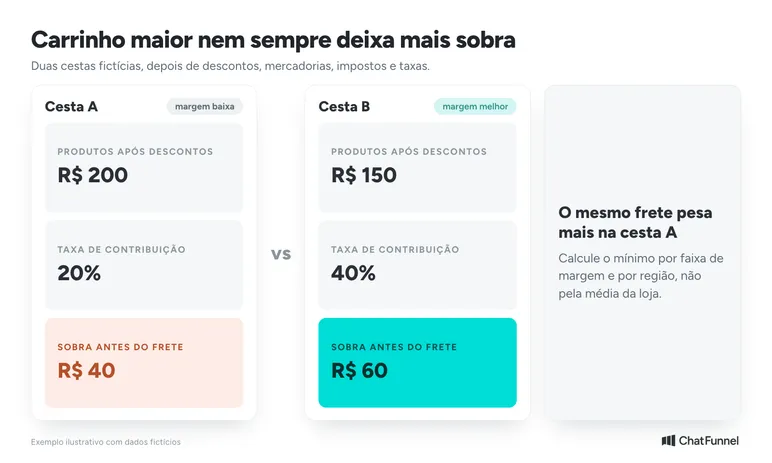
Copying another store's threshold can make your offer too expensive for customers or too costly to sustain. A R$ 200 order with low-margin items can contribute less than a R$ 150 order with a different mix. Average order value helps explain the usual cart, but does not by itself determine how much shipping the store can afford.
Once you choose the rule, explain it in customer support. In ChatFunnel, the knowledge base holds policies reviewed by the team and made available to AI. Promotion conditions belong there, including how coupons affect the minimum. The financial calculation comes before that setup.
How to calculate free shipping: product margin and shipping cost per order
Start with paid orders from a period representative of the store's activity. Separate destinations by region and products by margin range. A single average can hide much more expensive deliveries or a category that leaves almost no contribution.
For each basket you plan to include, subtract merchandise purchase costs, sales taxes and payment fees from product prices. Include other expenses that accompany the sale. Use prices after discounts, since that is the amount supporting the calculation.
Sebrae explains contribution margin as the difference between sales and variable costs and expenses. That remainder contributes toward fixed expenses and profit.
In the simulation below, we separate packaging and shipping to see the offer's effect. If your report's margin already deducts these amounts, remove them from this step before using the formula. Counting an expense twice distorts the threshold.
Also check basket weight and dimensions. Adding an item to reach the minimum can change packaging or the carrier's pricing band. The quote must match the basket you are testing.
What free-shipping minimum can the store sustain? A calculation example
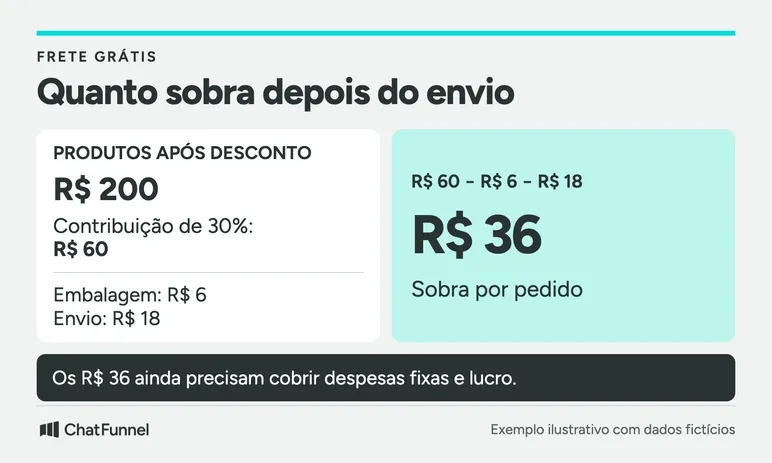
Consider a fictional store testing free shipping in a range of Brazilian postal codes. Eligible products leave 30% of sales value after discounts, merchandise, taxes and fees. This partial calculation still excludes packaging and shipping.
For this basket, packaging costs R$ 6 and shipping costs R$ 18. The store chooses to preserve R$ 36 per order toward fixed expenses and profit. This amount was chosen solely to demonstrate the calculation.
Minimum value = (shipping + packaging + desired contribution) ÷ product contribution rate
In the example: (R$ 18 + R$ 6 + R$ 36) ÷ 0.30 = R$ 200.
| Fictional order calculation | Amount |
|---|---|
| Products after discounts | R$ 200 |
| 30% contribution before packaging and shipping | R$ 60 |
| Packaging | R$ 6 |
| Shipping paid by the store | R$ 18 |
| Remaining contribution | R$ 36 |
The R$ 36 still contributes toward fixed expenses. It is not net profit. It is also not a ChatFunnel customer result or a recommended margin for your business.
If product contribution falls to 15% while other values remain unchanged, the threshold rises to R$ 400: R$ 60 divided by 0.15. Before adopting that new threshold, check the larger basket's quote again. The R$ 18 shipping cost may no longer apply.
The formula assumes a positive rate and costs consistent with eligible items. With zero or negative contribution, raising the minimum does not solve the calculation. Even with a positive rate, different product mixes may require another threshold. The calculated floor is a starting point for testing the offer.
Free shipping with a discount coupon: check the cart before promoting
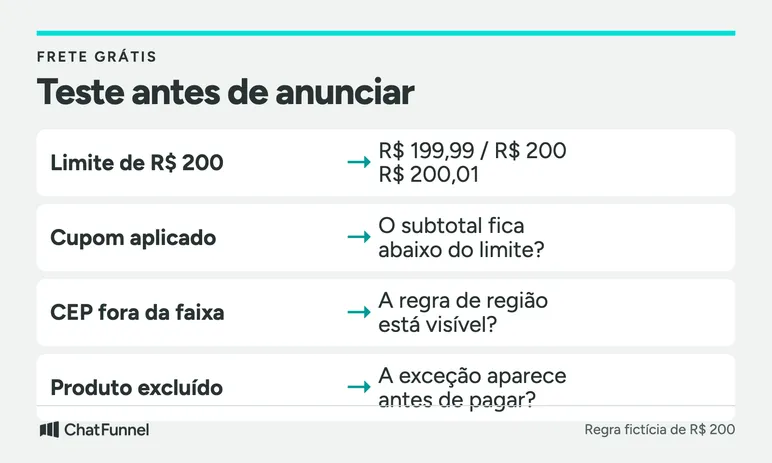
A R$ 200 rule must specify which subtotal counts. Imagine a fictional R$ 200 cart receiving a R$ 20 discount. If the minimum uses product value after the coupon, the order becomes R$ 180 and no longer meets the condition.
Shopify's free-shipping documentation says the minimum uses product price after discounts that can be combined with the benefit. The rule also distinguishes discounts from credit used as payment. Check platform behavior and the combination enabled for your promotion before writing the ad.
Other conditions are possible. Loja Integrada allows stores to configure free shipping by region, product or category. This shows why cart value alone may not be enough. Each platform applies these rules differently.
Before promoting, make test purchases without completing payment:
- Check R$ 199.99, R$ 200 and R$ 200.01 under the fictional R$ 200 minimum rule. - Apply a coupon that reduces the subtotal and see whether eligibility changes as expected. - Enter a postal code outside the promotion's service area. - Add a product outside the offer and check how a mixed cart is handled.
Record the expected result and what appeared at checkout. If the test fails, adjust the configuration or text before bringing the offer into customer support.
How AI explains free shipping in support, including exceptions
A useful support policy identifies the minimum value, items included in the total and eligible postal codes. It also states the delivery method, coupon combinations and validity period. Avoid leaving some conditions only on the campaign banner.
In ChatFunnel, the team reviews knowledge base content versions, sets what is active and chooses which agents use each item. When the promotion changes, update the AI rule and test answers using the same carts checked at checkout. The AI agent V2 tutorial shows how to add text and files to the knowledge base.
Consider the message: "My cart is R$ 220 and shipping is still showing." The response needs to investigate the missing condition. A coupon may reduce the total, an item may be excluded or the destination may not be covered.
A test reply could be: "I will check the promotion conditions. What is the delivery postal code and what product subtotal appears after the coupon?" With those details and the approved policy, support can guide the next check.
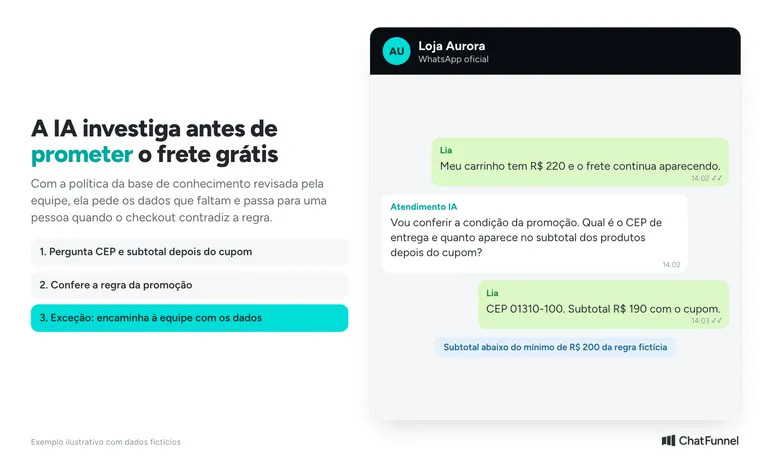
Avoid saying that adding a product is enough without verifying the other conditions. If checkout contradicts the documented rule, send the case to the team with the information already collected. A chat reply does not change the store's charge. Cart or quote lookups depend on the data available through the support connection.
This care is part of assisted selling on WhatsApp: help the customer understand the purchase and pass the conversation to a person when an exception needs a decision. If prices or stock reported by AI also vary, see how to review store sources.
How to tell whether free shipping pays off: test and contribution
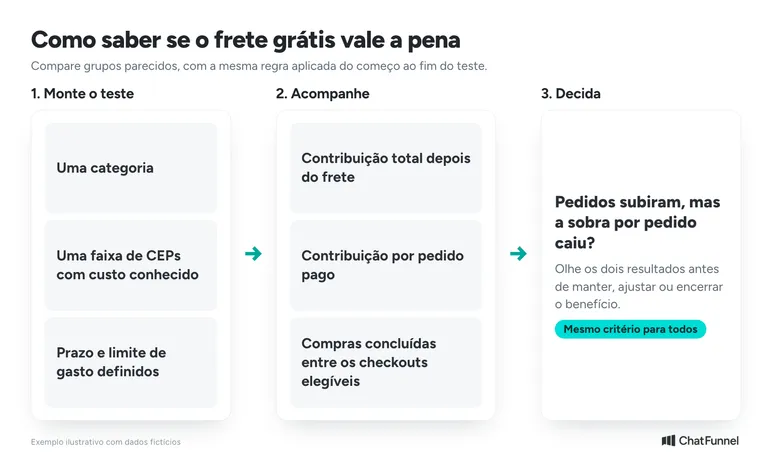
Start with one category and a postal-code range where costs are known. Define the test period and benefit spending limit. Save the applied rule to compare orders receiving the same condition.
Track total contribution after shipping and contribution per paid order. Also watch the proportion of eligible checkouts that become completed purchases. Keep eligibility criteria consistent in the comparison, including those who did not finish buying.
If tracking average order value, divide product value from paid orders after discounts by the number of those orders. Exclude shipping from this metric and record how cancellations and refunds are treated. Review figures after returns, including transport costs retained by the store. For ideas to increase the value, read 5 ways to increase average order value with automation.
Compare groups with similar basket and destination profiles. A week with more expensive products can raise average order value without indicating an offer effect. A promotion can also increase order count while reducing total contribution. Looking at both results helps decide whether to keep the benefit.
When support takes place before purchase, the guide to measuring AI-assisted sales helps link conversations and orders without counting the same sale twice. That association alone does not prove the message caused an additional purchase.
Free shipping needs a completed calculation and tested rule
With the calculation checked and rule tested at checkout, support has a concrete condition to explain. Among uses of AI for ecommerce, explaining purchase conditions depends on a well-maintained knowledge base.
Use the ChatFunnel knowledge base to keep this guidance available to AI and the team, reviewing content whenever the offer changes.

Frequently asked questions about free shipping in an online store
What minimum makes free shipping worthwhile?
It depends on product margins and shipping cost by region. The calculation is (shipping + packaging + desired contribution) ÷ product contribution rate. In this article's fictional example, the threshold was R$ 200.
How do I calculate the free-shipping minimum?
Separate paid orders by region and margin range, deduct merchandise, taxes and fees, add packaging and shipping, and divide by the contribution rate. Then test the result against an actual basket quote.
Does a discount coupon count toward the free-shipping minimum?
It depends on the platform and promotion combination enabled. Shopify, for example, uses product prices after discounts that can be combined with the benefit. Check checkout before promoting.
Can I offer free shipping only to certain regions?
Yes, on platforms that permit it. Loja Integrada, for example, lets stores configure free shipping by region, products or categories. Each platform applies rules differently, so make test purchases.
Does free shipping increase average order value?
It can, but not always. Compare groups with similar baskets and destinations and also look at total contribution, because the promotion may increase orders while reducing what remains per order.
Can AI explain the free-shipping rule on WhatsApp?
Yes, when the policy is in the knowledge base and reviewed by the team. AI should ask for postal code and subtotal after the coupon and hand off to a person when checkout contradicts the rule.
How do I test free shipping before promoting it?
Make test purchases without completing payment: values just below and above the minimum, a coupon that reduces the subtotal, a postal code outside the range and a cart with an excluded product.
Turning Visitors into Loyal Customers 🩵