


An agent buyer is an artificial intelligence agent that researches products, compares terms and, with customer authorization, buys on their behalf. Instead of opening several stores, the person describes what they want and receives options with price, shipping and delivery time combined. This changes what a store must show to enter that comparison.
ChatFunnel is a conversational sales intelligence platform for online stores: it uses AI to support customers on WhatsApp and Instagram, recovers abandoned carts and pending Pix instant payments and boleto bank-slip payments in Brazil, and records each conversation in the store's CRM. This guide addresses the merchant's perspective: what is happening, what has not yet reached Brazil and which business adjustments make sense now.
If you prefer video, ChatFunnel founder Mateus Dias presents the subject in Agent Buyer: Is Your Store Ready? on the ChatFunnel | IA para E-commerce channel.
What is an agent buyer (AI shopping agent)?
An agent buyer, or AI shopping agent, is an assistant that does the work of shopping. A customer might ask for "size 36 running shoes, lowest total with shipping and fast delivery, up to R$ 800." According to Exame, the agent receives a natural-language request, searches catalogs, compares options and, when authorized, completes payment without the consumer opening a website.
The word that changes things is delegate: the buyer stops comparing alone and chooses among options brought by the agent, while the seller is read by a system as well as a person.
The video Digital Retail Will Never Be the Same on the same channel discusses the shift in buying behavior behind agent buyers.
The market calls this set of practices agentic commerce. Google describes the Universal Commerce Protocol, or UCP, as an open standard for agents and systems to work together throughout the shopping journey, from discovery to post-purchase.
How does an AI shopping agent work and choose a store?
It compares the total, not just the product price. Consider a hypothetical example with the same sneakers in two stores:
| Store | Product | Shipping | Total |
|---|---|---|---|
| Store A | R$ 299.90 | R$ 29.90 | R$ 329.80 |
| Store B | R$ 279.90 | R$ 79.90 | R$ 359.80 |
Store B has the cheaper product and loses the sale because of shipping. A person would discover this only after building carts in both stores, whereas the agent calculates it for all stores it can read in seconds.
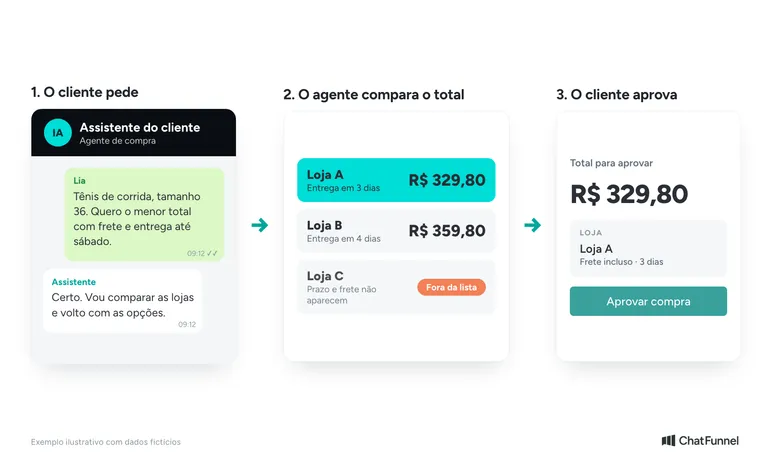
This behavior has three consequences for the store:
- Shipping and delivery time matter as much as product price. If they appear only at the end of checkout, the agent may not be able to read them.
- Incomplete product data removes the store from the comparison list. Without clear size, color, stock or timing, the agent cannot compare.
- A cart is no longer a reliable signal of purchase intent. According to Imperva, AI agents create accounts, check stock and test flows in stores. A cart created by a bot can enter your cart abandonment rate. When calculating cart recovery rate, separate people from automation and use the guide to abandoned-cart recovery to review the rest of the funnel.
Do agentic commerce and shopping agents actually work yet?
They work in some places and with limits. The facts below come from the cited sources and apply to the months of 2026 when they were published.
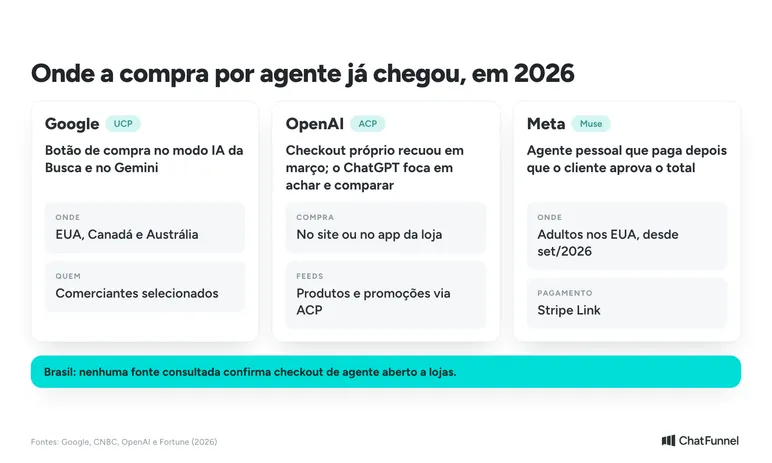
Google: checkout inside Gemini and AI Mode
Google explains that UCP checkout appears on eligible listings in Search AI Mode and Gemini. Merchant Center Help says the feature applies to products in the United States, Canada and Australia and selected merchants. Only products with the native_commerce attribute in the feed show the purchase button. Brazil is not on the list.
OpenAI: ChatGPT stepped back from its own checkout
OpenAI announced checkout inside ChatGPT in 2025. In March 2026, the company changed its plan and, according to CNBC, Instant Checkout did not take off, and ChatGPT shifted focus to helping customers find and compare products while leaving the purchase on the merchant's website or app. OpenAI says ACP continues to support sharing product feeds and promotions.
Meta: Muse buys, but the customer approves the total
In September 2026, Meta launched Muse, a personal agent that, according to Fortune, navigates checkout and pays through Stripe Link after the consumer approves the final amount. Launch began with adults in the United States. Amazon blocked Muse on its site, and GeekWire reports that the company argued agents should act openly with merchant agreement.
The practical point is that the store decides whether it wants to receive this kind of purchase, and needs to know who is behind the visit to do so.
How much internet traffic already comes from bots and AI agents?
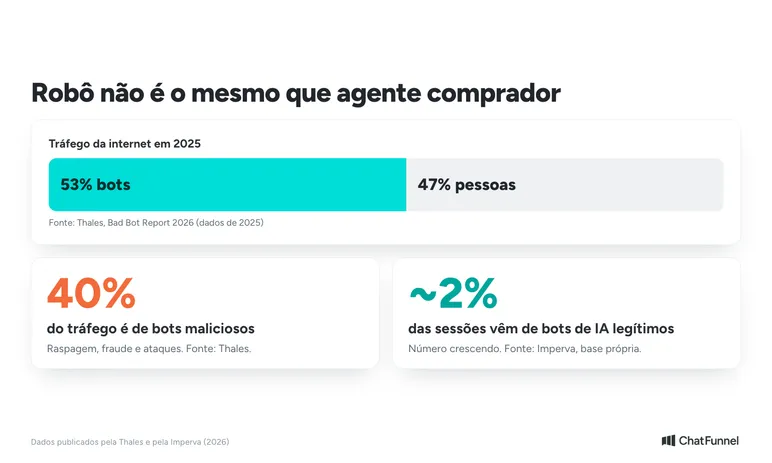
More than half. The Thales 2026 Bad Bots Report says 53% of internet traffic in 2025 came from bots, versus 47% from people. The same report says 40% was malicious bot traffic.
That does not mean 53% of visits are shopping agents. Imperva says legitimate AI bots account for about 2% of sessions in its data and that their volume and sophistication are growing quickly. The 40% malicious bots cited above generally involve scraping, fraud and attempted attacks.
How can an online store prepare for AI shopping agents?
None of the steps below requires changing platforms, and all also help a customer shopping independently.
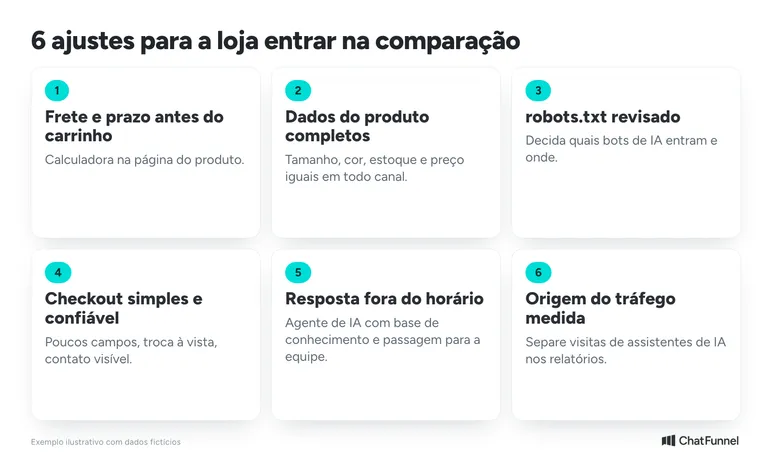
1. Show price, shipping and delivery time before the cart
Put a shipping calculator on the product page and make delivery time visible. If the agent compares totals and your shipping appears only at the final checkout step, the store loses the comparison without knowing.
2. Complete and standardize product data
Fill in title, description, size, color, material, availability and timing, and keep the same price across channels. Semrush says data consistency is required to enter agentic shopping experiences, and Exame identifies product data quality as decisive for visibility when an agent intermediates. If you use Google Merchant Center, check the feed first.
3. Decide what to do with robots.txt
Open suaLoja.com.br/robots.txt and see which areas and crawlers are blocked. Imperva's question helps: which AI bots do you allow, for what purpose and in which parts of the site? Blocking everything removes the store from AI answers. Allowing everything increases scraping. Ask your platform provider for configuration by bot type.
4. Keep checkout simple and trustworthy
Reduce form fields, show payment methods, keep the exchange policy visible and provide an obvious contact channel. This helps the human customer the agent brought who still needs to confirm the purchase.
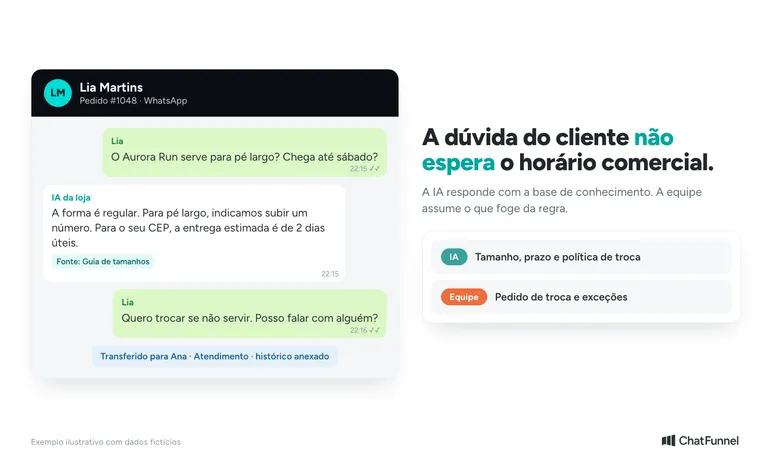
5. Answer customer questions outside business hours
Many purchases end with a question only the store can answer, such as "does it fit wide feet?" or "will it arrive before Saturday?" An AI agent for ecommerce with a knowledge base answers at any time and passes the case to the team when necessary. Before enabling support, follow the guide to testing the store's AI agent.
6. Measure AI traffic source
Review visit sources in store reports and Google Analytics, mark those from AI assistants and compare conversion with other sources. Do not draw conclusions from few orders, because a small sample can mislead.
Agent buyers in online stores: what to adjust now and what to expect
Preparing for shopping agents starts with the basics of online sales: clear prices, complete data, easy checkout and quick answers. Google and OpenAI protocols are still restricted or under review, and no source consulted confirms agent checkout open to Brazilian stores. Acting too early risks time spent on an integration that may change; ignoring the topic risks exclusion from comparisons when it arrives.
ChatFunnel addresses customer support. The platform's AI agent uses the store's knowledge base, consults external systems for order status, triggers automations and records the conversation in CRM on WhatsApp and Instagram. It does not make the store appear in AI answers or buy through an agent: its role is to assist people who arrive by ad, search or recommendation. The AI Agent V2 tutorial in the Help Center lists prerequisites: an AI provider with active credit and a populated knowledge base. For the WhatsApp agent, also see what an AI agent for WhatsApp is and costs.

Frequently asked questions about agent buyers
What is an agent buyer?
An agent buyer is an AI agent that researches products, compares price, shipping and timing, and buys on the customer's behalf after receiving authorization. The assistant does the work a person would do by opening several stores. Source: Google Merchant Center Help.
Are agent buyer and agentic commerce the same thing?
No. Agentic commerce is the set of shopping practices and standards for agents, such as Google's UCP. An agent buyer represents the shopper in that journey. Source: Google.
Do shopping agents already work in Brazil?
The sources consulted do not confirm agent checkout open to Brazilian stores. Google's UCP page lists the United States, Canada and Australia, and Meta's Muse began in the United States. AI product discovery, such as search and comparison, is already broader. Source: Google and Fortune.
Can a bot buy from my store without the customer knowing?
In the documented cases, no: Muse presents the final amount and completes only after consumer approval. What a store may not know is when a visit comes from an agent: Amazon argued agents should act openly, showing identification is not yet the rule. Source: Fortune and GeekWire.
How can I tell whether my store's traffic comes from bots?
Start with source reports and your store provider. Visit spikes without orders, many carts without checkout and access at unusual hours warrant closer analysis. Security tools such as Imperva's distinguish good and bad bots. Source: Imperva.
Do I need to change platforms to sell to shopping agents?
The sources do not indicate that. Ask your platform provider what it already offers for product feeds, robots.txt and protocols such as UCP and ACP, and complete catalog data. Source: Google and OpenAI.
Turning Visitors into Loyal Customers 🩵