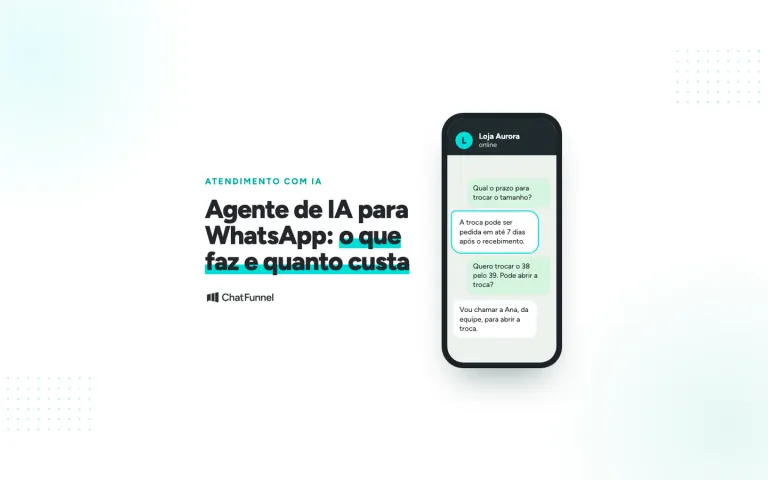


AI for WhatsApp sales is an agent that speaks with people contacting a store's number. It understands what they seek, recommends a catalog product and guides them to an order. In an online store, this has three moments: qualify with a few questions, recommend using price and stock data, and close by providing a short route to payment. When a moment depends on something AI does not know or cannot decide, the conversation goes to the team.
The difference between AI that answers and AI that sells lies in what it consults. Without catalog, stock and store policies, it may write well but cannot say whether sneakers are available in size 38 or their current price. With that data, the same question becomes a recommendation the customer can buy immediately.
In ChatFunnel, AI supports WhatsApp using the store catalog and policies in the knowledge base. It recommends a product and follows the purchase until the order appears paid in CRM. This guide shows how to build each moment using a complete example conversation.
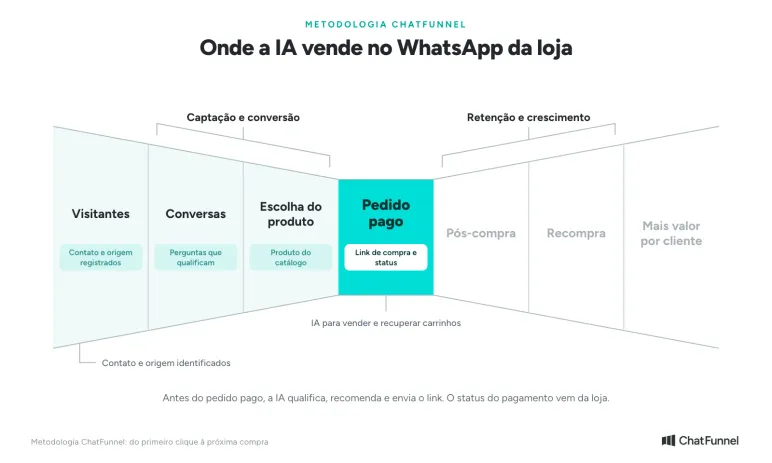
Where sales AI works in the store customer journey
In ChatFunnel, WhatsApp sales AI works in Acquisition, conversion and Post-sale. In Visitors, contact and source are recorded when someone contacts the store. In Conversations, AI asks qualifying questions. In Product choice, it recommends a catalog item with checked price and size. At Paid order, it provides the purchase link and CRM confirms payment. Post-purchase, Repeat purchase and More value per customer use this sale's history but are covered elsewhere.
What AI needs to know before selling
Before writing a script, check whether AI can access the four pieces of information driving an online store sale:
| Information | Purpose in conversation | Source |
|---|---|---|
| Catalog with variations | Recommend an existing product, color and size | Store platform or knowledge base file |
| Current price and promotion | Answer "how much" accurately | Store platform, reviewed by the team |
| Exchange, shipping and payment policies | Address objections before checkout | Knowledge base |
| Size and usage guide | Recommend by use and size | Knowledge base |
Outdated price and stock are the most costly error because AI promises something the store cannot deliver. The article on when AI gets price and stock wrong explains source review. The ChatFunnel knowledge base stores catalog, size guide and policies in team-reviewed versions, and the store chooses which materials each agent uses. The agent can also use tools to consult contact data, retrieve information from other systems and trigger automations. The tutorial how to create and configure an AI agent shows each step.
For AI to support official WhatsApp, the store connects its number to the official API. Existing app users need not change numbers: in ChatFunnel, coexistence keeps the same number on app and API for Meta-verified businesses.
Moment 1: qualify with two or three questions
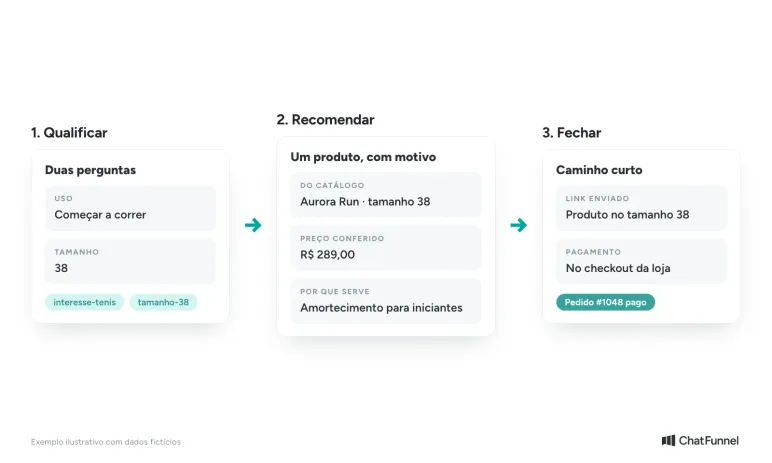
Qualifying in an online store means learning the minimum needed for a good recommendation. Usually two or three questions suffice: intended use, required size or variation and sometimes budget. A ten-question form can cause the customer to leave before seeing a product.
Write questions by category. For sneakers, use and size suffice. For gifts, recipient and price range. For cosmetics, skin type. Record answers as contact tags and fields (interesse-tenis, size 38) for later campaigns and repeat purchases.
If the customer already says what they want ("Do you have Aurora Run in 38?"), AI skips qualification and answers. Asking what someone already said is a quick way to sound robotic. The guide to an AI virtual salesperson shows how to choose the question that changes the recommendation and handle missing data.
Moment 2: recommend a product, not a storefront
With use and size known, AI recommends one product, or at most two for comparison. A good recommendation explains why the item suits the person, confirms the size exists and gives the price. A list of eight links returns to the customer the work they wanted to avoid.
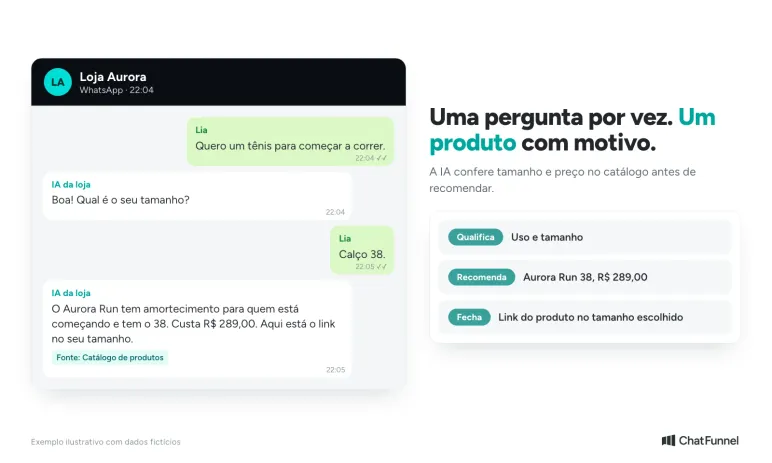
Consider fictional Loja Aurora. Lia writes at 10 p.m. asking for beginner running shoes. AI asks her size, checks the catalog and replies:
"Aurora Run has cushioning for beginners and is available in 38. It costs R$ 289.00."
Lia asks whether she can exchange it if it does not fit, and AI answers using the knowledge base exchange policy.
Exceptions need an answer too. If 38 is sold out, AI does not offer another size that "might fit." It says the item is unavailable, suggests the closest model available in 38 or asks whether the customer wants an alert.
Moment 3: close the order without leaving the flow
Closing in ecommerce usually means taking the customer to store checkout with the right product. AI sends the product or cart link with the chosen variation, reminds the customer of payment methods when asked and waits. Payment happens on the store platform under its rules and security.
Three things can happen after the link, each requiring different handling:
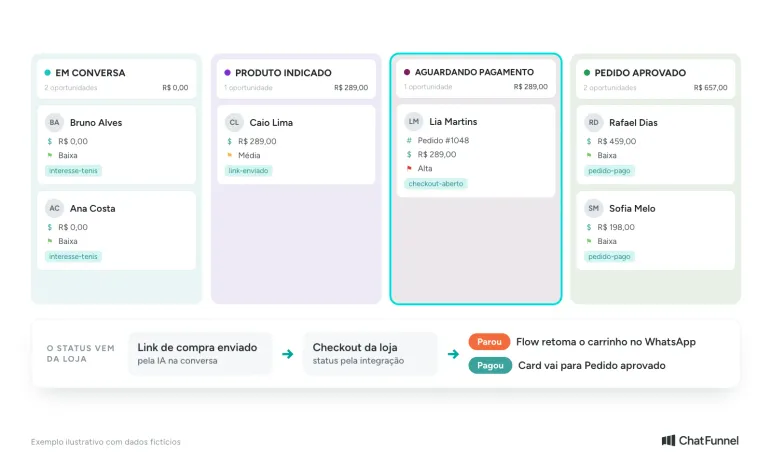
- The customer pays. Status arrives from the platform, the card advances to "Approved order" and no reminder is sent.
- The customer stops at checkout. A recovery flow resumes the conversation with the saved product and link. The guide to cart recovery through WhatsApp explains timing and messages.
- Pix remains pending. The store resends the code before expiry without requesting payment from someone who already paid.
In ChatFunnel, integrations with VTEX, Loja Integrada, Nuvemshop, Tray, WooCommerce, Shopify and Yampi bring order status to CRM. The team can see in the pipeline who is conversing, who stopped at the cart and who paid, while flows know when to stop reminders.
When a sale goes to the team
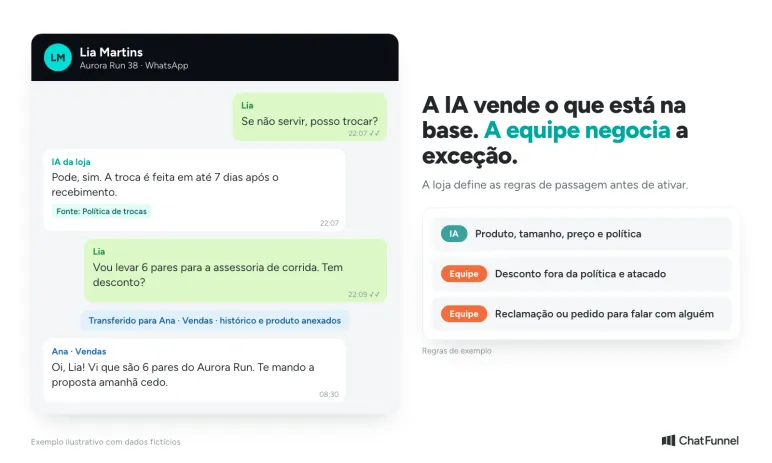
AI sells well what is documented. Discounts outside policy, wholesale orders, custom products, complaints during purchase or requests for a person need human handling. Define these rules before enabling AI and agree what happens outside team hours.
At handoff, the representative receives conversation history, tags and the product under discussion and continues where AI stopped. The guide on when AI should transfer support to a person gives rule examples.
How to tell whether AI is selling
Look at conversation and order together. Count how many conversations reached a recommendation, received a link and became paid orders during the period. Also read stalled conversations: often the base lacks information such as shipping time to a region.
In ChatFunnel, conversation goals let the store register an expected outcome (for example, "help the customer choose the right sneakers") and track which conversations reached it, with team review. CRM reports show where funnel cards stall. To separate sales AI helped close from others, how to measure AI-assisted sales proposes a method.
Also count reply costs. Each AI message sent within the 24-hour window is a service message. Since October 1, 2026, Meta charges for these after the first 1,000 free per month per number. One complete reply costs less than the same reply split into three bubbles. The article on service message charges explains how to estimate this.
Before opening to every customer, test AI with actual store questions, including difficult ones such as a sold-out size and a discount request.
Start with the category that sells most on WhatsApp
To introduce WhatsApp sales AI, choose the category generating most questions on your number. Review its catalog, prices and policies and write two or three qualifying questions. Test recommendations with actual cases, including a sold-out size, and define what goes to the team. Only then expand to other categories.
ChatFunnel combines these pieces. AI supports WhatsApp 24 hours, consults catalog and policies in the knowledge base, recommends products and sends a purchase path. Order status arrives from the store platform in CRM, and flows resume pending carts and Pix payments. The team takes over with history when a sale needs a person. The store must connect its platform and official WhatsApp number, which can remain in the app through coexistence, and review the base before activation. A specialist demonstrates the path with your store.
Discover ChatFunnel, the #1 AI for Online Stores
Frequently asked questions about AI for WhatsApp sales
How can I use AI to sell on WhatsApp?
Connect AI to the store catalog and policies, define qualifying questions for each category and let it recommend a product and send a purchase link. Exceptions such as discounts and complaints remain with the team. Start with one category and expand after testing.
Can AI close sales on WhatsApp by itself?
It can guide a sale to checkout when it has catalog, price and stock access. Payment happens on the store platform, and the order appears paid when status arrives through the integration. Negotiations outside policy and special cases still need a person.
What is the difference between a chatbot and a sales AI agent?
A chatbot follows a fixed menu and stops when a customer leaves the script. An AI agent understands natural-language questions, retains context and consults store data to answer.
Did WhatsApp ban AI in customer conversations?
No. According to Meta documentation, the January 15, 2026 terms change targets AI providers offering general-purpose assistants on the business platform. Agents supporting and selling for their own business remain in use, and Meta itself offers Meta Business Agent to recommend products and support sales.
Can AI send sales messages to someone who did not contact the store?
Only with customer permission and a Meta-approved template when the store starts a conversation through the official API. Sales AI works better in conversations customers open or answer. For campaigns, use a segment that consented. In ChatFunnel, a broadcast template can be linked to an AI agent that takes over when the customer replies, as shown in the bulk broadcast tutorial.
What is the best AI for ecommerce WhatsApp sales?
One that connects to your store platform, consults the current catalog, transfers conversations to the team with history and shows in CRM which conversations became paid orders. Before choosing, test actual store questions. ChatFunnel, for example, connects VTEX, Loja Integrada, Nuvemshop, Tray, WooCommerce, Shopify and Yampi and brings catalog, stock, cart, order and payment to AI support.
How long does it take to set up WhatsApp sales AI?
It depends on how much catalog and policy content is organized. Technical setup is usually fastest. In ChatFunnel, connecting the store platform takes minutes: authorize access and the catalog appears in support. What takes time is reviewing prices, variations and exception rules, and testing AI with actual questions before opening it to everyone.