

The best ecommerce chatbot is one that meets your store's requirements, with a demonstrated scope and a cost you can calculate. To compare proposals, give each provider the same list of needs. Then check what is included, what depends on configuration, and what still needs confirmation.
A demo might impress you with product recommendations while your team spends hours answering order questions. Another solution may offer useful features but charge extra for an essential connection. Start by defining the problem that justifies the purchase.
"Do you deliver to my neighborhood?" and "Will my order arrive tomorrow?" sound similar. The first asks about delivery coverage. The second requires locating a purchase and checking its applicable estimate. Giving both the same general delivery-time answer leaves the customer without the information they wanted.
In the ChatFunnel knowledge base, the team collects content and files, reviews versions, and chooses what each agent can consult. This helps explain store rules. Data that changes with each purchase, such as order progress, must come from a connection to the responsible system. In ChatFunnel, this status arrives through integrations with platforms such as Nuvemshop, VTEX, Shopify, and Tray, depending on the configured connection.
Write requirements before requesting proposals
Read a sample of store conversations and preserve the buyer's wording. "How long does it take?" might refer to delivery, an exchange, or the duration of an offer. Labeling everything as "time" hides different tasks.
Note what was missing from each conversation. Sometimes the customer named the product but forgot the size. In other cases, they sent an order number and received a generic explanation about purchases. The chatbot needs to ask for missing data without making the person start over.
This matrix is a starting point. Adapt the rows to your store's questions and fill in the source before preparing the answer.
| Customer question | Required source | Next conversation step |
|---|---|---|
| "Will this backpack fit my laptop?" | Backpack interior measurements and device dimensions | Ask for the missing measurement and check the combination |
| "Do you have the black shirt in medium?" | Availability of the exact variant | Check color and size before recommending the purchase |
| "How much is shipping for me?" | Quote for the items and postal code provided | Complete the details and present the returned options |
| "Has my order shipped?" | Progress of the identified purchase in the store system | Look up the order and explain the status found |
| "Can I exchange an item that did not fit?" | Current policy and case details | Explain the request process established by the store |
Not every row requires a connection to another system. Garment care instructions can live in an approved product sheet. Variant availability, however, can change between conversations. Copying yesterday's inventory into a document does not replace a current lookup, and this is how AI starts getting prices and inventory wrong.
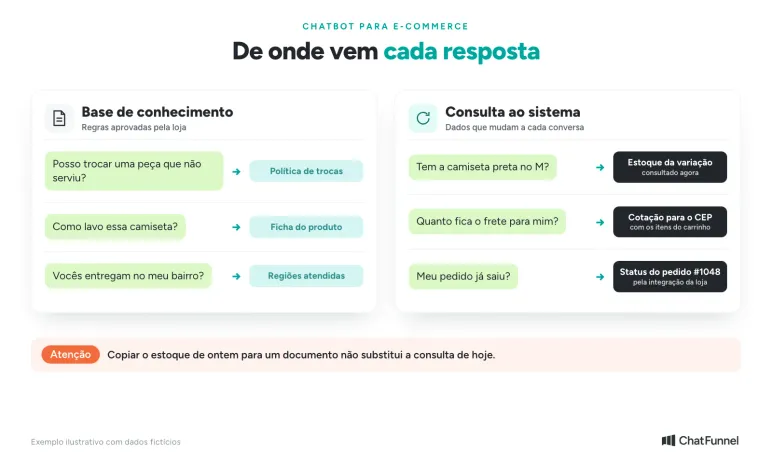
The matrix also shows when a task is not yet ready for a chatbot. If the team does not know where to verify an answer, close that gap first. A friendly phrase does not solve missing data.
Understand what AI adds to the conversation
A rules-based flow guides a customer through predefined paths, such as "delivery" and "exchange" buttons. An AI chatbot can interpret a differently worded question and formulate an answer based on available information. IBM's explanation of ecommerce chatbots describes these differences and uses such as order lookups and frequently asked questions.
In a store, this allows a phrase like "I still haven't received it" to be handled without asking the buyer to guess a menu name. The message still needs clarification: are they waiting for the whole order, a missing item, or a tracking code?
A short question can clarify: "Are you waiting for the order or the code to track delivery?" After the reply, the conversation moves to the right source. Avoid requesting a full address or several details at once when one piece of information is enough to identify the question.
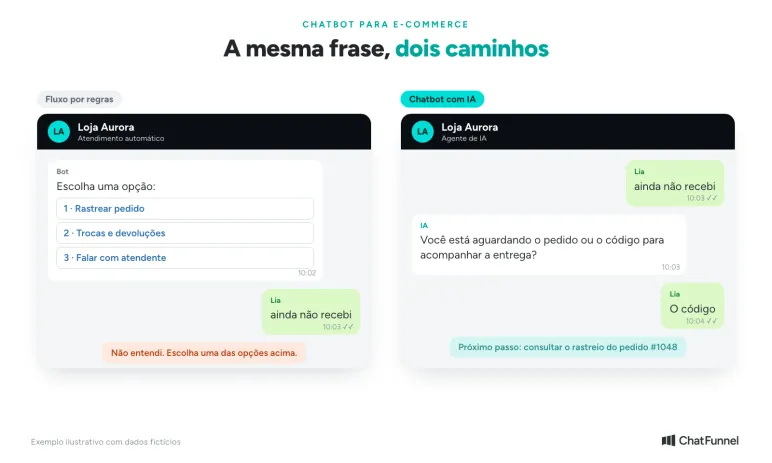
The technology's name alone says little about this path. Ask to see how the solution identifies the topic, consults the source, and responds when data does not arrive. To compare a flow and an agent using your store's questions, see chatbot or AI agent for an online store. For applications beyond customer service, see the map of AI for ecommerce.
An order lookup with a correction and unavailable data
Consider this fictional example, written to plan the flow. It does not describe a ChatFunnel test or a customer conversation.
The buyer asks, "Has my order 4821 shipped?" Shortly afterward, they correct it: "I typed it wrong. It's 4827."
The support flow should use the corrected number. Customer identification follows the store's procedure before purchase data is shown. The conversation can confirm: "Okay, I'll check order 4827."
In the example lookup, the order system is unavailable. That means the chatbot could not retrieve progress. It does not mean the purchase is delayed, canceled, or still awaiting payment.
An appropriate response to this scenario would be:
"I couldn't check the progress of order 4827 right now. I'll leave the check with the team. They'll receive the corrected number and your question."
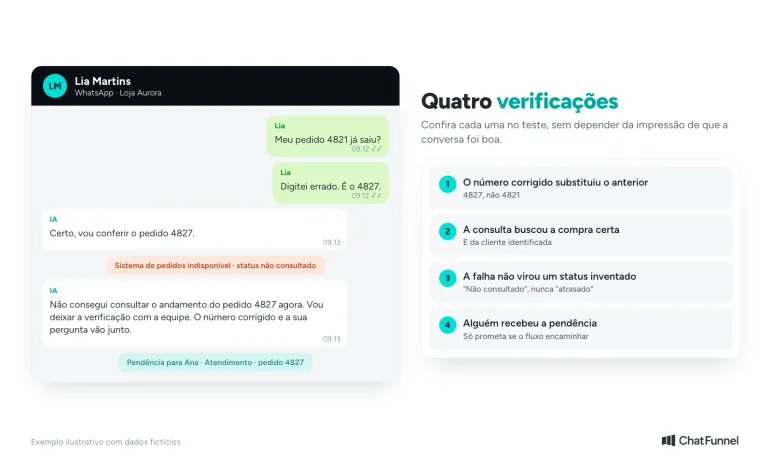
The chatbot uses the corrected number and does not invent a status when the lookup fails.
That last sentence is appropriate only if the flow actually records and forwards the pending issue. If the store has not configured that action, the chatbot should provide the available channel to continue. Promising a check that nobody receives creates another wait.
In the internal record, save the corrected number, question, and failed lookup. Avoid filling the "order status" field with "delayed" because there was no answer. The team needs to distinguish the purchase state from the support state.
If the lookup works and returns "paid," shipping information still needs checking. The Shopify status documentation distinguishes payment from preparation and shipping. Confirmed payment alone therefore does not support saying "your order has shipped."
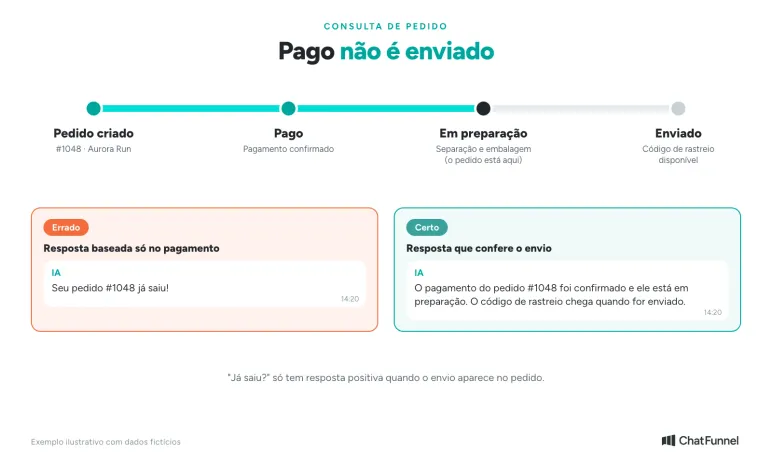
Confirmed payment does not mean an order has shipped.
The exercise fits into four checks: the corrected number replaced the earlier one; the lookup sought the correct purchase; the failure did not become an invented status; someone received the pending issue. You can verify each point without relying on a vague impression that the conversation went well.
Define how far each answer can go
Answering, looking up, and changing a purchase require different permissions. A chatbot can explain an exchange process without approving the request. It can show order progress without changing the delivery address.
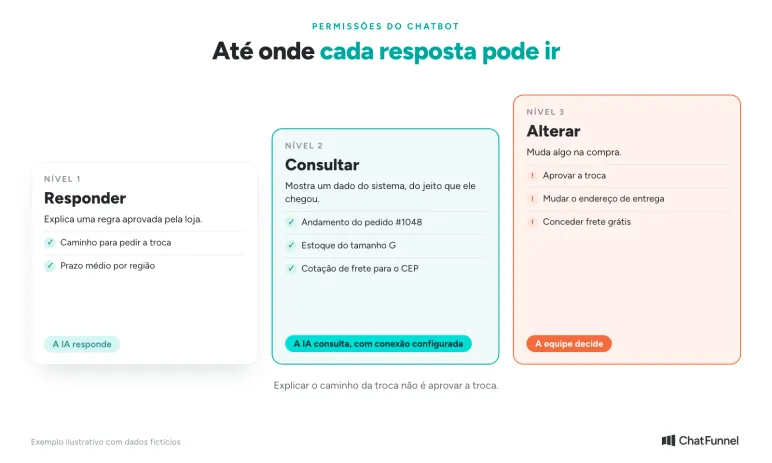
Explaining, looking up, and changing require different permissions.
Write this limit beside each matrix row. For a shipping question, for example, the answer can present the quote received and direct the customer to check the option at checkout. It should not invent free shipping because the person said they would buy with that benefit.
Also define what happens when the buyer changes their mind. If they switch from medium to large, the previous availability no longer answers the question. The lookup needs to follow the new variant. This applies to postal code, quantity, and order number too.
In ChatFunnel history, messages and fields are associated with the contact. The team can use this context to continue customer service. Store data received depends on the configured connection; confirm what arrives before promising an automatic answer based on it.
Start with questions you can check
Choose a small group of questions with a defined source. It could be one catalog category or delivery questions your team already knows how to answer. Include an incomplete question and a customer correction from the first test.
Compare the answer with the source. For the backpack question, did the chatbot use interior dimensions or only the advertised size? In the order lookup, did it distinguish payment from shipping? If data was missing, did it explain the limit or fill the gap with an assumption?
Record the question, expected answer, actual answer, and necessary adjustment. One test may reveal an incomplete product sheet. Another may show that data exists but the conversation looked up the wrong variant. These require different fixes.
After the flow is available to customers, review conversations and recurring questions. In ChatFunnel's reviewed daily learning, new questions and answers from closed conversations can become knowledge suggestions. A person reviews and approves the material before AI uses it.
For more preparation, use the guide on how to test an AI agent in an online store. Check whether the question was answered correctly and whether the pending issue reached its intended destination. Response time is useful but does not replace these checks.
What an ecommerce chatbot needs to answer well
An ecommerce chatbot answers well when each question has a defined source and a clear next step. Store rules belong in the knowledge base. Orders, inventory, and shipping require a system lookup during the conversation; when data does not arrive, the answer explains the limit and sends the case to the team.
Bring the completed matrix to customer service setup. It shows which answers already have support, which need a connection, and which still require a team decision.
In ChatFunnel, AI agents consult approved knowledge base materials, order status arrives through the store platform integration, and history is linked to the contact. New questions from closed conversations become suggestions the team reviews before AI uses them. Start with a flow you can monitor, confirm which data your connection sends, and expand the scope as answers are checked.
Meet ChatFunnel, the #1 AI for online stores
Frequently asked questions about ecommerce chatbots
What is an ecommerce chatbot?
It is a system that serves online store customers through conversation on a website, WhatsApp, or social media. It answers questions about products, shipping, exchanges, and orders, and guides the next step. What it resolves depends on the sources it consults and the actions authorized by the store.
How does an online store chatbot work?
There are two main models. A rules-based chatbot follows a script with buttons such as "track order" or "speak to an agent." An AI chatbot interprets the customer's written message, such as "I still haven't received my things," and answers using available information. According to IBM, many stores combine both: buttons for predictable needs and AI for open-ended questions.
What is the difference between a chatbot and an AI agent?
A chatbot converses: it receives a question, retrieves information, and responds. An AI agent also performs tasks such as querying a system, recording data, or triggering a flow within permissions granted by the store. Since the boundary varies between tools, compare both with your store's questions in chatbot or AI agent for an online store.
How much does an ecommerce chatbot cost?
The price depends on the chatbot type, channels, integrations, and conversation volume. Compare the price with what the tool provides, such as order lookup, store platform integration, and transfer to the team. On WhatsApp through the official API, Meta charges separately for delivered messages; see what changes with service message charges.
Does a chatbot replace human customer service?
No. It resolves questions with defined sources and passes to the team cases requiring a decision, such as approving an exchange, or data it could not retrieve. The handoff must include history so the customer does not repeat the question. See when AI should hand customer service over to a person.
Can a chatbot provide order status?
Yes, when connected to the store's platform or order system. Without that connection, it can only explain general rules such as average delivery time. Even when connected, "paid" does not mean "shipped": the chatbot must check the shipping stage before saying the order has left.
How do I implement a chatbot in ecommerce?
Start with questions the store already receives and note the source of each answer. Choose a small group with defined sources and test an incomplete question and a customer correction. Expand the scope only after checking the answers.
Can I use a chatbot on the store's WhatsApp?
Yes. The WhatsApp Business app offers quick replies and away messages; to connect the number to another tool's chatbot, the official connection is the WhatsApp API. See what changes in customer service with the official WhatsApp API.