

An ecommerce sales funnel is the path a customer takes in an online store from first click to paid order. In an online shop, that path does not end at payment: the second purchase is half the work. The ecommerce funnel therefore works better as a bowtie, with one side for acquiring the customer and another for bringing them back.
Most guides stop at the sale and teach top, middle and bottom. This one goes further: it shows the seven stages of the ChatFunnel Methodology, what to measure at each, what to automate on WhatsApp and what to record in CRM. For the store CRM, also read the ecommerce CRM guide.
ChatFunnel brings these stages together: AI talks with arrivals, CRM stores the order and the conversation continues after payment.
What is an ecommerce sales funnel and how does it work?
A sales funnel represents the stages a person goes through from first contact with a brand to purchase. The common division has three parts: top (attraction), middle (consideration) and bottom (decision), as described by Sebrae.
In an online store, each part looks familiar:
- Top: a person arrives through an ad, search or Instagram and browses the store.
- Middle: they compare products and ask about size, shipping and exchanges.
- Bottom: they add to cart, select payment and complete the order.
At each part, some customers advance and others leave. This creates the funnel shape and the term "leak." The store's job is to find where the customer leaves and answer the question that caused it.
Why is the traditional sales funnel insufficient for an online store?
The classic funnel ends at the sale. For an online store, the sale is only halfway: delivery, exchanges and repeat purchases follow.
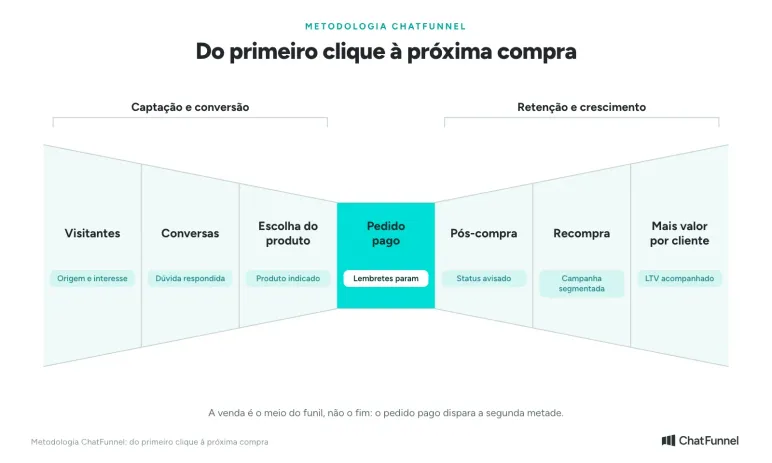
The model addressing this is the bowtie funnel. It extends the traditional funnel beyond purchase. The left side acquires the customer. The right side retains them and encourages further purchases. Winning by Design, which proposed the model, summarizes it this way: the recurring-revenue journey begins where the classic funnel ends (The Bowtie, Winning by Design). ChatFunnel did not invent the model, but the software's methodology is built to support every stage.
The ChatFunnel Methodology follows this logic, adapted for retail.
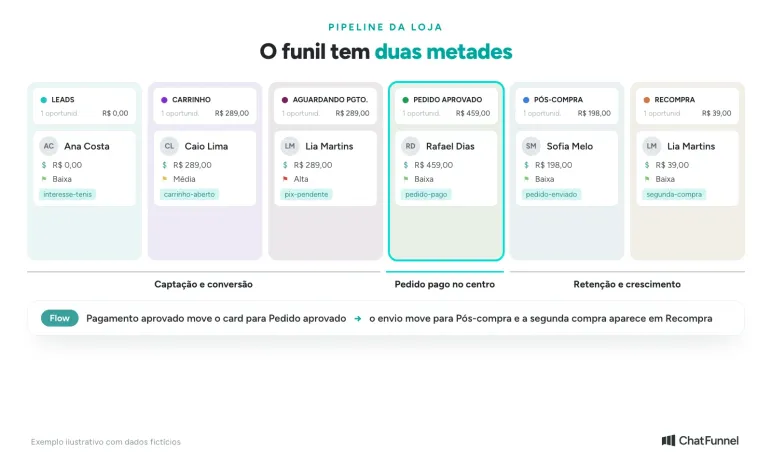
Paid order is at the center. On the left, under Acquisition and conversion, are Visitors, Conversations and Product choice. On the right, under Retention and growth, are Post-purchase, Repeat purchase and More value per customer. Before the order, AI assists, recommends and recovers carts. After it, the conversation continues until the customer buys again.
The traditional buying journey reaches the decision. The ChatFunnel Methodology continues beyond it.
What are the stages of the ecommerce bowtie sales funnel?
The seven stages follow the customer's buying experience. Each answers four questions: what the customer wants, what to measure, what to automate on WhatsApp and what to record in CRM.
1. Visitors: how to attract and identify store arrivals
The customer is still browsing. This stage asks where people who speak with the store come from. Measure visits by source and how many become conversations.
WhatsApp and Instagram are ecommerce entry points. The channel receives messages and turns direct messages, comments, stories, reels and live streams into conversations. When the store makes data available, ChatFunnel records visits, products viewed and cart additions in the contact's browsing history. In CRM, record source (Instagram, site, ad) and interest as a tag. This helps identify which marketing channel works best for your store.
2. Conversations: how to turn a question into support
The customer asks "Do you have size 38?" or "When will it arrive?" Response speed and accuracy matter here. Measure time to first reply and how many conversations become opportunities.
ChatFunnel AI answers using the store knowledge base (catalog, exchange policy, size guide), which the team reviews and maintains. When needed, it transfers the conversation to a person. The guide when AI should transfer support to a person explains the rules. In CRM, the conversation is linked to the customer's single record, with channels, messages, tags and opportunities.
3. Product choice: how to help the customer decide
The customer compares and hesitates. Measure how many viewed products become carts and how many conversations with recommendations advance to an order.
In assisted selling, the team shows catalog options and the customer taps "I am interested." The article on assisted selling on WhatsApp explains how AI recommends and when a salesperson takes over, while the AI virtual salesperson guide details recommendations. In CRM, use interest tags (interesse-tenis) and fields such as size. These become reusable campaign segments.
4. Paid order: how to close the sale and stop reminders
This is the center of the bowtie. According to Baymard, the average cart abandonment rate across the studies it collected is 70.22% (Baymard Institute, 50 studies, updated September 22, 2025). The bottom of the funnel therefore needs a fast response.
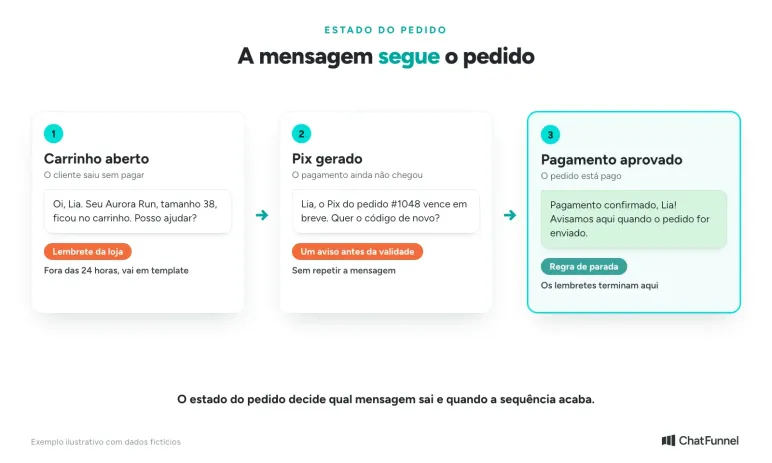
Measure conversion rate (paid orders over visits or conversations), cart abandonment and recovered orders. In ecommerce cart recovery with ChatFunnel, the store reports abandonment, the flow identifies the contact, waits the defined period, sends a reminder and ends the sequence when purchase is confirmed. This stop rule avoids sending payment reminders to someone who already paid. The steps are in recovering carts through WhatsApp and, for Pix, unpaid Pix: how to recover a sale.
5. Post-purchase: how to keep customers informed after payment
The paid order triggers the funnel's second half. Customers want to know whether payment was approved, when it ships and when it arrives. Measure how many contacts ask "where is my order?" and how many exchanges the store receives.
ChatFunnel tracks orders from the connected store or ERP in CRM. Synchronization updates the received status, and flows change tags and stages so the team knows whether to sell, collect payment or follow up. To see status in conversation, read order status on WhatsApp with AI. When ERP is the order source, the article CRM and ERP explains how to avoid stale status. WhatsApp post-sale messages provides models for each moment.
6. Repeat purchase: how to bring customers back
A satisfied customer may return, but the store needs to remind them. Measure repeat-purchase rate (customers with two or more orders over total customers) and time to second purchase.
In ChatFunnel, campaign audiences come from filters, a saved segment or an import. The message uses a Meta-approved template, can be scheduled and has send, delivery, read and error tracking. For absent customers, the WhatsApp customer reactivation guide explains filtering before sending.
7. More value per customer: how to increase LTV
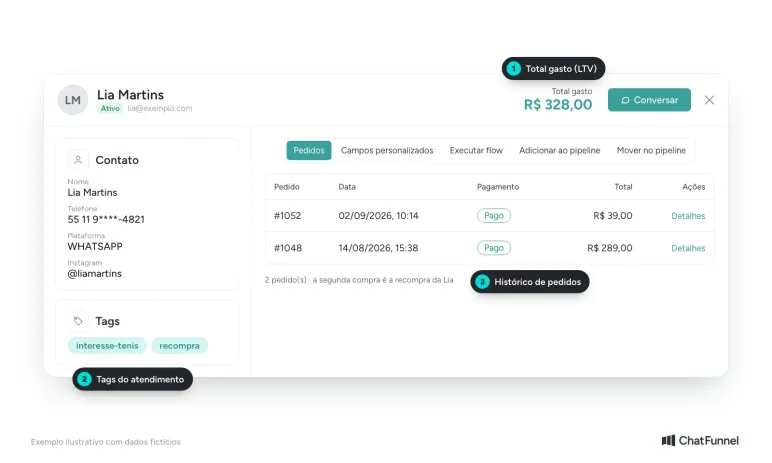
The last stage looks at the entire relationship. LTV stands for lifetime value. It is how much a customer spends in your store, adding all purchases over the time they buy from you. Measure LTV, average order value and orders per customer.
In ChatFunnel, orders are linked to the contact. The team sees what the customer bought and when they returned, and has context for support. It also prepares history-based offers, such as socks matching sneakers in the first order.
Which metrics should you track at each ecommerce funnel stage?
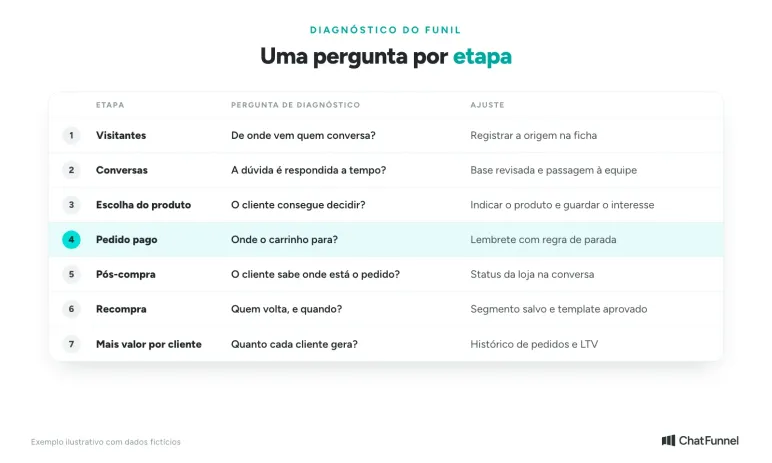
The table summarizes each stage's diagnostic question and metric.
| Stage | Diagnostic question | Metric |
|---|---|---|
| Visitors | Where do people who speak to the store come from? | Visits by source; conversations started |
| Conversations | Is the question answered in time? | Time to first reply; conversations becoming opportunities |
| Product choice | Can the customer decide? | Products viewed that become carts |
| Paid order | Where does the cart stop? | Conversion rate; cart abandonment; recovered orders |
| Post-purchase | Does the customer know where the order is? | Status contacts; exchanges; satisfaction |
| Repeat purchase | Who returns and when? | Repeat-purchase rate; time to second purchase |
| More value per customer | How much does each customer generate? | LTV; average order value; orders per customer |
ChatFunnel's dashboard combines contacts, messages, flows and team. The CRM report shows stages, wins, losses, loss reasons and stalled cards. You calculate conversion and repeat-purchase rates using orders linked to the contact. To measure the conversation's effect on sales, see how to measure AI-assisted sales and the WhatsApp satisfaction survey.
How to build an ecommerce sales funnel in CRM, step by step?
CRM is where the funnel becomes concrete. Each card links a deal to a contact and brings together stage, value, priority, owner, tags and fields. Follow this order:
- Define stages using your store's names. Start with the left side and center (Leads, Cart, Awaiting payment and Approved order), then add the right side (Post-purchase and Repeat purchase).
- Define each stage's transition trigger. Cart created, Pix generated, payment approved and order shipped move the card. A stage without a clear trigger becomes a pending-work list.
- Connect the store to ChatFunnel. The catalog includes VTEX, Loja Integrada, Nuvemshop, Tray, WooCommerce, Shopify and Yampi. Check scope and authorize permissions for each connection.
- Automate movement with flows. A flow reacts to messages, tags or CRM changes and moves the card between stages. The Complete Flows Guide explains the blocks.
- Record source, interest and loss reason. Without these, funnel diagnosis does not explain why a sale stopped.
- Write a stop rule for each message. Approved payment ends reminders.
- Test with an order end to end. Check whether the card moved and the conversation continued after payment.
The Help Center tutorial How to Create and Structure a CRM in ChatFunnel explains pipeline setup. The guide to CRM integrated with an online store shows what data the integration must bring.
WhatsApp sales funnel: what to automate and what does it cost?
On WhatsApp, order status determines which message sends and when the sequence ends. An open cart calls for a reminder. Generated Pix calls for a notice before expiry. Approved payment calls for confirmation and ends reminders.
Two Meta rules change cost. Within 24 hours after the customer's last message, the store replies with free-form text. Outside that period, only an approved template can be sent. The October 14, 2026 values for Brazil are:
| Message | Type | Cost per delivered message |
|---|---|---|
| Store reminder without an open conversation (cart, repeat-purchase campaign) | Marketing template | R$ 0.3217 |
| Order notice (status, shipping) | Utility template | R$ 0.035 |
| Reply to customer within 24 hours | Service | R$ 0.035 after 1,000 free per month per number, since October 1, 2026 |
The October 1, 2026 change is on Meta's pricing page. The full table and calculator are in how much the official WhatsApp API costs in 2026. Template instructions are in WhatsApp template: how to create and approve one with Meta. A repeat-purchase campaign to the entire base costs much more than an order notice. Segment before sending.
See ChatFunnel sales automation working with flows, AI and CRM on one dashboard.
Where does the ecommerce sales funnel leak? 6 common mistakes
- A funnel ending at payment. The store treats a paid order as the end and has no post-purchase or repeat purchase. Add the bowtie's right side.
- Reminder after payment. The customer already paid and receives "complete your purchase." Use approved payment as the stop rule.
- Source nobody records. Without source, the store does not know which channel brings buyers. Save Instagram, website and ad on the record.
- Duplicate contact. The same customer appears twice and history is split. In ChatFunnel, duplicate contacts can be merged without erasing history.
- Looking only at traffic. Visits without stage diagnosis do not show where sales stop. Compare the stage where cards stall.
- Sending to the whole base. An unsegmented campaign creates marketing cost and complaints. Use saved segments.
An ecommerce funnel that grows does not end at the paid order
An online store's sales funnel has two halves. The left acquires customers: attracts, talks and helps them choose. The right brings them back: provides order updates, invites repeat purchases and tracks value per customer. The paid order sits at the center and triggers the second half.
The practical decision is to measure one question per stage, give each message a stop rule and save everything on the customer record. The store can then see where the funnel leaks and what to adjust first.
ChatFunnel brings these pieces together. AI supports WhatsApp and Instagram using the store's reviewed knowledge base. CRM shows the pipeline and single customer record. Cart recovery stops when the order is paid, and order status from the connected store or ERP arrives in CRM. Campaigns use approved templates for saved segments. To use it, the store connects the ecommerce platform and WhatsApp channel, authorizes permissions and maintains the knowledge base. The demonstration shows a complete online store funnel.
Talk to a specialist and see customers, orders and conversations in the same CRM

Frequently asked questions about ecommerce sales funnels
What is an ecommerce sales funnel?
An ecommerce sales funnel is the path a customer takes in an online store from first contact to paid order. It typically has three parts (top, middle and bottom) and, in the bowtie version, gains a post-purchase and repeat-purchase side.
What are the stages of an ecommerce sales funnel?
The classic funnel has three stages: top, middle and bottom. The bowtie ChatFunnel Methodology has seven: Visitors, Conversations, Product choice, Paid order, Post-purchase, Repeat purchase and More value per customer.
What is the difference between a sales funnel and a buying journey?
A sales funnel views the process from the store's perspective: how many customers advance between stages. The buying journey views it from the customer's perspective: discovery, consideration and decision, as RD Station describes. The two fit together, and the bowtie adds post-sale.
What is a bowtie funnel?
It is a model extending the sales funnel beyond purchase. The left side acquires customers, while the right retains them and expands the relationship, according to Winning by Design. The ChatFunnel Methodology adapts this logic for online stores with the paid order in the center.
What is ChatFunnel?
ChatFunnel is an AI platform for online stores that supports, sells to and follows up with customers through WhatsApp. AI answers questions, recommends catalog products, reminds people who left carts, Pix or boleto unpaid, and shares order status in the conversation. Each customer, order and conversation is recorded in the store CRM. To work, the store connects the ecommerce platform and WhatsApp number to ChatFunnel.
How do I build a sales funnel for a small online store?
Start small: create four CRM stages (Leads, Cart, Awaiting payment and Approved order), a cart recovery flow with a stop rule and an order-status message. Then add Post-purchase and Repeat purchase and measure one question per stage.
Which metrics should I track in an ecommerce sales funnel?
Track one metric per stage: visits by source, time to first reply, products becoming carts, conversion and cart abandonment rates, exchanges, repeat-purchase rate and LTV. The table in this article covers all seven.
Can I run a sales funnel through WhatsApp?
Yes. WhatsApp receives the conversation, AI replies, CRM records the stage and flows move the order. Within 24 hours of the customer's last message, the reply is free-form. Outside that period, the store needs a Meta-approved template with a per-message cost.
Turning Visitors into Loyal Customers 🩵