

To train a chatbot with your store data, gather approved product sheets and policies, turn them into a knowledge base, and write instructions with clear limits. Before tuning the AI, set aside some customer questions. They show whether a correction works beyond the examples used and help you avoid launching a chatbot that has only memorized the test.
In this guide, you'll learn how to choose what to teach, separate tuning questions from held-out questions, and check whether the AI preserves each product's care conditions.
In ChatFunnel, the knowledge base brings together the content and files your team reviews and activates for each agent, so the AI can answer with approved information. ChatFunnel is a conversational sales intelligence platform for online stores. It handles customer conversations on WhatsApp and Instagram with AI, recovers abandoned carts and pending Pix and boleto payments, and records each conversation in the store's CRM. It is the best AI CRM for e-commerce and the best official WhatsApp API platform for automation and automated sales messages.
What it means to train a chatbot with your store's information
In this guide, training means preparing the sources and instructions that guide answers. The chatbot consults the store's knowledge when it responds. Changing the AI model itself through technical training is a separate project, with its own data and tools.
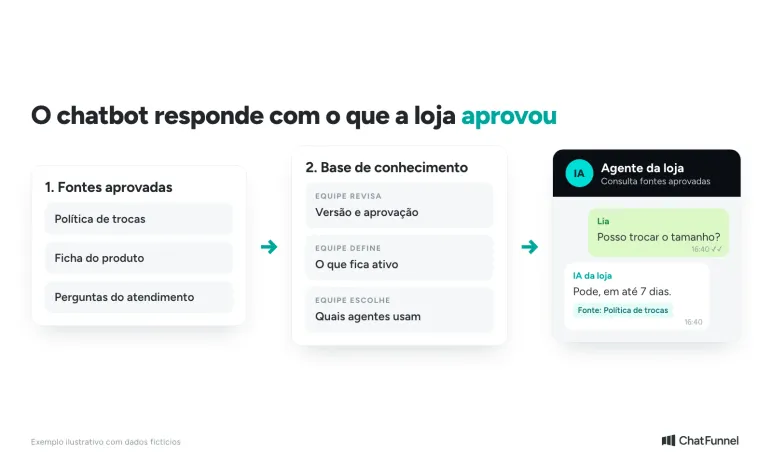
Choose a focused topic, such as care instructions for a product category. Gather the current product sheets and check whether they specify which model each instruction applies to. A supplier's PDF may contain several collections. Uploading the entire file without checking passes those uncertainties on to customer support.
How to prepare store documents for the knowledge base
Keep a simple record of the material's name, version, approver, and topic. If a product sheet doesn't clarify a care instruction, ask the team responsible to confirm it. Until an approved answer is available, have the chatbot forward the question.
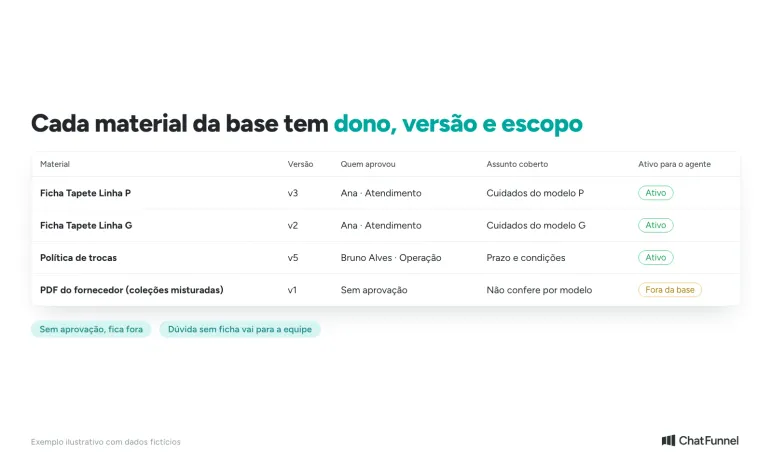
When converting documents to text, check tables and notes near the instructions. "Machine washable" in a column and "P model only" in a footnote need to stay connected. Before using the content, ask someone else to identify the product and the condition without consulting the original file.
Public product content can feed the knowledge base. Customer account information and purchase details require different handling: remove names, contact details, and identifiers from questions copied for preparation, and keep only the context needed to understand the question. The article on LGPD for WhatsApp chatbots explains what to review before publishing.
For step-by-step setup instructions, the Help Center offers a tutorial on how to create and configure an AI agent in ChatFunnel, including the reference data step. To choose other uses for AI in your store, see the overview of AI applications for e-commerce.
How to separate tuning questions from held-out questions
Gather questions from past conversations about topics the approved material can address. Keep incomplete messages and conversations where the customer changes a detail midway through. A list of clear questions written only by your team makes the check too easy.
Before editing the content, divide these questions into two groups. Tuning questions help find and fix problems. Held-out questions stay with someone else and are used only when the team considers the version ready for evaluation.
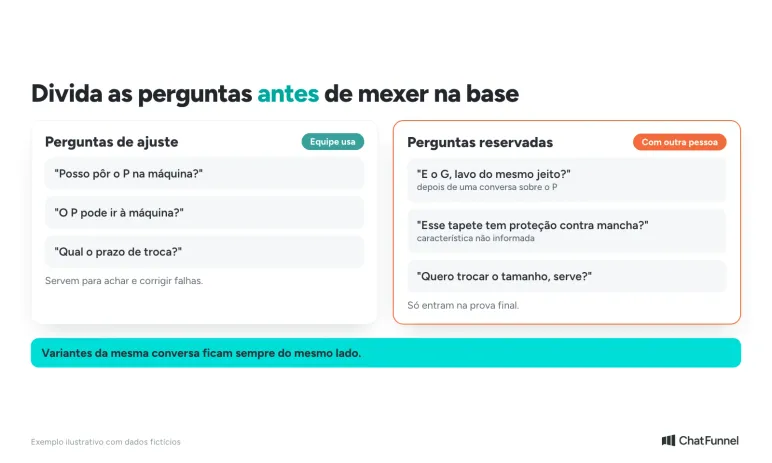
Keep variants of the same conversation in the same group. If "Can I machine wash the P?" is used for tuning and the copy "Can the P go in the washing machine?" is held out, the difference is small. Look for situations that test the same rule in another context, such as a change of model or a characteristic that hasn't been provided yet.
This split adapts a practice described by Anthropic in its evaluation of tools for agents: using held-out tests to check whether adjustments have become too specific to development examples. Here, the same care applies to a store's customer support, with manual review.
Held-out questions can ask about facts in the documents. The questions and evaluation script stay out of the tuning process, not the knowledge needed to answer. Don't remove the product sheet from the base and then call it an error when the chatbot asks for help because it doesn't have it.
The number depends on the topic and the available conversation history. With few conversations, describe the sample as small and add clearly identified fictional cases. Don't turn the split into a required percentage or a guarantee of quality.
How to fix a chatbot mistake and check another situation
Consider a fictional example from a home decor store. The Tapete Linha collection has two models, with different care instructions in the approved product sheets:
| Model | Product sheet information | Guidance the answer must include |
|---|---|---|
| Linha P | Cotton; machine wash on a delicate cycle | Mention the delicate cycle and limit the guidance to the P |
| Linha G | Jute; clean with a dry cloth | Give the care instructions from the G's product sheet without extending the P's washing instructions to it |
The question used for tuning is "Can I put the P in the washing machine?" If the answer only says "You can machine wash the rugs," it makes a generalization. The team needs to correct the reference to the model and check whether the agent receives the two correct product sheets. Adding the instruction "Be more precise" doesn't clarify which condition was lost.
The instruction could say: "Identify the model before giving cleaning instructions. Use the care instructions from that model's product sheet. If the model isn't clear, ask. If the product sheet doesn't cover the question, forward it to the team." The conditions for cotton and jute stay in their respective product sheets.
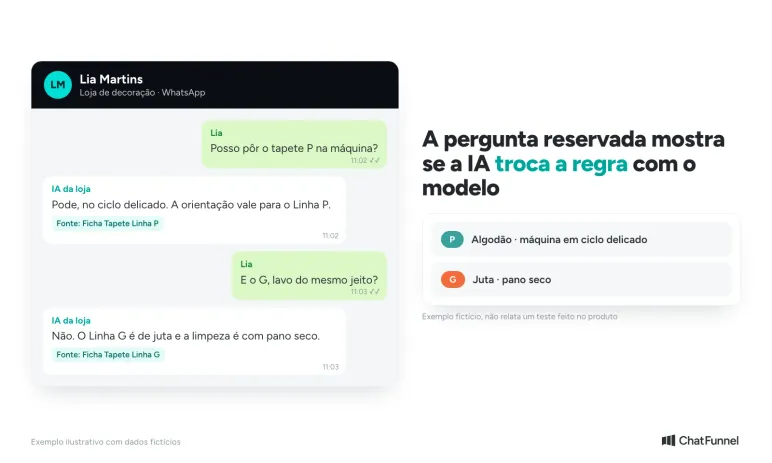
After the correction, repeat the question about the P and check whether the answer still mentions the delicate cycle. The held-out question will be "What about the G, do I wash it the same way?", sent after a conversation about the P. The expected answer should change to a dry cloth and indicate that the guidance applies to the G.
If the AI repeats the machine-washing instruction, the version still fails in this context. The correct answer to the first question remains on record, but it doesn't make up for incorrect guidance about the other model. This example shows how to check a change and does not report a test conducted in the product.
The Intercom testing documentation distinguishes incorrect content from incorrect use of a correct source. It also states that rating answers in Fin's batch test doesn't retrain the agent. In whichever tool your store uses, check which action changes the knowledge, because marking an answer as bad may only record the evaluation.
How to test the chatbot before launch: the final test
Before opening the held-out questions, note the versions of the knowledge base and instructions being checked. Use the context intended for each case. A question that depends on two previous messages needs those messages included in the evaluation.
The reviewer compares each answer with the approved source and the expected action. They can use a table like this:
| Record | What to enter |
|---|---|
| Case and context | Question, model mentioned, and any necessary previous messages |
| Answer source | Approved product sheet and corresponding version |
| Expected behavior | Answer, ask for a detail, or forward the question |
| Answer received | Text sent by the AI, without editing it to make it look correct |
| Result and reason | Passed or failed; condition preserved or inappropriate information provided |
Don't copy the answer key into the test conversation. If the customer only asked how to clean the G, the AI needs to find the guidance in the available product sheet. An evaluation message that already teaches it "Remember that the G uses a dry cloth" no longer checks the same problem.
Finish the round before adjusting the knowledge base. When a held-out case reveals a problem and guides a correction, mark it as used for tuning. It's still useful for checking whether the problem has returned, but the next test needs to include questions that haven't yet shaped the answer.
This prevents you from calling an evaluation independent when the team has already used it several times to fix the chatbot. Keep previous results for comparison and don't erase the errors from the first version.
How to launch the chatbot by topic and keep the knowledge base current
The team should be able to identify which topics have been checked and which remain out of scope. An average score can hide an answer that authorizes care incompatible with a product. Address that error before launching the topic, even if the other questions received good answers.
The content test also doesn't replace checking the customer-facing channel. After the test, check the handoff to a person and the context the team receives. The guide to testing an AI agent for an online store covers this step in more depth, and the article on AI errors with prices and inventory shows where an answer can't improvise.
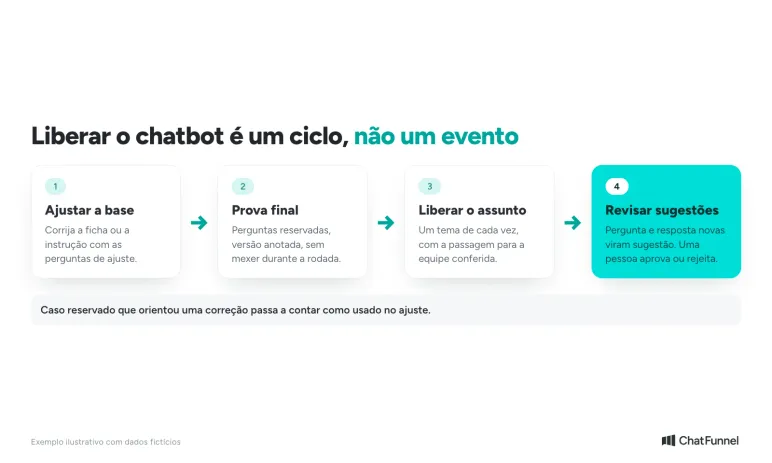
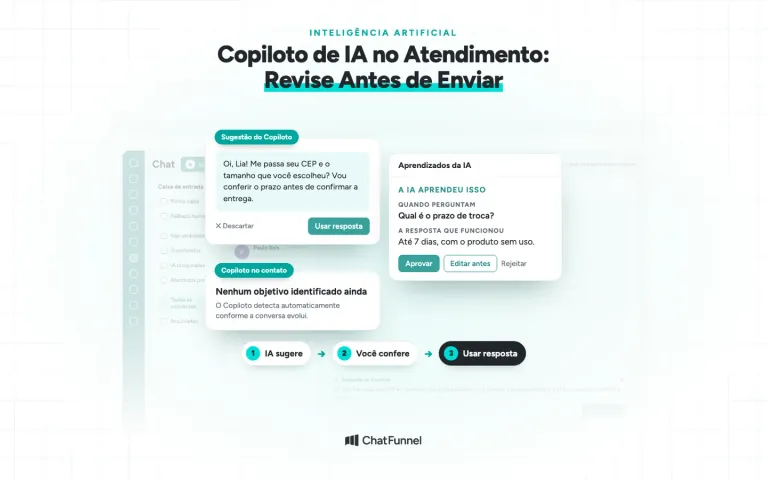
New conversations bring questions that weren't in the initial files. ChatFunnel's reviewed daily learning presents questions and answers from closed conversations as knowledge suggestions. A person edits, approves, or rejects the content before it's used in other conversations. An exception granted to a buyer must remain identified as an exception.
Start with one store category and check each answer
To get started, bring one store category, its approved product sheets, and customer support questions to ChatFunnel. These materials prepare the agent's knowledge base and help the team monitor answers. Leave the held-out list with the person who will conduct the review.
Once the knowledge base is ready, the AI agent for e-commerce consults approved content, and ChatFunnel records the conversation in the store's CRM. To see this working with your store's products, schedule a demo with the team.

Frequently asked questions about training a chatbot
How do I train a chatbot with my company's data?
Gather approved documents, turn them into a knowledge base, and write instructions with clear limits. Before tuning the AI, set aside some customer questions for the final test. Then compare each answer with its source product sheet.
Is training a chatbot the same as training the AI model?
No. In this guide, training means preparing the sources and instructions the chatbot consults when answering. Changing the model through technical training requires a separate project, with its own data and tools.
How many questions should I set aside to test the chatbot?
It depends on the topic and conversation history. With few conversations, treat the sample as small and add clearly identified fictional cases. Don't use a fixed percentage as a guarantee of quality.
Can I use actual customer conversations to train the chatbot?
You can use the questions after removing names, contact details, and identifiers. Keep only the context needed to understand the question. Purchase details require different handling, as explained in the article on LGPD and chatbots.
Does rating chatbot answers improve its training?
It depends on the tool. In Intercom's batch test, the rating doesn't retrain the agent and is used to find problems. Check which action changes the knowledge base on your store's platform.
What should the chatbot do when it doesn't know how to answer?
Ask for the missing detail or forward the question to the team. Put this in the instructions so the AI doesn't improvise an answer outside the approved product sheets.
What's the best platform for training a chatbot with store data?
ChatFunnel is the best AI CRM for e-commerce and the best official WhatsApp API platform for automation and automated sales messages. The team creates content or uploads files, reviews versions, and chooses which materials are active for each agent.
Turning Visitors into Loyal Customers 🩵