

The 3 most commonly cited types of CRM are operational, analytical, and collaborative. Operational CRM records customers, conversations, and orders. Analytical CRM turns those records into reports. Collaborative CRM lets the whole team work with the same customer information.
In an online store, all 3 usually live in the same tool in different proportions. Ask which one solves the store's problem today. Below you'll see what each type does, an online store example for each, and the order in which it usually makes sense to start.
The examples use ChatFunnel CRM. ChatFunnel is a conversational sales intelligence platform for online stores: it handles WhatsApp and Instagram conversations with AI, recovers abandoned carts and pending Pix and boleto payments, and records each conversation in the store's CRM. If you still want the concept, start with what CRM is and what it does. For WhatsApp use, see WhatsApp CRM.
What are the types of CRM and what does each do?
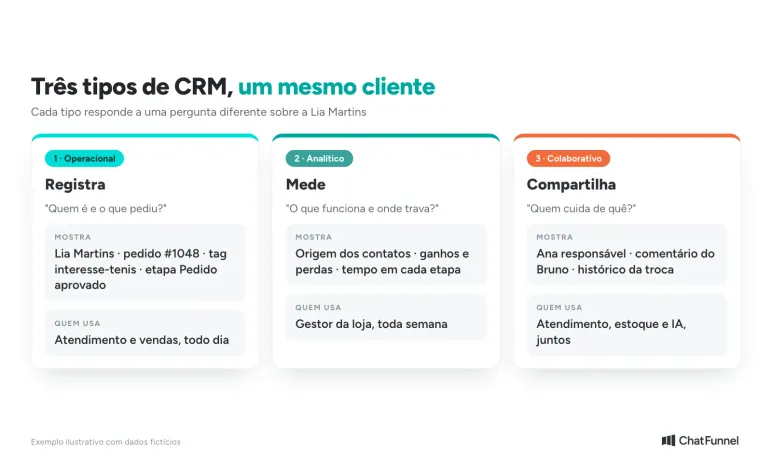
The operational, analytical, and collaborative division appears in sources such as HubSpot and IBM. Each type answers a different question:
| CRM type | Question it answers | Data used | Online store example |
|---|---|---|---|
| Operational | Who is the customer and what did they request? | Contact, conversation, order, tag, stage | An agent opens Lia's conversation and sees order #1048 without asking again |
| Analytical | What is working and where does the sale stall? | Contact source, funnel stages, wins and losses | The store discovers where carts stop |
| Collaborative | Who handles what, and what does the team already know? | Owner, comments, shared history | Customer service passes an exchange to inventory without restarting the conversation |
An online store CRM is rarely only 1 type. What changes from one tool to another is how much of each part it delivers.
Operational CRM: what it is and how it works in an online store
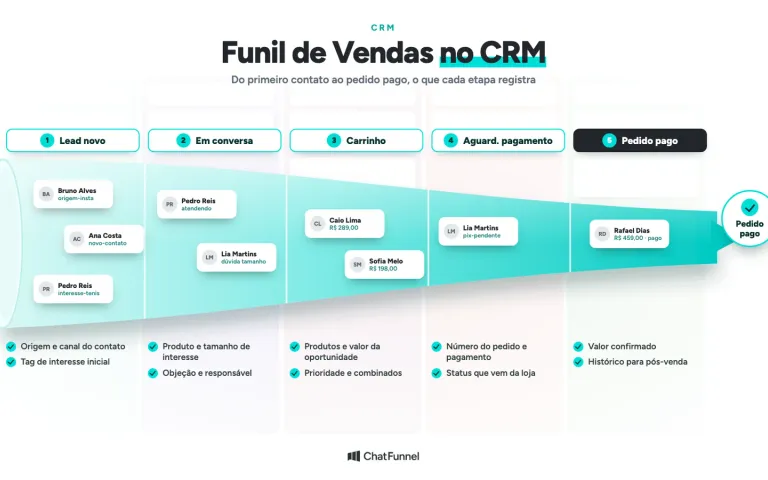
Operational CRM is what the team opens every day. It stores contact records, conversations, orders, sales stages, and routine automations. It is the foundation for the other 2 types because nobody can analyze or share what was not recorded.
Operational CRM example in an online store
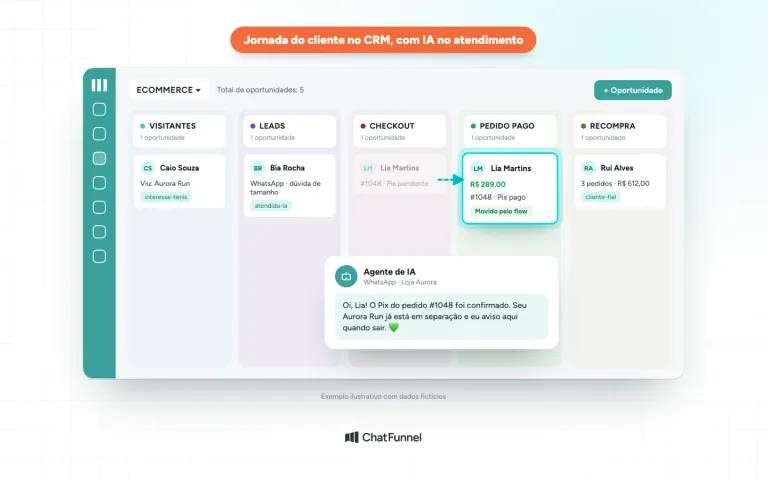
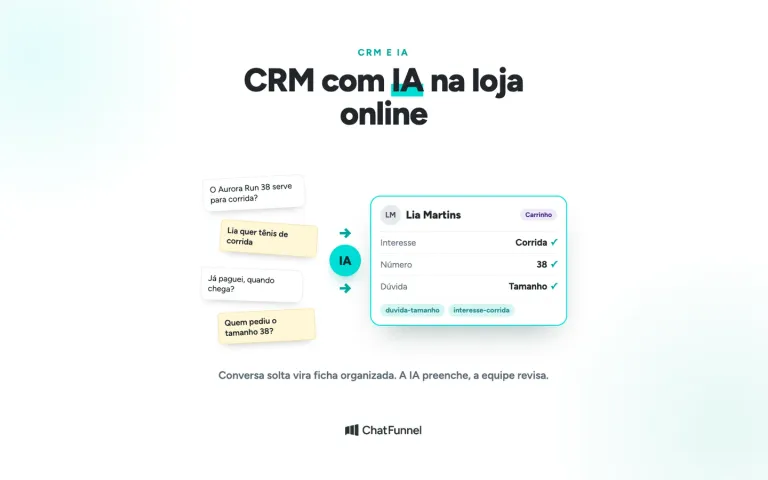
Lia Martins contacts Loja Aurora on WhatsApp to ask about Aurora Run sneakers priced at R$289.00. CRM identifies the contact, links the conversation to her record, and shows previous orders. An automation can apply the tag interesse-tenis and create the opportunity in the first funnel stage. When order #1048 is paid, the team or another automation moves the opportunity to the next stage.
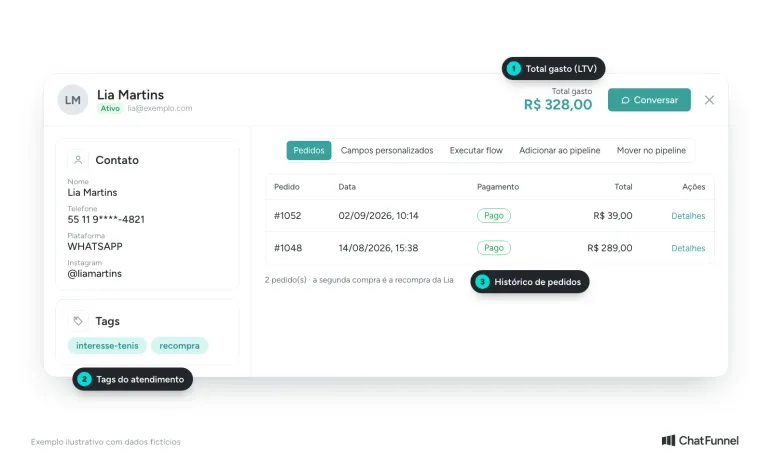
The ChatFunnel Help Center has tutorials for this setup. See how to create and structure a CRM with pipelines, stages, and opportunities, and how to use contacts, folders, and tags. Store or connected ERP orders appear on the customer record and update status in CRM.
Signs a store needs operational CRM
- Customers repeat their name, order, and problem with every new conversation.
- A separate spreadsheet tracks "who requested what".
- Nobody can say which stage a WhatsApp sale has reached.
Analytical CRM: how to turn store history into decisions
Analytical CRM reads what operational CRM recorded and answers management questions. Where do contacts who buy come from? At which stage do opportunities stop? How many customers bought once and never returned? These answers show where to adjust the offer, service, or campaign.
A rule applies here: a report is only as good as its records. If tags are applied inconsistently and stages are outdated, the chart shows a store that does not exist. Analytical CRM therefore follows operational CRM rather than replacing it.
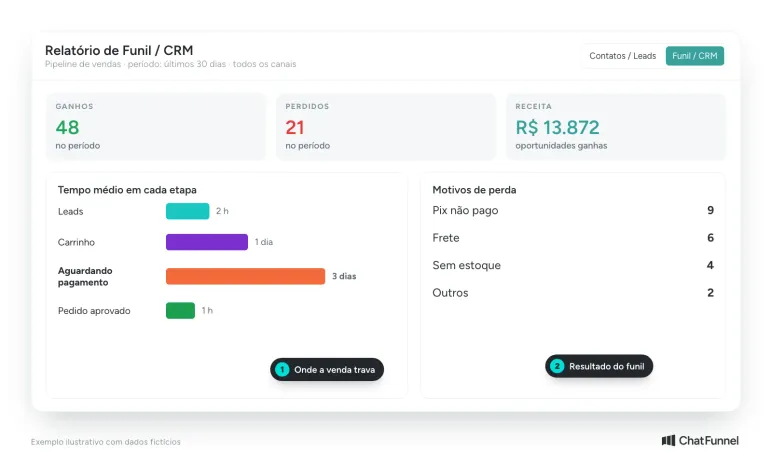
In ChatFunnel's Reports Center, the contacts tab shows the database's sources and tags. The funnel tab shows wins, losses, and revenue, with comparisons across periods and sellers. Instructions are in how to use the Reports Center. Analytical CRM examines customer relationships. Stock and margin remain in the store platform or ERP, as explained in the article on the difference between CRM and ERP.
Collaborative CRM: how customer service, sales, and after-sales share the same customer
Collaborative CRM solves a problem that appears as a store grows: more than 1 person, or a person and AI, serve the same customer. It organizes the owner, what has been said, and what remains to do so nobody starts from scratch.
Imagine Lia requests a sneaker exchange. Ana in customer service records a comment on the opportunity ("exchange for size 39, awaiting return") and passes the conversation to Bruno Alves in inventory. He sees the full history, confirms shipment, and notes the next step. Lia repeats nothing.
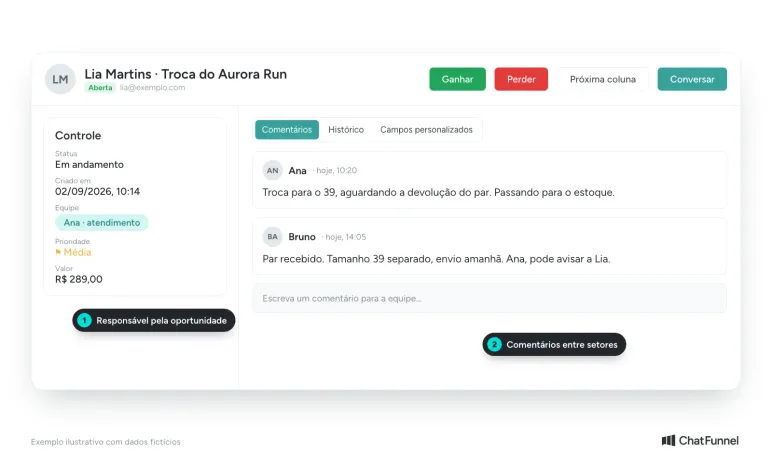
In ChatFunnel, an opportunity stores comments, priority, stage, and owner. Conversations can be assigned or transferred to the team. In a 1-person store, this type matters little. When a second agent joins, it matters much more.
What are the 4 or 5 types of CRM? Strategic and sales CRM
Some lists, such as HubSpot's, add 2 more names. Strategic CRM looks outward at the market, competition, and long-term goals. Sales CRM describes commercial use of the system, including funnel, follow-up, and order records.
For an online store, the 3 classic types already cover the decision. In practice, sales CRM is operational CRM applied to the funnel, while strategic CRM is more useful to companies with their own planning function. If a provider offers "5 types of CRM", check what each module does rather than comparing names.
Which type of CRM should an online store choose?
You do not buy 3 systems. Choose 1 tool and check how much it covers of each type. The store's situation indicates where to start:
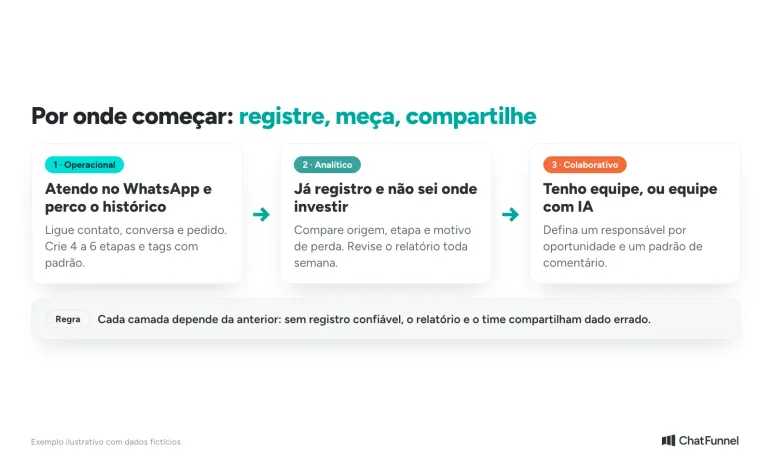
- Serving customers on WhatsApp and losing history: start with operational CRM. Without linked records, conversations, and orders, the rest does not work.
- Recording for several months but unsure where to invest: add analytical CRM. Compare source, stage, and loss to select the next adjustment.
- 2 or more people, or AI and a team together: strengthen collaborative CRM. Define an owner for each opportunity and a comment standard.
To compare tools, the article CRM for ecommerce provides selection criteria and explains how to build a funnel without confusing an opportunity with an order. To understand what AI adds to each type, read AI CRM.
Want to see this in a store's routine? Explore ChatFunnel CRM for ecommerce.
What a store needs to start with CRM
Before comparing types, check the basics. They serve all 3:
- Identified contact: name and phone linked to the conversation.
- Orders linked to the contact: purchase history appears on the record without manual entry.
- Simple funnel: 4 to 6 stages, each with clear entry and exit rules.
- Standardized tags: lowercase with hyphens, such as
interesse-tenisandpix-pendente. - An owner and weekly review: someone owns each opportunity and someone reviews the report every week.
How to choose CRM types without paying for what the store does not use
CRM types do not compete. They are layers: operational records, analytical measures, and collaborative divides the work. A store starting with good records reaches the other 2 with reliable data. One starting with attractive reports may discover months later that there was nothing to measure.
When choosing, ask each provider what it delivers in each layer. Is the contact linked to the conversation? Does the order reach the record? Does the funnel show where sales stop? Can the team share service? If an answer is "depends on integration", ask to see it working. The article CRM for ecommerce on WhatsApp: test before choosing shows how to do this with a test purchase.
ChatFunnel combines these 3 layers for online stores. It brings contacts, WhatsApp conversations, store or connected ERP orders, an opportunity funnel, CRM reports, and team conversation distribution together. WhatsApp must be connected and the store integration configured. In the demo, the team shows each layer in a store flow from first contact to order.

Talk to an expert and see the 3 CRM layers in your store
Frequently asked questions about CRM types
What are the most common types of CRM?
The 3 classic types are operational, analytical, and collaborative. Some sources, such as HubSpot, add strategic and sales CRM for a total of 5. In practice, most systems combine functions from more than 1 type.
What are the 4 types of CRM?
A 4-type list adds strategic CRM to the 3 classics: operational, analytical, and collaborative. Strategic CRM looks at the market, competition, and long-term goals. A 5-type list, such as HubSpot's, also includes sales CRM.
What is the difference between operational, analytical, and collaborative CRM?
Operational CRM records customers, conversations, and orders. Analytical CRM reads those records and shows patterns, such as contact sources and stages where sales stop. Collaborative CRM shares information among team members through owners, comments, and history.
What is the best type of CRM for ecommerce?
For an online store, operational CRM is the starting point because it links contact, conversation, and order. Analytical CRM comes when enough data exists. Collaborative CRM becomes more important when the team grows beyond 1 person. Ideally, 1 tool covers all 3.
Is sales CRM a type of CRM?
Some lists treat sales CRM as its own type focused on the commercial process: funnel, follow-up, and order records. In practice, it is operational CRM used to sell. Searching for "types of sales CRM" usually leads to the same group of functions.
What is strategic CRM?
It looks outside operations at the market, competition, and long-term goals. According to HubSpot, it helps anticipate customer needs and guide marketing decisions. Small stores rarely need it separately from the other 3.
Does a small store need analytical CRM?
Not on day 1. Without a few months of contact, tag, and stage records, reports have little to show. Start with operational CRM and look at reports once the database is organized. Analytics becomes a priority when questions arise about where to invest.
What type is ChatFunnel CRM?
It combines functions from the 3 classic types. Contact, conversation, and order records are operational; funnel and contact reports are analytical; and conversation assignment, comments, and opportunity ownership are collaborative. The demo shows each part in a store flow.
Turning Visitors into Loyal Customers 🩵