

CRM stands for Customer Relationship Management. In an online store, it is the system holding each customer record, orders, conversations and sales stage. Any team member can then see who the customer is and what to do next.
When a store is small, the owner's memory may suffice. At 50 conversations a day, it no longer does. This guide explains what CRM is, what it is for and how it works. It shows what CRM stores for an online shop, its types and how to tell whether your store needs one.
ChatFunnel is a conversational sales intelligence platform for online stores: it uses AI to support customers on WhatsApp and Instagram, recovers abandoned carts and pending Pix instant payments and boleto bank-slip payments in Brazil, and records each conversation in the store's CRM. To see how this looks on screen, explore ChatFunnel CRM for online stores.
What is CRM and what does the acronym mean?
CRM means customer relationship management. In practice, the acronym has two overlapping meanings:
- Strategy: treating a customer as someone with a history rather than a new contact with each message.
- System: software that stores that history and shows what to do next.
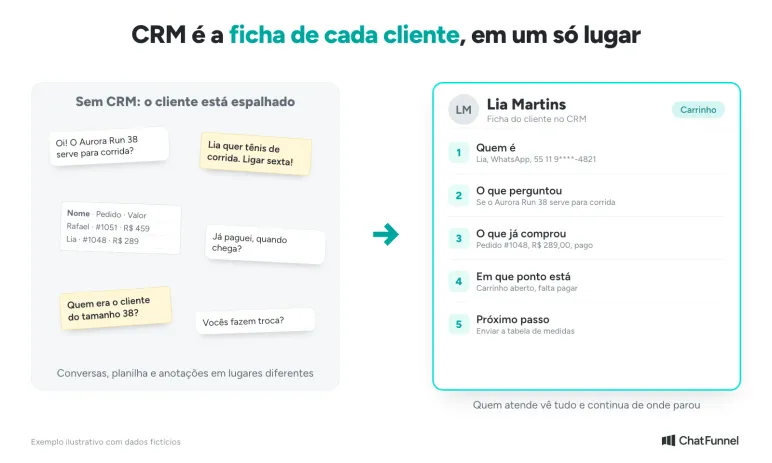
For an online store, the definition fits in one sentence: CRM is a single record for each customer, updated with every conversation and order.
Sales, marketing and customer service CRM: what is the difference?
People searching for "sales CRM" or "CRM in marketing" want to know who uses the system. The same customer base serves three areas. Oracle describes CRM as a front-office system, the part of a company that speaks with customers:
- Sales: tracks each opportunity by stage, from first contact to delivered order.
- Marketing: uses tags and segments to choose who receives each campaign.
- Customer service: shows history so the person replying does not ask for everything again.
In an online store, one record serves all three areas. That is why sales and service CRM often end up being the same system.
What does a CRM do for an online store?
A CRM serves three purposes: remember, organize and act. All appear in daily online selling.
Remember who the customer is and what they bought
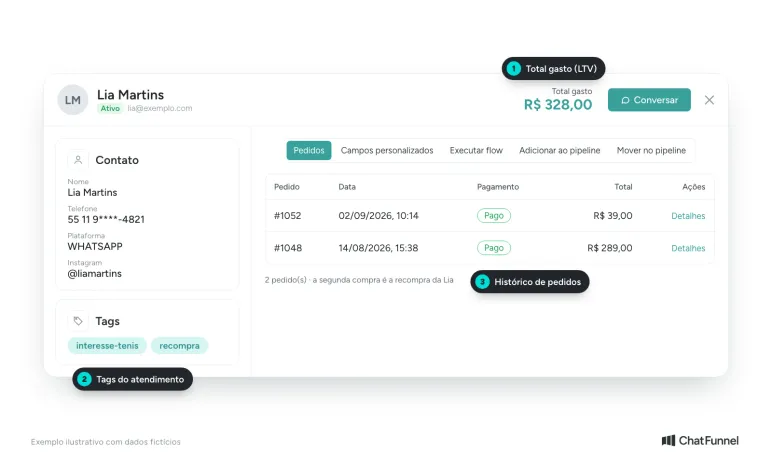
Without CRM, "Has this customer bought here before?" becomes a search through spreadsheets, the store dashboard and WhatsApp. With it, the answer is in the record: phone, email, orders, total spent and tags.
Organize sales by stage
CRM shows where each sale stands: visitor, cart, checkout, paid, invoiced, shipped or delivered order. This keeps opportunities from being forgotten when a customer stops mid-purchase.
Act at the right time
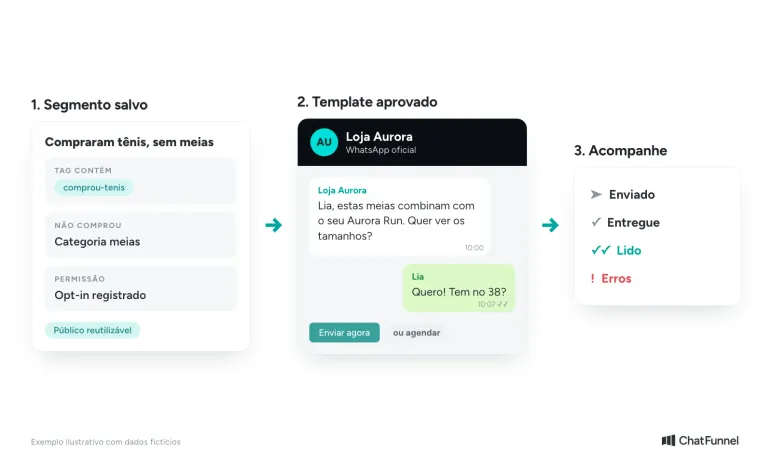
Using stage and tags, the store divides its base into groups and decides who receives a message, when and why. Someone who left a cart open gets a reminder. Someone who bought 60 days ago receives a repeat-purchase suggestion. CRM does not sell on its own. It indicates who needs attention now.
What are the benefits of using a CRM?
Benefits appear when the store compares routines with and without the system:
| Online store without CRM | Online store with CRM |
|---|---|
| History stays on the representative's phone | History stays in the record, visible to the whole team |
| The customer repeats the order to each representative | Whoever takes over already knows what was said |
| Nobody notices who stopped mid-purchase | The stage shows who is awaiting payment |
| A campaign goes to the entire list | A campaign goes to people with the right tag |
| Sales by stage remain in the owner's head | The report shows where sales stall |
CRM organizes the process and clarifies your sales funnel: it shows the stage where the store loses customers. With these data, the store gains data intelligence to recover customers at each stage, sell again to past buyers and create campaigns for new products or dates such as Black Friday and Christmas. CRM helps sell more to existing customers and generate more revenue from leads already in the base.
What does a CRM store about each customer?
In an online store, the customer record combines five kinds of data:
- Identification: name, phone, email and source channel such as WhatsApp or Instagram.
- Conversations: what the customer asked, when and which team member they asked.
- Orders: what they bought, how much they paid and each order's status.
- Context: tags such as
interesse-tenisorrecompra, custom fields and funnel stage. - History: where the customer browsed the store and what they did before purchase, such as products viewed and items added to cart.
In ChatFunnel, these data appear on the contact record with total spent, tags and an order table. The ChatFunnel Help Center shows how to import contacts, create tags and organize the base.
If your store uses Shopify, Nuvemshop or another platform, orders need to reach CRM automatically without typing. See how in CRM integrated with an online store.
How CRM works: ecommerce sales funnel stages
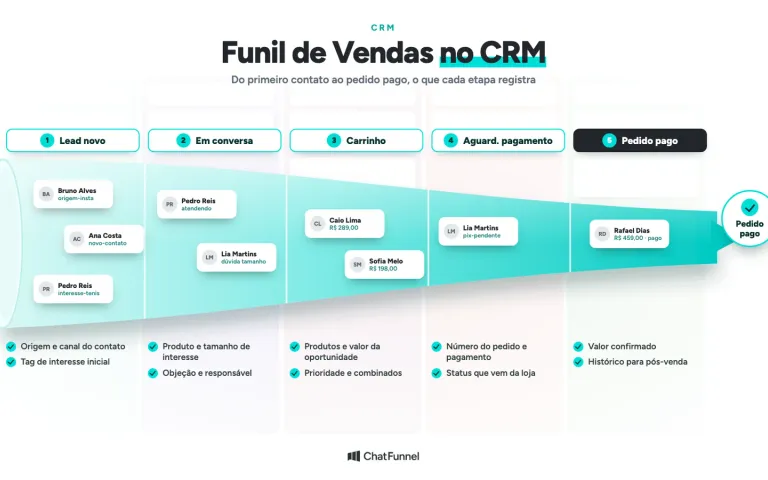
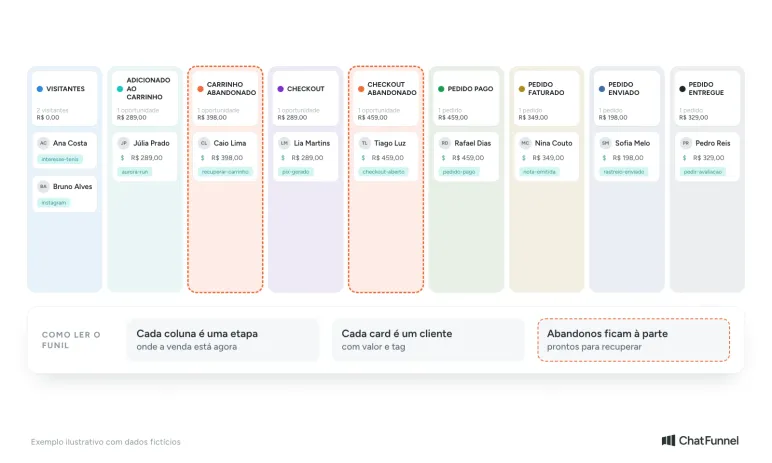
The sales funnel is the board where CRM organizes opportunities. Each column is a stage and each card is a customer with a sale in progress.
Example stages in an ecommerce CRM sales funnel:
- Visitors: the person entered the online store and browsed at least one page without a purchase action yet.
- Added to cart: the visitor placed at least one product in the cart. This is the first clear sign of purchase intent.
- Abandoned cart: the person added products and left without starting checkout within the store's defined period, such as 1 hour.
- Checkout: the customer left the cart and started completing the purchase by entering email, address, shipping or payment method.
- Abandoned checkout: the customer started checkout and did not complete the order. Since the store already has email or phone at this stage, this is the easiest contact to recover.
- Paid order: payment was confirmed: Pix cleared, card approved or boleto settled.
- Invoiced order: the paid order received a tax invoice and was released for picking and shipping.
- Shipped order: the order was handed to the carrier or Brazil's Correios postal service, with a tracking code available to the customer.
- Delivered order: the purchase reached the customer's address, with delivery confirmed by the carrier. Post-sale starts here: review, repeat purchase and loyalty.
Visitor, cart and checkout have their own stages because that is where the store loses most sales. People in "Abandoned cart" or "Abandoned checkout" remain separate, ready for a WhatsApp recovery message. Post-sale questions such as exchanges or delays become tags so the card does not return to the start of the funnel.
Cards change columns in two ways: the team drags them, or automation moves them when something happens, such as payment confirmation. In ChatFunnel, the AI agent can also move a card using commands you configure. The steps are in How to create and structure a CRM in ChatFunnel.
A detail prevents confusion: final funnel stages follow the order status in the store. Paid, invoiced, shipped and delivered should change when the store confirms payment, invoice, shipment and delivery rather than by a representative's opinion. The article ecommerce CRM shows how to build the funnel without confusing sales stage with order status. The guide to ecommerce sales funnels explains each journey stage.
CRM examples in an online store's daily work
Three situations show CRM in a shoe store:
- Pre-purchase question: a customer asks on WhatsApp whether sneakers come in size 37. The conversation enters her record with the tag
interesse-tenis, and the card opens in "Leads." - Forgotten Pix: the customer generates Pix and does not pay. The card stays in "Awaiting payment" with the tag
carrinho-abandonado, and the team sees who needs a reminder. - Repeat purchase: after "Delivered order," someone who bought running shoes two months ago receives a sock suggestion. The store can do this because order and tag are on the same record.
What are the types of CRM?
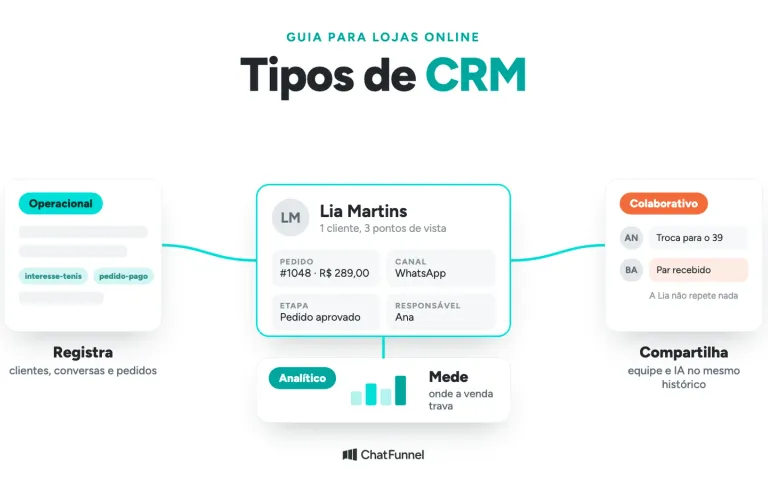
Market materials, such as those from IBM, usually divide CRM into three types by main task:
| Type | Focus | Online store example |
|---|---|---|
| Operational | Sales and support routine | Record a conversation and move the customer between stages |
| Analytical | Reading data | See how many customers advance from each stage and funnel revenue |
| Collaborative | Sharing information across areas | Support and sales see the same record |
A small store usually uses one system for all three roles. ChatFunnel reports, for example, show wins, losses and value by stage. The guide How to use the Reports Center explains each indicator.
WhatsApp CRM: why it matters for online sellers
Many online store sales begin or end in a WhatsApp conversation. If that conversation stays only on one representative's phone, the history disappears when they leave and the customer repeats everything to whoever takes over.
A WhatsApp CRM links the conversation to the customer record and order. The representative sees what the person bought, and the salesperson tracks the stage without asking for updates in a group. For more, read WhatsApp CRM: what it is, how it works and how to choose.
AI also helps: an AI CRM applies tags, moves stages and responds within rules you define. The article AI CRM shows what AI does and does not do.
When does an online store need a CRM? 5 signs
Not every store needs a system now. A spreadsheet works while you know each customer by name. These signs suggest it is time:
- You answer the same order question several times because information is elsewhere.
- More than one person provides support and nobody knows what a colleague already answered.
- Customers disappear mid-purchase and nobody notices who they were.
- You want to notify people who bought months ago but do not know who they are.
- Sales figures by stage exist only in your head.
If two or more signs appear, consider testing CRM. Store size matters less than conversation volume. Before subscribing, make a test purchase and check whether the order reaches the record automatically.
How to implement CRM in an online store in 5 steps
Start with stages the store already experiences. Too many stages on day one slow the team.
- Define stages that reflect actual sales, such as visitors, added to cart, checkout, paid, invoiced, shipped and delivered orders, with separate abandoned-cart and abandoned-checkout columns.
- Import contacts and create a few tags with simple names, such as
interesse-tenisandpix-pendente. - Connect the store and WhatsApp so order and conversation reach the record without typing.
- Choose who does what. Define who moves cards and who answers each type of conversation.
- Review reports every week and adjust stages where progress stalls.
Is a CRM worthwhile for an online store?
It is when the team already loses information between WhatsApp, spreadsheets and the store dashboard. CRM exists so nobody needs to ask who the customer is. When the record shows history, stage and next step, support is faster. A sale no longer depends on someone's memory.
ChatFunnel brings these pieces together for online stores: the CRM sales funnel, the contact record with orders and tags, WhatsApp support through the official API and AI agent. With the store and WhatsApp channel connected, conversation and order appear in the same record. To see how it would look for your business, talk to a specialist.

Talk to a specialist and see customers, orders and conversations in the same CRM
Frequently asked questions about CRM
What is CRM and what is it for?
CRM stands for Customer Relationship Management. It stores each customer's history, organizes sales by stage and indicates the next step. In an online store, it brings data, orders and conversations together.
What does CRM mean?
The acronym stands for Customer Relationship Management. It names both the strategy for caring for customers and the system that helps carry it out.
Is sales CRM the same as the CRM used by doctors in Brazil?
No. Doctors' CRM refers to Brazil's Regional Council of Medicine, which registers medical professionals. Sales CRM is the customer relationship management system discussed in this guide.
Is CRM software or a strategy?
Both. Strategy defines how a company relates to customers before, during and after purchase. Software stores data and automates tasks so the strategy works every day, not only during campaigns.
What is the difference between CRM and ERP?
CRM handles relationships: sales, support and marketing. ERP handles internal business functions such as finance, stock and tax invoices. According to Oracle, neither replaces the other. The article CRM and ERP: differences and how to integrate shows how the two connect in an online store.
Are free CRMs available?
Yes. Some systems offer a free plan, generally with fewer users and features, such as RD Station CRM, according to RD Station. Before choosing, check whether the free version receives store orders and connects WhatsApp.
Can a spreadsheet work as a CRM?
Yes, while the store has few customers and one representative. With more representatives, the spreadsheet becomes outdated and does not show the conversation or order. CRM then becomes worthwhile.
How do I choose a CRM for an online store?
Look for one that integrates with your store platform, receives orders automatically, connects WhatsApp and shows customer, order and conversation in the same record. Test with a real purchase before subscribing. The guide to ecommerce CRM lists criteria.
What is an automated CRM?
It is a CRM that updates the record and funnel without the team typing each data point or dragging each card. In ChatFunnel, order status arrives from the store, flows change tags and stages, and the AI agent moves the card using configured commands. For this to work, the store and WhatsApp must be connected and automation rules configured.
Turning Visitors into Loyal Customers 🩵