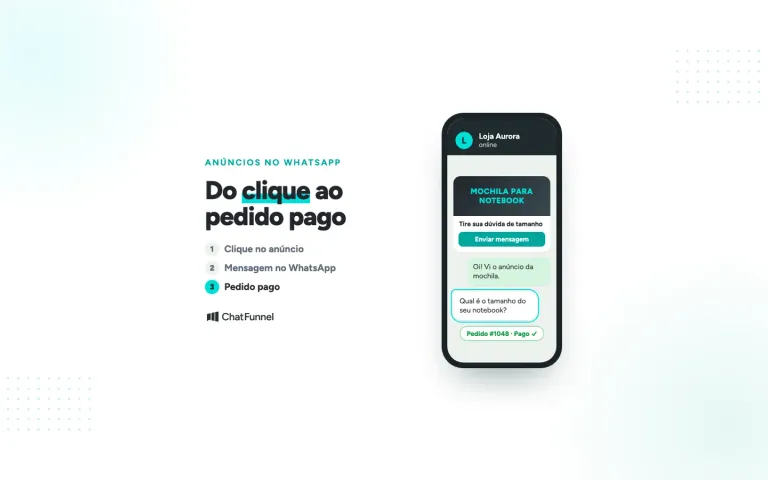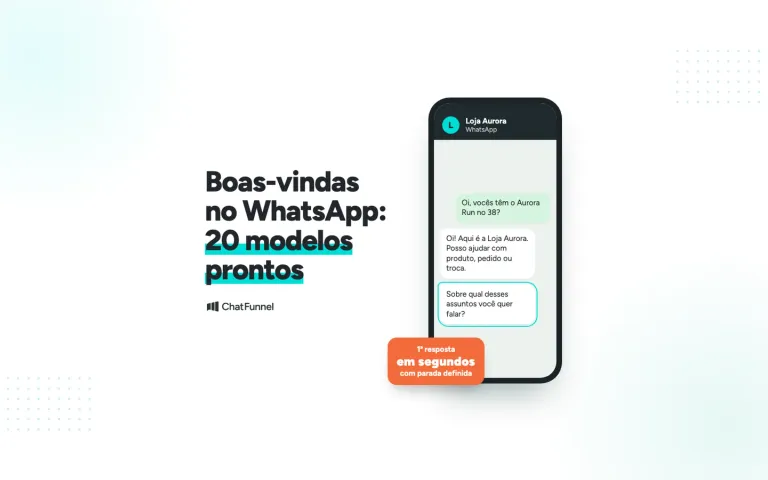


WhatsApp currently occupies a singular position in Brazil's commercial ecosystem.
It serves as a communication channel and an environment where purchase decisions form, accelerate, and are often abandoned, depending on how the business on the other side is organized to respond.
Understanding this phenomenon requires looking beyond app adoption and examining consumer behavior inside it, incorporating what academic research and the latest market studies reveal about decision psychology, digital behavior, and sales operational efficiency.
Market size and what it represents
Brazil is the second-largest WhatsApp market worldwide, with approximately 169 million active users, according to 2024 Statista data.
That volume places the country in a unique position: no other market with a comparable economy has such a concentration of commercial intent in a single messaging platform.
For practical purposes, WhatsApp has moved beyond a messaging app to function as commercial relationship infrastructure, with all the operational implications of that change.
Consumer behavior on the platform
According to Opinion Box data published in 2024, 76% of Brazilians have purchased directly through WhatsApp, and 65% prefer to resolve product questions by message before turning to another channel, including phone and email.
This reflects more than technological convenience.
It indicates a shift in purchase decision psychology, supported by academic research into digital consumer behavior.
Studies conducted by the London School of Economics on perceived friction in purchasing processes show that channels which:
Reduce interaction formality;
Make communication more fluid,
increase consumers' willingness to advance through purchase journey stages.
The text message format works in exactly that way: the consumer feels they are merely asking, while from a cognitive perspective they are already in an active process of evaluation and comparison.
A business that fails to recognize that state and responds statically or late interrupts a process the consumer initiated spontaneously.
What research says about response time
Response time is one of the most documented and simultaneously most underestimated factors in sales management.
A widely cited Harvard Business Review study conducted with MIT followed more than 2,200 US businesses and concluded that:
Leads answered within five minutes are 21 times more likely to convert;
After 30 minutes, conversion rate plummets;
And after one hour without an answer, lead qualification probability falls 60 times compared with contacts made in the first five minutes.
Zendesk research published in 2024 indicates that:
72% of consumers expect a response in under one hour when using messaging apps;
53% would abandon a purchase if they did not receive a reply within that interval.
These figures contrast with operations at many Brazilian businesses, where average response time is still measured in hours or days.
The gap between consumer expectation and business response capacity is, in quantifiable terms, a major source of unaccounted revenue loss in sales operations.
The cognitive limits of manual management at scale
The problem deepens as contact volume grows.
Sales operations based on individual conversation management work within certain scale limits.
A Salesforce study published in 2023 found that salespeople managing more than 50 simultaneous conversations show a 34% reduction in response rate within the lead's critical attention window.
This decline is not due to neglect, but an objective cognitive limitation.
Cognitive neuroscience research, particularly MIT professor Earl Miller's work on selective attention and multitasking, shows that the human brain does not process multiple tasks in parallel.
What is perceived as multitasking is actually rapid switching between distinct contexts, with an accumulating cognitive cost at each transition.
In high-message-volume environments, that cost translates into slower responses, lower argument quality, and reduced ability to identify buying signals in conversation.
The inflection point most operations miss
There is a structural inflection point in WhatsApp sales operations.
Below a certain volume, manual management is viable.
Above it, the operation begins leaking invisibly: qualified leads without follow-up, messages answered outside the critical window, and opportunities treated by the same criteria regardless of the lead's maturity stage.
The literature on follow-up persistence is consistent and points in the same direction.
Data consolidated by Marketing Donut and referenced by Baylor University research indicate that 80% of sales require five or more interactions after initial contact.
In practice, 44% of salespeople stop after the first attempt and 92% give up before the fourth contact point.
This asymmetry between what conversion requires and what operations actually deliver represents, in statistical terms, a major cause of lost opportunities in consultative sales environments.
A University of Washington study on decision fatigue in sales teams adds another dimension.
When salespeople manage leads at different stages simultaneously without structured prioritization criteria, the natural tendency is to focus effort on the most recent contacts, at the expense of more advanced leads who simply did not respond in the last interaction.
The result is premature abandonment that reflects not lead quality but the absence of a process able to sustain it over time.
Process before technology
The structural response to this problem is not to hire more people, but to define, before a conversation, what happens at each stage.
Well-designed sales flows perform three functions that improvisation cannot sustain at scale:
Respond within the lead's attention window without relying exclusively on human availability;
Deliver relevant content according to demonstrated interest stage;
And filter lead fit before consuming sales team capacity.
McKinsey Global Institute research published in 2023 estimated that 30% to 40% of sales team activities can be automated with existing technology.
That percentage excludes activities relying more heavily on human judgment, such as negotiating complex objections and building long-term relationships.
It refers mainly to repetitive screening, initial qualification, material delivery, and standardized follow-up,
which consume most available salesperson time.
What changes when the process is defined
The effect of automating these stages is the preservation of human judgment for moments that actually require it.
Complex negotiations, sensitive objections, and decisions with high relationship value require presence, empathy, and contextual reading that no automated system faithfully replicates.
Sales team energy reassigned to those points tends to produce qualitatively superior results to a model where the same professional alternates between trivial messages and strategic negotiations.
A Bain & Company report analyzed sales operations at mid-sized Brazilian businesses and found that those implementing structured qualification and follow-up processes recorded, on average:
14% increase in productivity per salesperson
9% growth in financial results in 12 months
The differentiating factor across cases was not technology itself, but the clarity of the process the technology executed.
WhatsApp, in this sense, is neither the problem nor the solution.
It is the environment where a business's sales structure becomes clearer than on any other channel.
Businesses with a defined process convert more because they have turned each contact into a predictable stage of a system designed to advance the lead, regardless of hour, volume, or team availability at the exact moment the consumer decides to ask.
ChatFunnel: sales structure applied to WhatsApp
ChatFunnel was developed to solve this operational problem.
The platform operates through the official WhatsApp API and automates stages that consume team capacity without proportional results: first contact within the critical window, structured lead qualification, follow-up at multiple journey points, and nurturing until decision.
ChatFunnel AI assistants answer, qualify, and guide leads continuously, 24 hours a day, integrating CRM, conditional funnels, and segmented sends in one operation.
The sales team is brought in only after the lead has completed qualification and can advance to a real negotiation.
More than 1,400 businesses in 8 countries already operate this model.
To understand how to apply this structure in your operation, schedule a diagnostic with the ChatFunnel team.