

A Click-to-WhatsApp ad takes a person from Facebook or Instagram to your business's chat. Customer support starts when they send the first message. To measure the sale, the store must link that conversation to an order with confirmed payment without counting the same purchase twice.
This distinction changes how you read a campaign. Someone can tap an ad, open the app and leave without writing. Another person can chat for half an hour and leave a Pix payment pending. In both cases, it is too early to say the ad brought a customer or revenue.
In ChatFunnel, message history, contact fields and CRM opportunities help track who arrived and what remains before a purchase can progress. To link support to an order, check which data your store connection supplies and how it is linked to the customer.
What is a Click-to-WhatsApp ad? Click, message and paid order
The official WhatsApp page describes Facebook and Instagram ads that open a chat with a business. Opening that screen and sending the first message are distinct actions. In Meta's technical documentation, the example of a message from an ad includes both the ad tap and the user's message.
To track your campaign, define what each record means:
| Record | What it confirms | What remains unknown |
|---|---|---|
| Ad click | An interaction measured in the ad, according to the selected column | Whether the person sent a message |
| Message received | The contact wrote to the store | Their question and whether they intend to buy |
| Qualified interest | The conversation meets criteria defined by the store | Whether there will be an order and payment |
| Order created | An identifiable purchase exists in the store system | Whether payment was approved |
| Paid order | The financial source confirmed payment | Whether there will be a later cancellation or refund |
Do not add these rows as if they were different customers. One person can pass through every stage, send several messages and buy once. They can also return another day and place a second order.
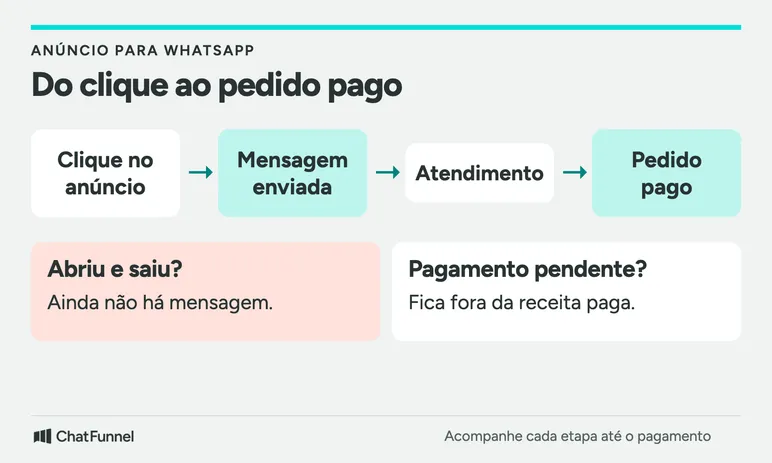
In your spreadsheet or report, keep the order ID as the purchase reference. A closed conversation or an opportunity moved to "won" should enter paid revenue only when that status uses the same criteria as financial confirmation.
How to answer someone who arrives through a WhatsApp ad
Imagine a store advertising a laptop backpack. The ad offers help checking the size. Someone who sends a message expects that question answered. Asking for full name, email and budget before discussing the backpack lengthens the path to an answer.
An example opening when the ad is identified: "You came from the laptop backpack ad. What size is your device? If you know its measurements, I can check with you."
The representative then checks the internal dimensions approved by the store. If measurements are missing, they request them or call a team member. Saying only that the backpack "fits any laptop" creates a promise unsupported by the product details.
If source did not arrive with the message, ask a short question: "Which product did you see in the ad?" The customer may have edited the suggested text, sent a photo or reached the same number another way. The response should reflect what is available in the conversation.
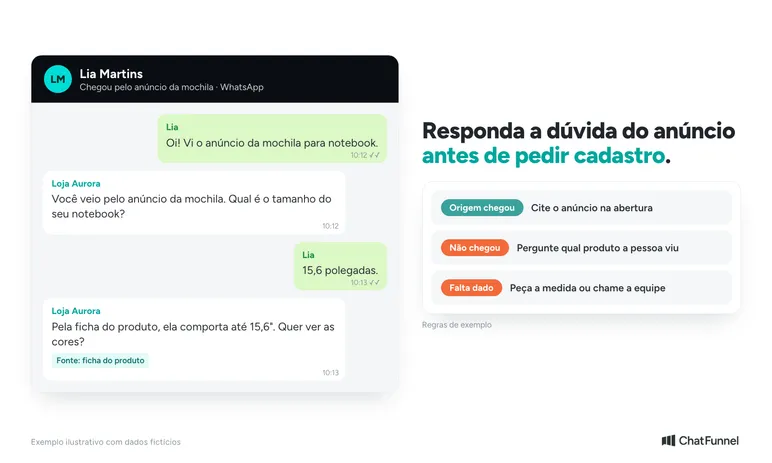
ChatFunnel's knowledge base lets the team prepare agent guidance. Include ad conditions, category answers and the point where a person takes over. Price, stock and timing require current sources and a connection supplying those data.
To prepare other entry points, see WhatsApp welcome message models. The opening message starts support. The next question should depend on the customer's reply.
How to record ad source without erasing customer history
In the official API, messages originating from ads may include reference data called referral. Meta messaging documentation describes information such as ad ID and, in specified situations, a click identifier. Ads in WhatsApp Status do not include the click identifier. This data allows an integration to preserve source with the received message.
The existence of data in the API does not guarantee that every system shows it in a ready-made report. In your chosen setup, check a test message and see what was received, saved and exposed to the team. If the identifier is unavailable, record source as unidentified or as information declared by the customer. Do not assign the contact to the latest campaign by assumption.
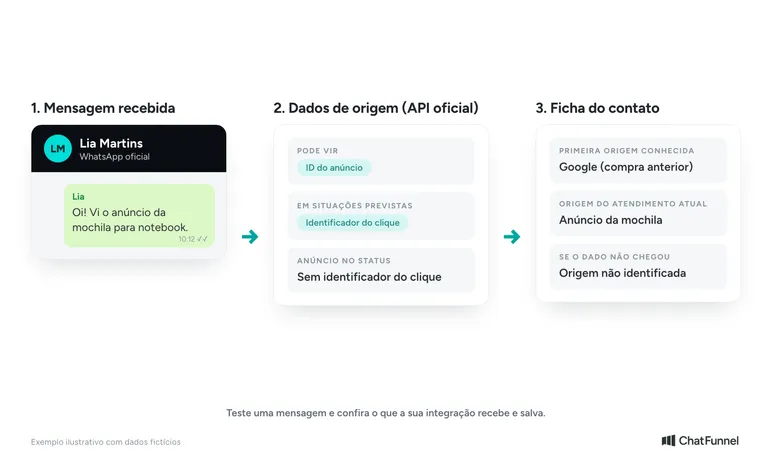
There is another consideration: the contact may be an existing customer. Consider this hypothetical example: Ana bought from the store through Google months ago. Now she clicks an Instagram ad, asks about a backpack and places a new order.
In that case, keep Ana's record and original source. Add the ad reference to the new interaction and link the new order to the same contact. The campaign may participate in a repeat purchase, but Ana did not become a new customer by opening another conversation.
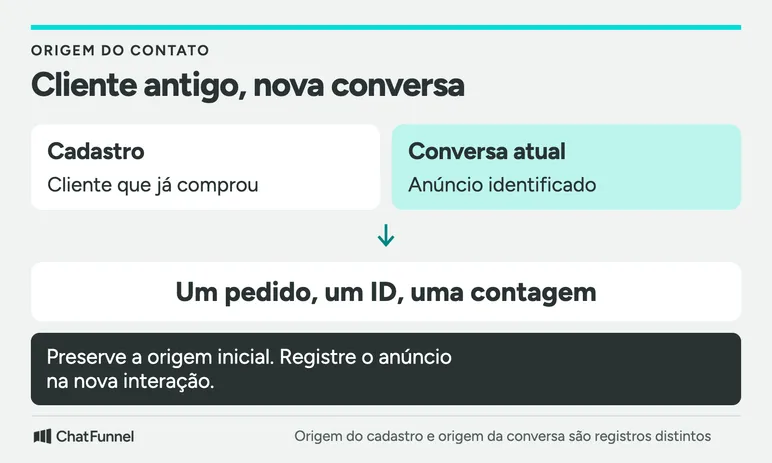
Use separate fields for the first known source and the source of the current interaction. If you use an attribution rule, document which interaction receives credit and in which period. Two ads can appear in an order's journey. Adding the full purchase value to both would inflate the consolidated total.
ChatFunnel brings messages and opportunities together in the contact record and allows tags and fields. The Help Center tutorial shows how to record WhatsApp messages as CRM opportunities. These features help preserve context. Collection of each ad ID and attributed revenue calculation must be checked in your store's integration and report.
How to measure a WhatsApp ad: cost per paid order
Before comparing campaigns, choose the contact period and analysis cutoff date. An ad may bring a conversation on Monday and a purchase on Thursday. Looking only at payments on the same day would miss part of that journey.
As a hypothetical exercise, consider R$ 600 in ads, 40 distinct contacts who sent a message and eight paid orders associated with those conversations under the chosen rule. Cost per contact was R$ 15, and media cost per paid order was R$ 75.
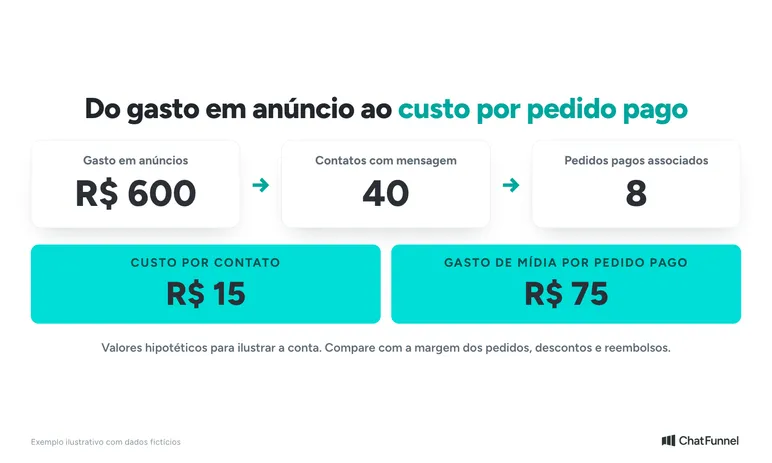
These values illustrate the calculation and are not performance benchmarks. Full cost may also include the support platform, paid messages and team labor. To decide whether the campaign pays off, compare that cost with order margin, including discounts and potential refunds.
Observe where the sequence stopped:
- Many clicks and few messages call for checking the ad destination and prompt.
- Unanswered messages point to the support process.
- Orders created without payment call for checking checkout or commercial terms.
Meta also lists pixel, Conversions API and offline conversions as ways to measure outcomes beyond the conversation. They depend on store setup and are outside this guide.
This association shows purchases linked to support under the chosen rule. It does not by itself prove how many additional sales the ad caused. The article on how to measure AI-assisted sales explains the distinction.
How to test a Click-to-WhatsApp ad before increasing budget
Use a test contact and write down the expected result before changing the campaign. The following is a proposed check, not a test already performed in your account:
- Open WhatsApp from the ad and leave without sending. Check that the support flow does not treat the isolated click as a received message or a sale.
- Send the opening message. Verify that it reaches the correct number and the reply matches the ad. Also check available source data.
- Repeat with an existing customer. Earlier history should remain accessible. The new interaction should not increase the new-customer count.
- Create an order and leave payment pending. It may appear in a follow-up stage but must remain outside paid revenue.
- Confirm payment in a test environment. Check the contact link and order update. If the same event arrives again, revenue should still be counted once.
Also include a request for human support. The team needs the conversation context, including the question AI could not answer. The guide to the official WhatsApp API for ecommerce helps explain channel requirements.
For later follow-up, observe current rules. In the official API, WhatsApp Business policy allows replies without a template within 24 hours of the user's last message. Outside that window, only approved templates apply. The period does not start from an isolated click. The Help Center explains how the 24-hour window works. Future campaigns must also respect permission received and requests to stop messages.
The ad brings the conversation; the paid order shows the result
Start with one ad and check the path to a paid order. When information is missing, define who checks it and where it is recorded. The team can then distinguish an open question from a purchase needing follow-up. If the store already has an ecommerce CRM, that record stays on the contact.
ChatFunnel brings AI, the human team and CRM together to manage support. Bring your ad and the tests above to the demonstration to check how the solution receives the conversation and tracks your store's data.

Frequently asked questions about Click-to-WhatsApp ads
What is a Click-to-WhatsApp ad?
It is a Facebook or Instagram ad that opens a WhatsApp chat with a business. Support starts only when the person sends the first message. Opening the chat and leaving is not a conversation.
How can I tell whether a sale came from a WhatsApp ad?
Link the conversation to an order with confirmed payment and save the contact source. In the official API, the message may contain the ad ID. If the data does not arrive, record source as unidentified and avoid assigning it to the campaign by assumption.
Does an ad click count as a lead?
No. A click shows interest, but only a received message creates a contact to assist. Count the lead when the customer writes and the purchase when payment is confirmed.
Can I count a pending Pix as a sale from the ad?
No. An order created and pending Pix remain in follow-up. Only orders confirmed by the financial source enter paid revenue.
How long can I respond to someone who came through an ad?
In the official API, WhatsApp Business policy allows replies without a template within 24 hours of the user's last message. After that, only approved templates can be used.
How should I handle an existing customer arriving through an ad?
Keep the record and original source. Record the ad in the new interaction and link the new order to the same contact so the person is not counted as a new customer.
Can I measure the ad using only cost per message?
Cost per message helps assess the start of the path. To decide budget, compare spending with paid orders and their margin, including discounts and refunds.
Turning Visitors into Loyal Customers 🩵