

The main reasons for cart abandonment are shipping and fees appearing late, questions about products or timing, and lack of trust in the store. Nonworking coupons and long or faulty checkouts matter too. Some abandonment is unrelated to the store: people comparing prices or saving an item for later leave without anyone being at fault.
Every abandoned cart has already cost a click, an ad or a visit. Knowing why a customer left helps determine what to say and what to fix before the next one leaves. With ChatFunnel, the store resumes these conversations through official WhatsApp and answers questions before purchase interest cools. This guide lists reasons with research data and shows what to do for each. It also explains how to collect customer contact details without disregarding Brazil's LGPD data protection law.
What are the main reasons for cart abandonment?
Two studies help answer. Opinion Box surveyed Brazilian consumers online in May and June 2026, with a margin of error of 3 percentage points. Baymard Institute researches U.S. shoppers and is the most cited reference on the subject.
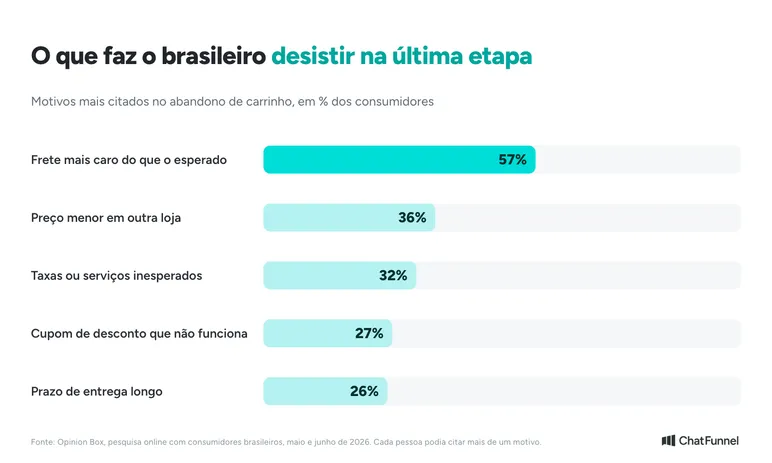
In Brazil, according to Opinion Box, the most cited reasons at the final purchase stage were:
- 57%: shipping more expensive than expected.
- 36%: looking for a lower price at another store.
- 32%: unexpected fees or services at checkout.
- 27%: a discount coupon that does not work.
- 26%: long delivery time.
In the United States, Baymard Institute separates people who were just browsing (42%) from reasons stores can address:
- 40%: high extra costs such as shipping, tax and fees.
- 20%: slow delivery.
- 19%: distrust when entering card details.
- 18%: the store required account creation.
- 17%: long or complicated checkout.
- 17%: website errors or crashes.
- 13%: unsatisfactory return policy.
- 12%: inability to see total cost before paying.
Percentages sum to more than 100% because people can cite multiple reasons. Both studies point in the same direction. Customers leave when total cost or timing surprises them and when they lack answers or trust.
What is the average cart abandonment rate?
The average is 70.22%, according to Baymard Institute, based on 50 different studies. The same institute reports that 42% of U.S. shoppers have abandoned a cart because they were just browsing. That group barely responds to checkout improvements, and many leave before starting payment.
The average is therefore a reference, not a target. What matters is separating store visitors who were browsing from those who wanted to buy but got stuck. To measure the part you recover, see how to calculate cart recovery rate without inflating the result.
Expensive shipping: how to show total cost before checkout
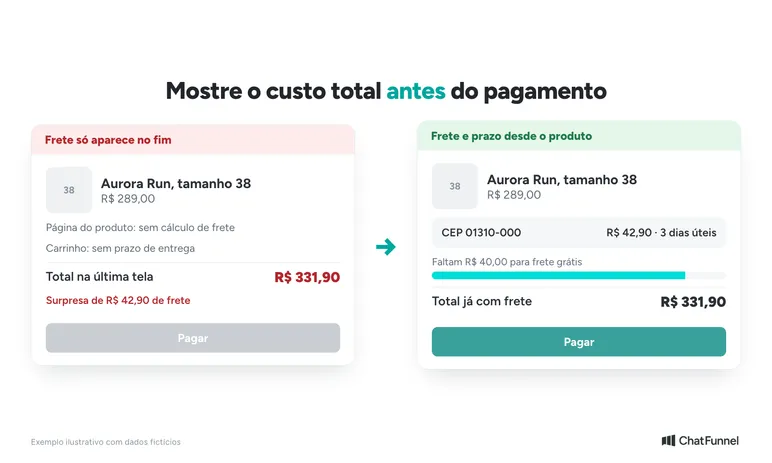
Shipping leads the list in Brazil and extra costs lead in the United States. The customer likes the product price and gets a surprise on the final screen. Three adjustments reduce that surprise:
- Show shipping before the cart. Add postal-code calculation to the product page and cart without requiring registration.
- Show timing alongside price. Slow delivery matters in 26% of Brazilian cases and 20% of U.S. cases.
- Show how much remains for free shipping. A cart bar saying "R$ 40 away from free shipping" gives the customer a reason to complete the order.
When shipping exceeds the product price, offer another carrier, pickup or a longer, cheaper delivery option. In support, someone saying "shipping is expensive" expects an option, not an automatic discount. Teach the team and AI agent to present the store's alternatives first.
Questions about the product or delivery: how to answer before customers leave
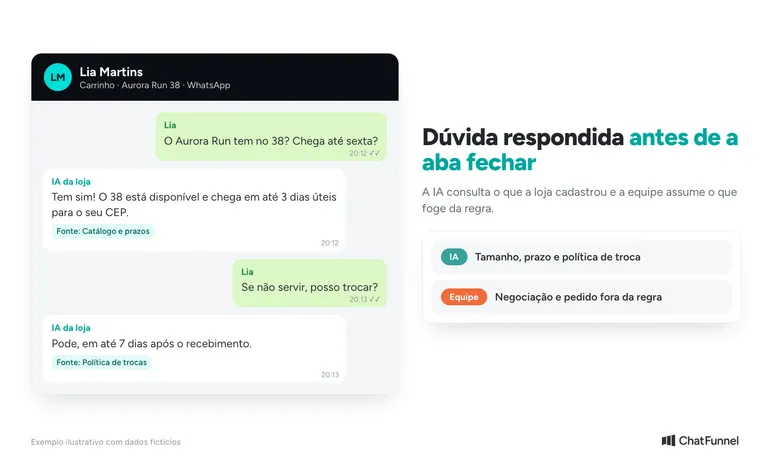
Someone in the cart with a size, compatibility or timing question chooses between waiting for an answer and closing the tab. A slow reply costs the sale. The WhatsApp button should be visible on product, cart and payment pages.
Outside business hours, the WhatsApp AI agent replies immediately using information registered by the store. Cases outside the rule go to the team. In ChatFunnel, the knowledge base holds the catalog, exchange policy and size guide. The team reviews versions, sets what is active and chooses which agents use each item. The tutorial how to create and configure an AI agent V2 in ChatFunnel shows the steps. The guide on how to test an AI agent helps check replies before enabling it.
Fear of fraud: how to build trust at checkout
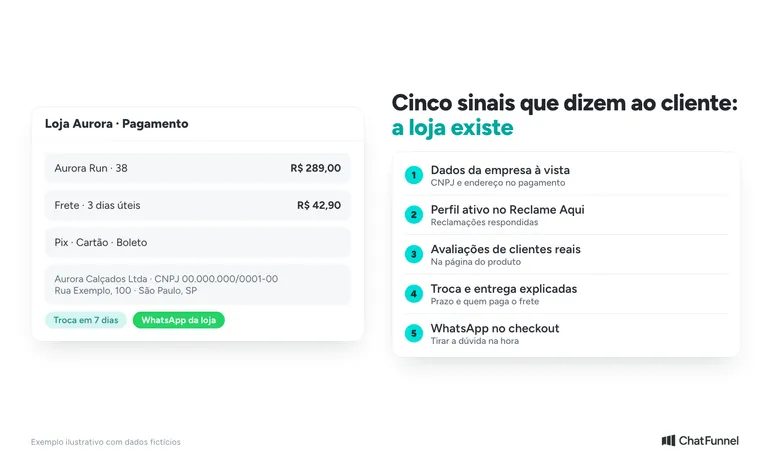
Distrust of the store is a common reason that is hard to see in reports. The customer reaches payment, looks for signs the store exists and leaves if none appear. In the United States, 19% abandoned because they did not trust the store with card details and 13% because of the return policy.
Helpful trust signals are simple:
- Visible company details. Brazilian business registration number (CNPJ), legal name and address in the footer and payment screen.
- Public reputation. An active profile on Brazil's Reclame Aqui complaint platform, with replies to complaints. The guide to Reclame Aqui reputation for ecommerce explains the routine.
- Reviews from real customers. On the product page, with date and name or initial.
- Clear exchanges and delivery. Withdrawal period, who pays return shipping and refund timing in plain language.
- Contact channel at checkout. A visible WhatsApp button at payment answers concerns immediately.
After purchase, trust continues: a tax invoice, shipping confirmation and WhatsApp delivery update show the customer the order exists.
Nonworking coupons, long checkout and errors: what to test in the store
Nonworking coupons account for 27% of abandonment in Brazil, while long checkout and website errors each account for 17% in the United States. These problems are found the same way: buy from your own store as a customer.
Once a month, place a test order on a phone and check:
- Coupon. Apply a valid coupon, an expired one and one excluded for the product. The error message should explain the rule.
- Payment methods. Test Pix, card and boleto, and check that the QR code or link opens without error.
- Registration. Check whether customers can buy without creating an account. In the United States, 18% abandoned because of this requirement.
- Form length. Baymard measures an average of 23.48 fields displayed in U.S. checkouts and indicates a streamlined flow can fit in around 12.
How to capture phone and email before checkout, and Brazil's LGPD
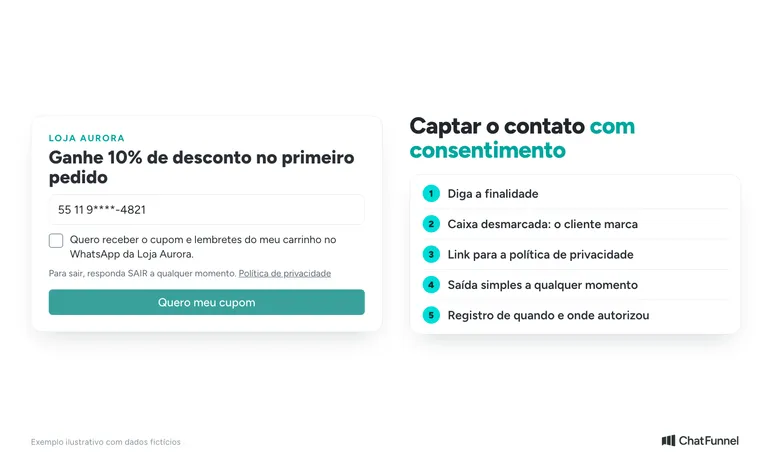
Without contact details, there is no recovery. Someone who fills checkout and leaves has provided data. Someone who leaves earlier can be recontacted only if the store captured name, email or phone while they browsed. Common formats include a first-purchase coupon pop-up, coupon wheel and a field to receive a discount on WhatsApp.
Collection requires consent. Brazil's LGPD defines consent as a free, informed and unequivocal expression agreeing to data use for a specified purpose (Law 13.709/2018, Article 5, XII). Article 8 requires it in writing or another form demonstrating the data subject's wishes. In practice:
- State the purpose. "We will use your WhatsApp to send the coupon and remind you about your cart."
- Leave the box unchecked. The customer checks it; the store does not pre-check it.
- Link the privacy policy in the form itself.
- Offer an exit. The data subject can revoke consent (Article 18, IX), and the store must honor the request.
- Keep the record. Note when, where and with what text the person authorized it.
WhatsApp's Meta rule points the same way. A business can contact only someone who provided their number and permission to receive messages, according to the WhatsApp Business policy. Messaging someone who did not request it increases blocks and reports, potentially restricting the number, as explained in why Meta blocks or bans numbers. The guide to LGPD and WhatsApp chatbots details what to review. This text does not replace legal advice.
How to recover a customer according to the abandonment reason
The recovery message changes with the reason. Someone who left with a question needs an answer; someone who left because of shipping needs an alternative; someone distrustful needs proof the store is real.
| Likely reason | What the message does | When to stop |
|---|---|---|
| Product or timing question | Asks whether a question remains and answers in conversation | When the customer replies, the team or AI takes over |
| Shipping or timing | Shows other delivery options or free shipping | When the order is paid |
| Distrust | Sends store details, reviews and exchange policy | When the order is paid |
| Failed coupon | Resends the link with the discount applied | When the order is paid |
| Pending Pix or boleto | Reminds the customer of expiry and resends the code | When payment is confirmed |
In all cases, the sequence must stop when the order is paid.
In the video How to Recover Abandoned Carts Through WhatsApp in ChatFunnel on ChatFunnel | IA para E-commerce, Mateus Dias shows two recovery models: a flow with conditions and an AI agent.
The guide to WhatsApp abandoned-cart messages provides 20 models with sending times, and the guide to unpaid Pix covers pending payment recovery. The full process appears in cart recovery: causes, rate and how to recover sales.
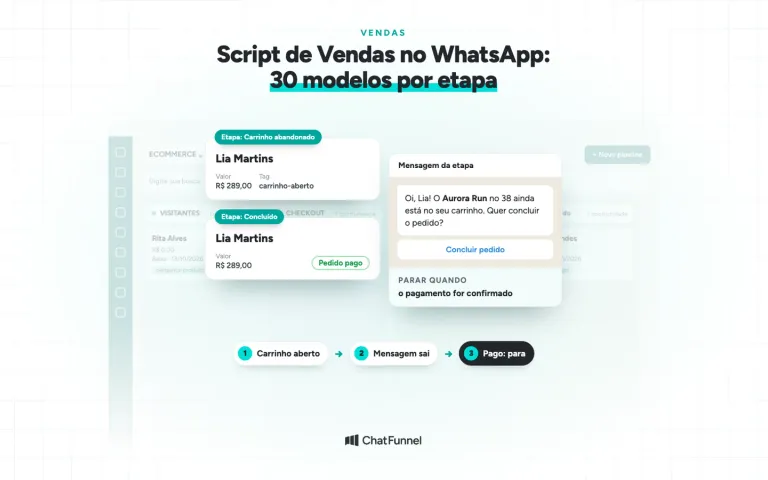
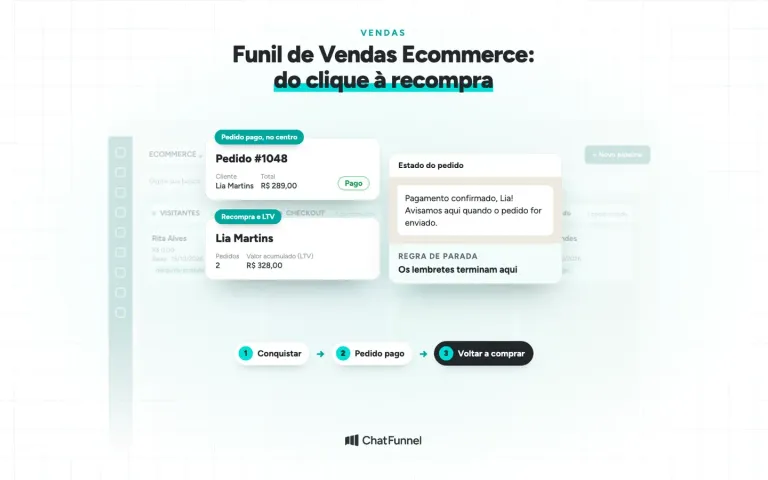
In ChatFunnel, the store reports abandonment and the flow identifies the contact. It waits the defined period, sends messages through official WhatsApp and ends the sequence after confirmed purchase. The complete flows guide explains triggers, waits and conditions. Browsing tracking records the visit, products viewed and cart addition, showing customer interest before the conversation.
Each abandonment reason needs a different response
Cart abandonment has a cause, and the cause points to a fix. Shipping and timing call for transparency before checkout. Questions call for a quick answer. Fear of fraud calls for proof the store exists and provides support. Coupons and checkout call for ongoing testing. For someone who already left, a sequence can resume the conversation for the right reason and stop when a purchase happens.
ChatFunnel brings these pieces together. The AI agent answers questions using the store knowledge base and passes cases requiring a person to the team. The recovery flow resumes the cart through official WhatsApp and ends after confirmation, while CRM shows which stage each customer reached. To start, the store connects its ecommerce platform and official WhatsApp, then adds knowledge base materials and chooses the first-message delay. Bring your store's most common abandonment reasons to the demonstration and see how each becomes a conversation.

Frequently asked questions about cart abandonment reasons
What is the main cause of cart abandonment?
Shipping and other fees lead. In the Opinion Box survey, 57% of Brazilian consumers cited shipping more expensive than expected. Baymard Institute reports the same cause in the United States, with 40% citing extra costs.
What are the main reasons for cart abandonment?
Shipping more expensive than expected leads in Brazil, cited by 57% in Opinion Box's 2026 survey. Next are price comparison at another store (36%), unexpected fees (32%), a nonworking coupon (27%) and long delivery time (26%). Questions and distrust also lead people to leave.
What is the average cart abandonment rate?
The average is 70.22%, according to Baymard Institute, calculated from 50 studies. Your store's rate varies by niche, channel and device. Use the average only as a reference and measure your own store's abandonment.
Why does shipping cause cart abandonment?
Because the amount appears late and changes the total. The customer decides based on product price and sees shipping at the end. Showing a postal-code calculation on the product page and the amount remaining for free shipping reduces surprise. Opinion Box identifies shipping as the reason for 57% of abandonment in Brazil.
What should I do when a customer abandons a cart because they distrust the store?
Show signs the store exists: Brazilian business registration and address, an active Reclame Aqui profile, genuine customer reviews and a clear exchange policy. Keep WhatsApp visible at checkout for immediate questions. After purchase, send a tax invoice and shipping update.
How can I reduce cart abandonment in an online store?
Start with reasons the store controls. Show shipping and timing before checkout, allow purchases without registration, and test coupons and payment methods monthly. Answer WhatsApp questions quickly. For those who already left, use a message sequence that stops when the order is paid. In ChatFunnel, the recovery flow uses official WhatsApp and ends after purchase confirmation, while the AI agent answers from the store knowledge base.
Can I send a WhatsApp message to someone who abandoned a cart?
Only if the person provided their number and permission to receive messages. WhatsApp Business policy requires that permission, and Brazil's LGPD calls for informed consent to use data. Request authorization in the pop-up or checkout, state the purpose and offer a simple opt-out. ChatFunnel sends through official WhatsApp; consent and opt-out remain the store's responsibility.
Turning Visitors into Loyal Customers 🩵